
F2008: Description and technical specifications
Maranello, 6th January 2008 - The F2008 is the fifty fourth single-seater built by Ferrari specifically to take part in the Formula 1 World Championship.
The design, codenamed internally as the 659, represents the Scuderia's interpretation of the regulations in force in 2008. A major new element of these is the introduction of a new electronic system to be used by all teams, known as SECU (Standard Electronic Control Unit) and produced by MES (McLaren Electronic Systems.) It consists of a single control unit and a software system, the development of which ends as the season begins. Other areas affected by rule changes are: gearbox, which must be used for four consecutive events; safety, with the introduction of higher side protection around the driver's helmet; materials, with a limit to the type of composites that can be used. As a result of these rules, there has been an increase in the weight of the car. All aerodynamic surfaces have been completely revised, however the current version will be replaced by a completely different configuration in time for the first race. In fact, an intensive and all encompassing development programme is planned to run throughout the season. The monococque has been further cut away under the driver's legs and the side pods and engine cover are more tapered. The suspension system has been reworked and developed around the new aerodynamics.
The wheelbase and weight distribution have been adapted to meet the challenge of the new regulations and on the basis of lessons learned last year in terms of the performance of the Bridgestone tyres. Changes to the technical and sporting regulations in terms of electronics, alongside the introduction of the SECU, have led to the removal of a host of a driver aids, such as traction control and engine breaking and the electronically assosted starting system, and also mean that management of the differential, engine and gearchange are much simpler. The gearbox casing is produced in carbon, while the transmission continues to be mounted longitudinally. For the second consecutive year the gearchange is fitted with a quick shift system, adapted to the SECU software and further speeded up. In dealing with the reliability aspect of the new regulations, Shell has played a key role in defining the lubricants for the gearbox. The braking system has been updated with new callipers and innovative concepts regarding cooling.
The 056 engine is mounted longitudinally and continues as a load bearing element. Its basic structure remains unchanged compared to the unit homologated at the start of last season, while its auxiliary systems, air and fuel intakes have been further developed. The technical regulations also call for the use of fuel corresponding to European Union norms, with a content of components derived from biological sources equal to 5.75%. As usual, during the design and development stages of the entire car, our technical partners played an important role. Apart from previously mentioned significant input from Shell , also worthy of note is the contribution of the Fiat Research Centre, especially in providing simulation systems and Brembo for its work in developing the braking system. As is now traditional, a great deal of attention was paid to the performance and optimising of the materials used at the design stage and through quality control, striving to maximise performance levels while attaining the highest possible safety standards. TECHNICAL SPECIFICATIONS Chassis
Carbon-fibre and honeycomb
composite structure
Ferrari longitudinal gearbox
Limited-slip differential
Semiautomatic sequential
electronically controlled gearbox
quick-shift
Number of gears: 7 + Reverse
Ventiled carbon-fibre
disc brakes
Independent suspension,
push-rod activated torsion
springs front and rear
Weight (with water, lubricant and driver): 605 kg
BBS Wheels (front and rear): 13''
Engine
Type: 056
Number of cylinders: 8
Cylinder block in cast
aluminium: V 90�
Number of valves: 32
Pneumatic distribution
Total displacement: 2398 cm3
Piston bore: 98 mm
Weight:
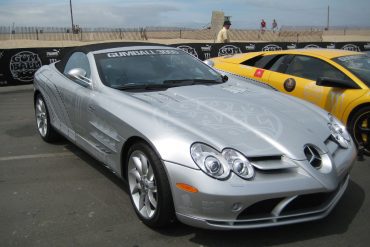
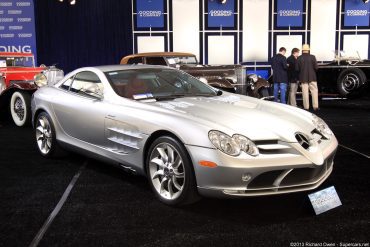
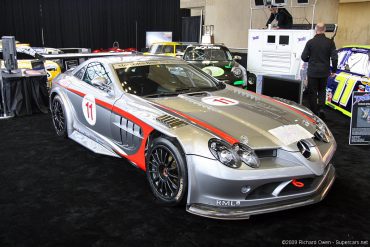
The company�s early racing history culminated in a very special chapter in the 1930s: the era of the Mercedes-Benz Silver Arrows. They scored top results in international races, set the standards in terms of sporting spirit, and put the engineering to the acid test. The Mercedes-Benz Silver Arrows were evidence for the company�s commitment to competition � every year and with every driver. At the same time, every victory clinched with these special racing cars and every record established contributed to a legend which has been intriguing people to this very day, and which is effortlessly being continued by the modern-day Silver Arrows which have been entered in racing since the 1990s.
Silver Arrows � the words have a magic. The popular racing car designation occurred in the 1930s. Mercedes-Benz changed the color of their Grand Prix cars from white to silver at the beginning of the 1934 racing season. Where this happened and the precise reason why have remained the subject of speculation to this day. According to a legend, during the night before the start of the race on the mechanics removed the white lacquer and filler from the W 25 body until the bare aluminum showed to meet a weight of 750 kilograms.
In the decades that followed the popular name �Silver Arrows� turned out to be quite flexible. In the 1930s, it was also used for competitor Auto Union. And the name resounded quickly throughout the country after the McLaren-Mercedes MP4-12 had been presented in mid-February 1997, sporting the attractive livery of its sponsor West, in which silver prevailed. First and foremost, however, the legendary name is applied to the Mercedes-Benz racing and record cars of the 1930s and 1950s.
The Ferrari 60 Relay baton which travels through each country was designed and created to symbolise Ferrari's history and is topped by a dazzling platinum and diamond Prancing Horse made by Damiani. It also features 60 enamel symbols
designed by the Intesta e D'Adda, Lorenzini, Vigorelli and BBDO advertising agencies, and by creative talents Alessandro Migliorini of Area Creativa, Marco Morosini, Enzo Naso of the eponymous studio and Wolfgang Seidl of Seidldesign.
The F2007 is the fifty third single-seater built by Ferrari specifically to compete in the Formula 1 World Championship.
The project, known internally as the 658, represents the Scuderia's interpretation of the technical regulations that apply for 2007, with changes principally concerning safety, through the introduction of more stringent front and rear crash tests and the addition of a composite material structure to provide lateral protection to the sides of the driver. These modifications have led to a significant increase in the weight of the car, in the region of just under ten kilogrammes.
The F2007 chassis has been significantly modified when compared to the 248 F1. The design was revised to accommodate a new front suspension that represents a major conceptual innovation, mainly in terms of aerodynamics. The shape of the side-pods and their openings are also revised, based on modifications to the cooling system, which also implies exits for the radiators on the upper part of the bodywork, while the engine air intake is also substantially different. The car has a longer wheelbase than its predecessor. The rear of the car is much narrower, taking advantage of the more sculpted shape of the gearbox housing, which again this year is made from carbon fibre. The gearbox itself, which is still mounted longitudinally, is fitted with an innovative quick-shift system (seven plus reverse). The rear suspension is similar to that on the 248 F1, but a significant development programme is planned in this area, in order to get the most out of the system, based on making progress in understanding the behaviour of the 2007 tyres. The front and rear aerodynamic configuration is also expected to change considerably before the start of the World Championship. The position of the rear view mirrors seen on the 2006 car remains unchanged and the same goes for the exhaust system.
In accordance with the regulations that come into force this year, the basic structure of the engine remains the same as the one homologated at the end of last season. Therefore, the 056 engine continues as a load bearing member and is again mounted longitudinally. Based on what is permitted in the regulations, the following modifications have been carried out to the engine signed off with the FIA in October 2006:
� the combustion chamber, the valves, the inlet and exhaust chambers, all aimed at optimising the torque curve, given the engine rev limit of 19,000 rpm;
� the piston, the piston pin and the piston cooling jets to aim for the best possible reliability when running at the limit of 19,000 rpm;
� the fluid systems (water and oil) and components to facilitate the integration of the 056 into the new car.
As usual, during the design and development phase of the complete car, the technical partners played an important role. A significant part was played by Shell in terms of fuel and lubricants, by the Fiat Research Centre in the use of simulation systems and by Brembo in developing the braking system. As is now traditional, a great deal of attention was paid to the performance and optimisation of the materials used, to the design stage and to quality control, striving to maximise the performance level and to ensure the highest possible standard of safety.
Shell Motorsport has teamed up with F1 Racing magazine to offer you the chance to apply for an exclusive 20 page colour booklet containing detailed explanations of the technical workings of a Formula One car.
The CL 63 AMG represents the highlight of Mercedes-AMG's 2006 model initiative so far, which has encompassed ten brand new high-performance AMG models to date. At the heart of the eight-cylinder flagship model is the AMG 6.3-litre V8 engine.
From its displacement of 6208 cc, the high-revving, naturally aspirated drive unit musters up 386 kW/525 hp at 6800 rpm and generates its peak torque of 630 Ne-wton metres at 5200 rpm. This gives the AMG powerpack a higher power-to-swept-volume and torque ratio than any other naturally aspirated series-produced eight-cylinder engine in the world. The CL 63 AMG is propelled from 0-100 in just 4.6 seconds, with top speed electronically limited to 250 km/h.
* Zero to 100 km/h in 4.5 seconds with a 378 kW/541 hp eight-cylinder engine
* Sports seats with a nappa leather/alcantara combination
Mercedes-AMG presented the E 63 AMG for the first time at the New York International Auto Show. Powered by the new, naturally aspirated AMG V8-engine, which develops a maximum output of 378 kW/514 hp and a maximum torque of 630 newton metres from a displacement of 6.3 litres, the E 63 AMG is the most powerful E-Class of all time. Available as a Saloon or Estate, this top-of-the-line E-Class model occupies the leading position in its segment, where no other vehicle has more output, torque and displacement.
The E 63 AMG also benefits from all the model enhancements which make the new-generation E-Class stand out, for example the occupant protection system PRE-SAFE�, the new Intelligent Light System or the new adaptive brake lights. Developed completely independently by AMG, this 6-3-litre V8-engine is the world�s only power unit to combine the high-revving concept with a large displacement � the result is around 20 percent more torque than from comparable engines in this output class. In line with Mercedes-AMG tradition, the new powerpack is hand-built in the AMG engine workshops on the "one man, one engine" principle. Thus equipped, the E 63 AMG Saloon accelerates from zero to 100 km/h in 4.5 seconds (Estate: 4.6 s). The maximum speed is electronically limited to 250 km/h.
- Giant sculpture as part of the initiative "Germany - Land of Ideas"
- Prominent guests from the worlds of politics, sport and society
- The new Audi TT Coup? shown to the public for the first time
Ingolstadt/Berlin, 6 April 2006
Brandenburg Gate, Berlin:
The events that took place directly in front of the Brandenburg Gate in Berlin on Thursday
evening were extremely revealing. At 19:00 h, AUDI AG, official partner of the initiative
"Germany - Land of Ideas", and FC Deutschland GmbH unveiled a giant car sculpture on the
"Platz des 18. M�rz". "The Automobile", a 2.5:1 scale sculpture, is part of the �Walk of
Ideas� which comprises six sculptures at prominent locations in Berlin that will be on show
until the autumn. The evening continued in spectacular fashion when the Ingolstadt brand
presented the new Audi TT Coupe to the world public for the first time, also in front of the
Brandenburg Gate.
Ferrari and Zagato have crossed paths several times, and each occasion has generated
something special and unique. These contacts have always arisen out of meetings, on
a personal and an industrial level, between two important figures in the automotive
world: Enzo Ferrari and Ugo Zagato. It is a relationship that has produced proposals
and projects which have never progressed, but above all a number of unique models.
However, most of the Ferrari Zagatos were the result of the intervention of racing
drivers and gentlemen drivers, who demanded from their Ferraris that extra
something, a mixture of lightness and aerodynamic efficiency, that Zagato expressed
with such outstanding skill. The Ferrari Zagatos are unique because the combination
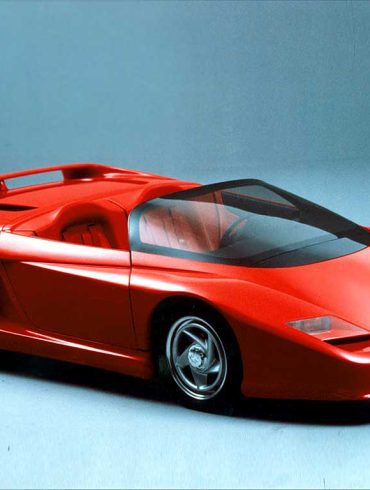
of the prancing horse on the bonnet and the Z on the side brought together prestige
and performance, elegance and sportiness
In its debut year, the brand-new CLK 63 AMG will also debut as the official FIA safety car for the 2006 Formula 1 season. With its 354 kW/481 hp AMG 6.3-litre V8 engine its modified brakes, suspension, cooling and exhaust system, and an extensive package of lightweight components, the fast-paced coup� is well prepared for its responsible role on the Formula 1 racing circuits. The first outing for the CLK 63 AMG safety car will be at the Bahrain Grand Prix (March 9 to 12, 2006); the standard version will then appear in the second quarter of 2006. Meanwhile, as in previous years, the C 55 AMG estate will be ready for action in all 18 Formula 1 races as the official medical car. Its job is to help as fast as possible at the scene of an emergency.
The Honda Racing F1 Team unveiled its challenger for the 2006 Formula One season in Spain this morning with the new driver line-up of Jenson Button and Rubens Barrichello.
The new Prancing Horse single seater was officially unveiled by Scuderia Ferrari Marlboro in front o fthe Italian and World press at Mugello. The new car will compete in the next Formula 1 World Championship.
Four years on from its launch, the successful Mercedes-Benz SL-Class has undergone a number of enhancements, the most significant being in the areas of technology, design and interior appointments. The engines, powertrain and chassis have been optimised to deliver a sportier response so that the unique Roadster now offers an even more enjoyable dynamic driving experience while perpetuating the "SL legend" which has existed for over 50 years. New V6 and V8 engines, as well as an uprated V12 powerplant, deliver assured driving pleasure. Second-generation Active Body Control and the more direct steering make for noticeably sportier handling without compromising the high level of comfort which is one of the hallmarks of the SL. The redesigned front section, new rear light units and new light-alloy wheels reflect the more dynamic character of the revised SL even when it is stationary. New interior appointments as well as painstaking attention to the details of the new materials and colour schemes give the interior an even more luxurious look and feel. Shift paddles on the steering wheel � which form part of the optional 7G-TRONIC Sport package � underline the dynamic character of the enhanced SL-Class.
Hamann Motorsport have announced an extensive aerodynamic component programme for the Lamborghini Gallardo. In addition, a new exhaust system boosts power to 528 hp. The kit comprises front spoiler, side sills, lateral air intake covers, air scoops, three-piece rear spoiler, rear diffuser, sports metal catalysts, sports rear silencer, and split-rim HAMANN 19" ANNIVERSARY II design light-alloy wheels.
By using sports steel catalytic converters and two stainless steel, double-pipe sport 76 mm diameter silencers, the performance of the HAMANN Lamborghini was increased by 28 hp; to 528 hp. At the same time the maximum torque was increased by 50 Nm to 560 Nm.
Two versions of the front and rear spoilers are available (one adjustable, one non-adjustable), while all components can be selected in either fibre-glass or natural carbon-fibre.
The multi-part wheels are available in both 19" and 20" versions.
V12 Zylinder,
700 PS/(514 kW) at 8,200 rpm,
715 Nm at 5,800/min,
Vmax >370 km/h,
0-100 km/h in 3.5 secs.,
0-200 km/h in 9.5 secs.,
0-300 km/h in 22.0 secs.
The new Mercedes-Benz S 65 AMG is celebrating its world premiere at the North American International Auto Show in Detroit on January 8, 2006. Its ultra-powerful AMG 6.0-litre V12 biturbo engine delivers performance that many sports car drivers can only dream about: it accelerates from 0 to 100 km/h in 4.4 seconds and 0 to 200 km/h in just 13.3 seconds (provisional figures). The top speed is 250 km/h (electronically limited).
An authentic and limited continuation series of the iconic sportscar has begun and the first chassis is set to be unveiled at the MIA/MDUK stand in January at the annual Autosport Racing Car Show, Birmingham.
As factory Fords, Ferraris and Porsches stamped their unforgettable presence on the world of endurance racing in the late 1960�s and early 1970�s, only one car gave privateers the chance to stand up to them � the Lola T70.
This limited series is unique in being a genuine continuation of the original specification car by the original manufacturer, bringing the experience of the golden age of sportscar competition to a new generation of historic racers.
Lola�s Executive Chairman, Martin Birrane, himself an avid fan of the original T70 series, said: �This is an exciting announcement because the T70 series was undoubtedly one of the most charismatic sportscars ever built, certainly from British shores.
Many racing enthusiasts have fallen in love with T70�s over the years and this project has come about through a high demand for more T70�s where they belong, on the grid. Thirty six years after its original unveiling we are again building them, only now alongside our contemporary sportscars like the new B06/10 LMP1 car. With some of the original staff at Lola still working for the company it will be an evocative build in Huntingdon.�
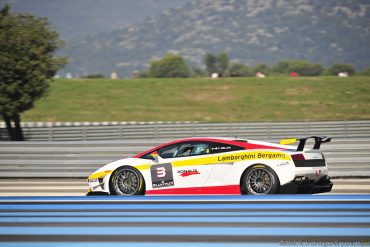
Experienced German motorsport preparation outfit Reiter Engineering - who are very closely linked to the Lamborghini factory - have developed the Gallardo for the GT3 category of international sportscar racing. Reiter previously built the GT1 class Murcielago R-GT which has made sporadic appearances in the FIA GT Championship and American Le Mans Series during the past couple of years. The GT3 class was recently been devised to offer more cost effective racing thrills, and it is expected to surge in popularity next year, when other brands to become involved will include Porsche and Aston Martin.
Audi competes with diesel sports car at Le Mans
AUDI AG is once again one step ahead of the opposition: The inventor of �TDI� will become the world�s first automobile manufacturer to fight for overall victory with a diesel engine at the famous 24 Hours of Le Mans. The all-new Audi R10, which was unveiled on Tuesday in Paris, is powered by a totally new 5.5-litre, twelve-cylinder bi-turbo TDI engine, which is extremely quiet and economical.
The Le Mans Prototype, with over 650 hp and more than 1,100 Newton metres torque, significantly exceeds the power produced by the majority of previous Audi racing cars � including that of its victorious R8 predecessor. Audi ventures into previously unexplored diesel-engine terrain with the V12 power plant manufactured completely from aluminium. As with the TFSI technology, which triumphed initially at Le Mans before being adopted for mass-production, Audi customers should benefit once again from the lessons learnt in motorsport.
With its poised, assured presence, the GL-Class leaves you in no doubt about its aspirations to conquer this competitive market segment. The distinctive design idiom exudes power and exclusivity. Calm body surfaces, powerful, wedge-shaped features and striking details give the impression the luxury off-roader is surging forward even when stationary. The spacious body (length 5088 mm, width 1920 mm, height 1840 mm) is beautifully proportioned.
Renowned for its early car launches, Toyota has raised the standards yet again by unleashing its 2006 race car over three months before the season-opening Bahrain Grand Prix, which is scheduled for 12 March. Technical Director Chassis Mike Gascoyne believes such a head start could offer the Cologne-based team a significant time advantage over its rivals ahead of the winter holiday period.
"We have been working on the TF106 since the end of 2004," Gascoyne reveals, "and the introduction of this car at such an early stage is a true testament to the work of the team and shows that we are able to react and push forward at a rate that is necessary to be at the forefront of Formula 1."
The TF106 marries a brand new rear end, designed to accommodate Toyota's latest specification V8 engine, with a development of the monocoque and front suspension of its pole-setting, podium-scoring TF105B interim car that was brought in for the final two races of the 2005 season.
For 10 years Modena Motorsport has been holding its Modena Track Days on the race tracks of the Nurburgring and SPA. This event now counts as one of the top Ferrari events in the world. The symbiosis between the almost complete Scuderia Ferrari F1 in action and the collection of historical cultural assets, combined with driving greats such as Jacky Ickx and Niki Lauda makes the Ferrari brand legend tangible.
In this unique environment the guests can try out the limits of their cars and their driving skills. At the end of the event a top-ranking jury will choose the most beautiful cars with a Concours d'Elegance.