

 By the early 1950s, several British automotive manufacturers had completely devoted themselves to satisfying the seemingly insatiable postwar appetite for affordable sports cars. One such manufacturer was Coventry’s Standard-Triumph. After a woefully misguided attempt to enter the market with the underpowered and frumpy-looking 1800 Roadster, in 1953 Standard unveiled a much smaller and more “sporting” sports car, which it called the TR2. The TR2 utilized a conventional, ladder-type frame, with independent front suspension and leaf-sprung live axle, mated to a 1991-cc, cast iron block, inline 4-cylinder engine, derived from—of all things—the Massey Fergusson tractor! With looks reminiscent of the Jaguar XK120, but at a fraction of the price ($2,000), the TR2 enjoyed robust sales.
As the ’50s progressed the TR2 received incremental improvements, warranting it being rebadged as a TR3 in 1955 and TR3A in 1957. Some of these improvements included the addition of front-wheel discs and an enlarged 2.2-liter engine. However, as the ’50s were coming to a close, it became apparent to the powers that be at Standard-Triumph that the TR3 was looking decidedly “old” and dated, compared to the latest offerings from its competitors.
 While Triumph wanted to breathe a breath of fresh air into the styling of the TR3, it didn’t really want to invest in updating any of the underlying mechanicals! The result was that Italian designer Michelotti was brought in to pen a new body for the TR3, which was both more modern and stylish, but which also included more modern creature comforts like roll-up windows (to replace the TR3’s side screens) and the addition of interior venting.
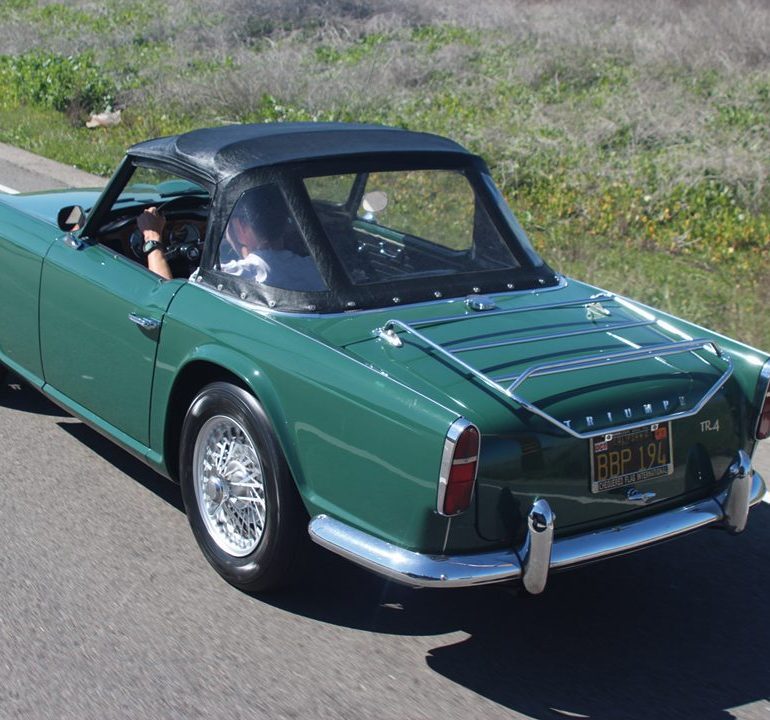
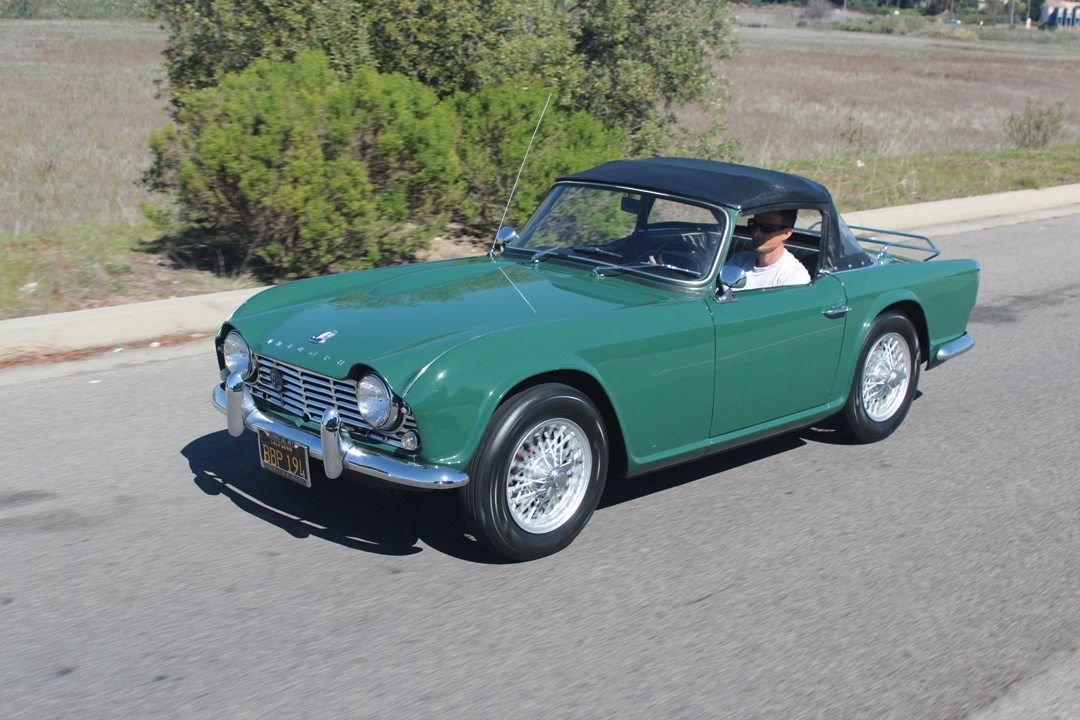
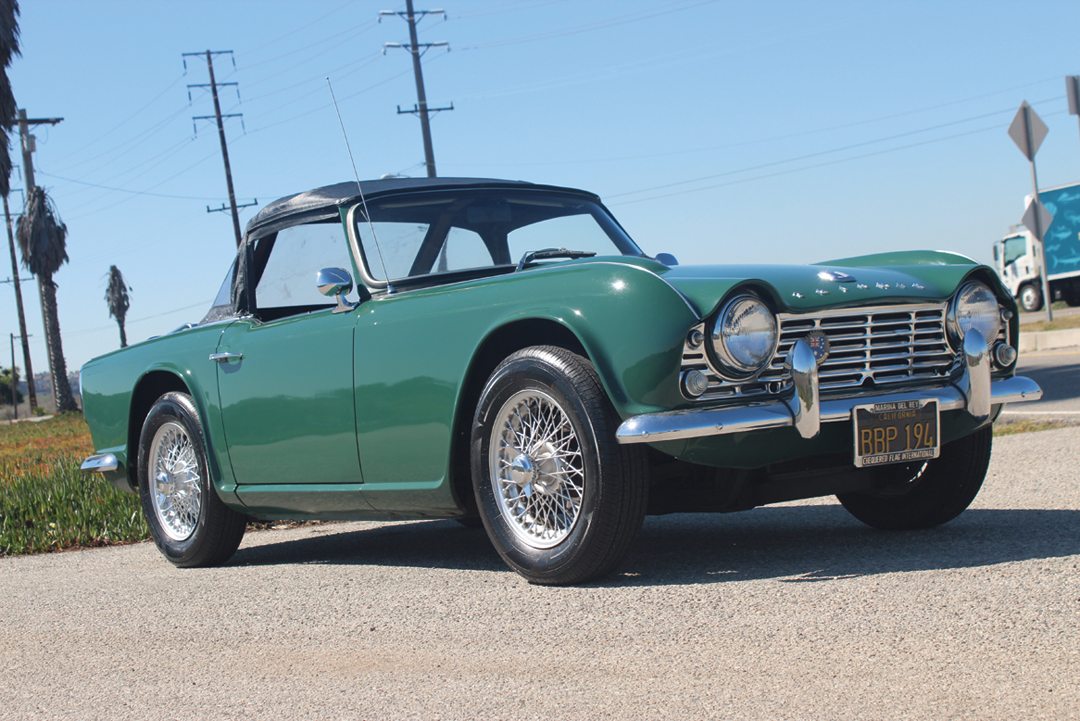
When debuted in September 1961, Michelotti’s modern styling tended to polarize enthusiasts, you either loved it or hated it. With its long, sloping “eyebrow” hood and more squared-off rear end, with subdued tail fins,the TR4 was in fact a big styling departure from the TR3, though mechanically it was essentially the same car underneath. While contemporary reviewers were decidedly mixed on its looks in period, with the benefit of time, the TR4 has come to be much more appreciated as not only a stylish model, but perhaps the most practical and useable Triumph TR. Constructed from 1961 to 1967, the TR4 was built by Standard-Triumph when it was still an independent company and represents its zenith, in terms of reliability and build quality. As a result, TR4s have, by and large, survived the past 50 years and make for a relatively easy classic to maintain and restore.
 On the Road
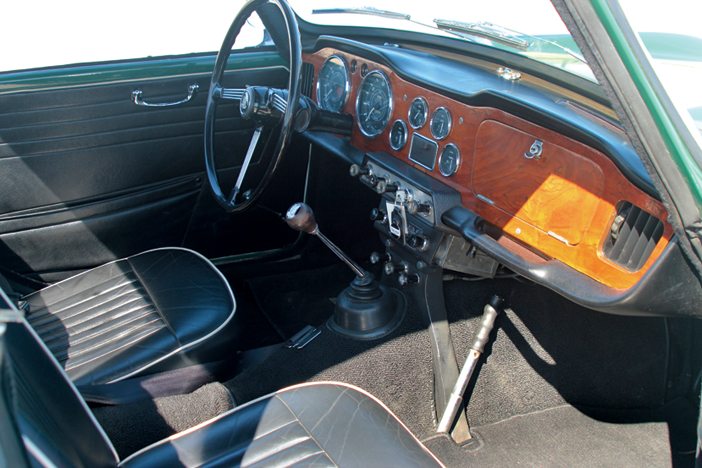
After opening the door to the TR4, the driver climbs into the car by simultaneously lowering oneself down into the low bucket seat while sliding the right leg under the large banjo-style steering wheel. Once in, the TR4’s cockpit is roomy with plenty of legroom for taller drivers, though with the top up, they may have to contend with having their head in the roof! With a tall belt line, and low seating position, the driver feels much more ensconced in the TR4, as opposed to the TR3 driver who may feel like they are sitting “on” the car. The wood-faced dashboard is clean and elegant with a large Smiths speedometer and tachometer either side of the steering column and a cluster of four Smiths ancillary gauges centrally clustered around the ashtray. Below this central grouping is a raised switchgear cluster that includes the ignition switch—give it a turn and the 2.2-liter four rattles to life with a low-toned burble. After depressing the pendulum-style clutch and selecting first in the 4-speed box, a crack of the throttle and releasing the clutch lets the TR4 pull smoothly away.
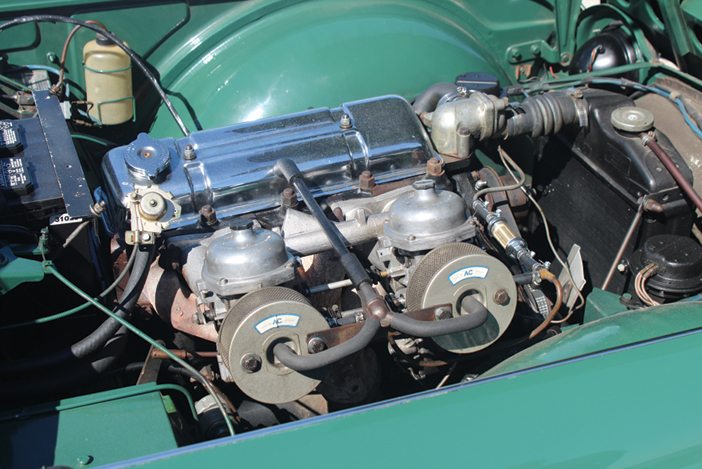
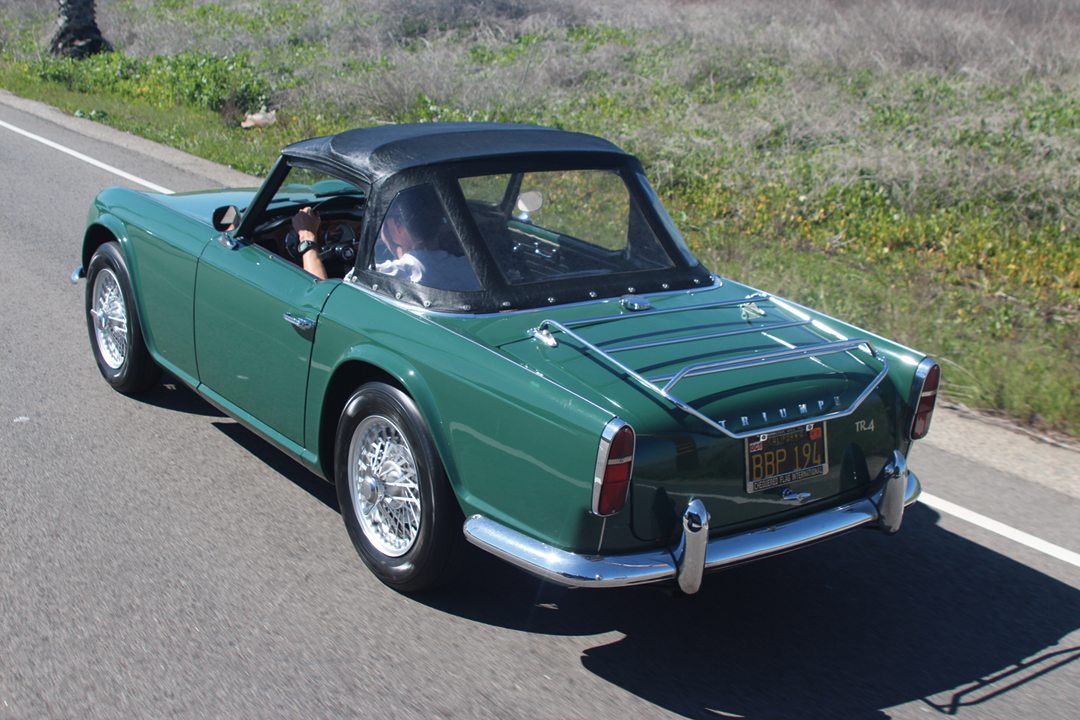 One of the TR4’s greatest strengths is the bags of torque available from the tractor-derived engine. Due to its long 92-mm stroke and three main bearing bottom end, the TR engine (whether it be TR2, TR3 or TR4) has a low redline (only about 5,500 realistically) but gobs of useable torque, literally available right from idle. As such, the TR4 is quite happy to lumber along in almost any gear and yet still be able to accelerate smoothly. Using that torque to get through the gearbox shows the TR4 to be a small displacement sports car with remarkable acceleration ability. In terms of real world driving experience, the TR4’s combination of rack and pinion steering, independent front suspension and all that available torque make for the most fun when accelerating hard out of slower speed second and third gear corners. With disc brakes up front and drums in the rear, the TR4 has ample stopping power, which will only fade under the hardest of racing conditions.
TR4s made up through January 1965 feature the same live axle rear suspension as found on the TR2 and TR3 and so can suffer from axle tramp under harder driving. The later TR4A, built from January 1965 to August 1967, features an independent rear suspension with semi-trailing arms, which help alleviate this and make the rear suspension more tunable.
Regardless of whether it is a live axle TR4 or the IRS TR4A, either example is a highly enjoyable and easy classic car to maintain and enjoy.
Driven Classics at a Glance:
 SPECIFICATIONS
1964 Triumph TR4
Production: 1961–1965 (TR4); 1965–1967 (TR4A)
Wheelbase: 88 inches
Length: 153.6 inches
Front Track: 49 inches
Rear Track: 48.5 inches
Weight: 2,245 pounds
Suspension: [Front] Independent with wishbones, coil spring and telescopic damper, [Rear] Live axle, half-elliptic springs and lever-arm shocks.
Engine: 2.2-liter, inline 4-cylinder, OHV
Bore x Stroke: 86-mm x 92-mm
Comp. Ratio: 9.0:1
Induction: Twin Stromberg 175 CDs
Power: 105-hp @ 4700 rpm
Torque: 132-lbs-ft @ 3350 rpm
Transmission: 4-speed synchro, plus reverse
Brakes: [Front] 11-inch Girling Discs, [Rear] 9-inch x 1.75-inch drums
PERFORMANCE
Top Speed: 105 mph
0-60 mph: 9-sec
Average fuel consumption: 27-30-mpg
VALUATION
Price at launch: $3,000
Excellent: $48,500
Good: $28,800
Average: $18,000
Poor: $11,800