
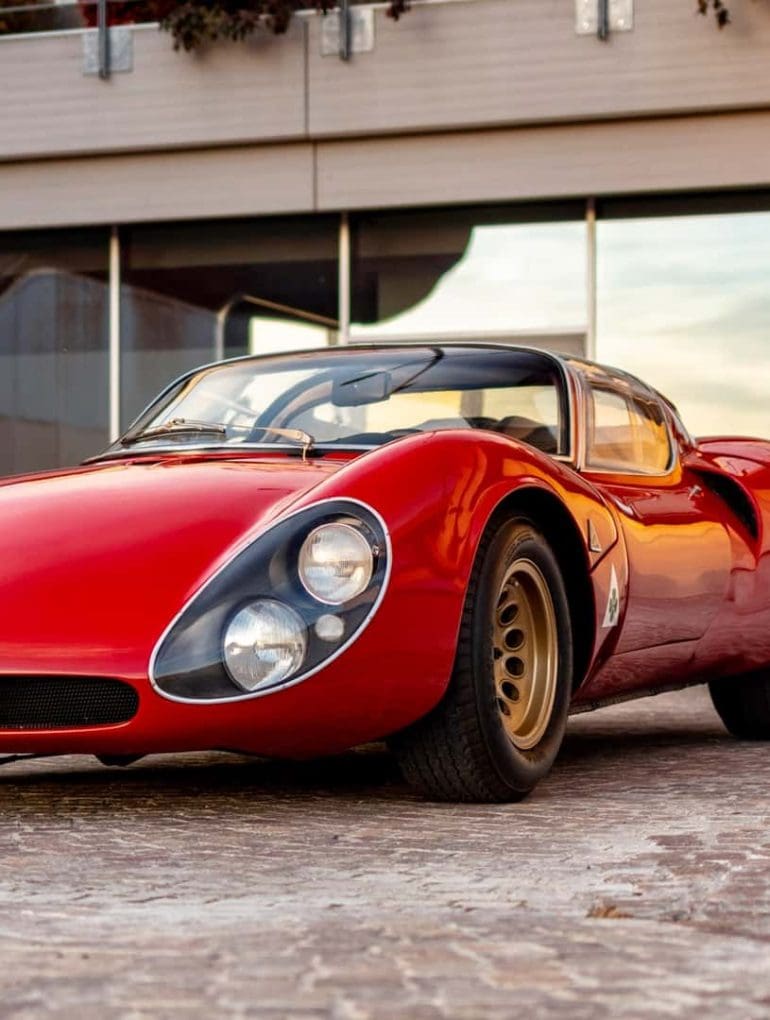

When automotive historians debate the most beautiful car ever created, Franco Scaglione’s Alfa Romeo Tipo 33 Stradale invariably enters the conversation. Yet despite near-universal acclaim, it remains relatively obscure. With fewer than 20 examples built and a price exceeding the Lamborghini Miura, the Stradale was never meant for commercial success—it existed to homologate Alfa Romeo’s racing prototypes. By exploring its troubled development and sublime design, we’ll discover why this hand-built masterpiece continues commanding multimillion-dollar prices over half a century later.
Background and Origins
After dominating Formula One with the mighty 158 and 159 Alfetta Grand Prix cars in 1950 and 1951, Alfa Romeo withdrew from works participation in motorsport. Despite fleeting programs like the C52 Disco Volante and 6C 3000 CM, the company stayed true to its word, limiting competition involvement to small-capacity production-based GT cars for privateers.
By 1962, however, the racing bug was biting again. A new subsidiary called Delta Automobili was created at Alfa’s behest, run by ex-Ferrari designer Carlo Chiti and Ludovico Chizzola. Charged with designing and manufacturing a new tubular chassis GT racing car—the Tubolare Zagato—Delta Automobili became Alfa’s back-door racing division. In March 1963, the operation was rebranded as Autodelta and became Alfa Romeo’s official competition department.
With the successful TZ, TZ2, and GTA models behind them, Autodelta was commissioned to create an all-new two-liter Group 6 Prototype for the 1967 season. The resulting Tipo 33 was unveiled at Alfa’s Balocco test track in March 1967, going head-to-head with two-liter Prototypes from Porsche, Ferrari, Alpine, and Matra.
While Group 6 had no minimum production requirement, Group 4 stipulated that 50 cars had to be produced in twelve consecutive months. Such was the Tipo 33’s speed that Alfa Romeo believed a Group 4 version would dominate class honors. Accordingly, in September 1967, it was announced that 50 new Group 4 cars would be constructed. Anticipating most production would be sold for street use, the model was officially designated Tipo 33 Stradale.
Design and Engineering
The Stradale was based on the big-tubed perimeter chassis of the 1967 Tipo 33 Group 6 car. This competition spaceframe comprised two light-alloy side members that doubled as fuel tanks. Magnesium front and rear subframes carried the suspension, engine, gearbox, and differential.
Suspension employed wishbones, helical springs, and anti-roll bars, with radius rods also installed at the rear. Fully adjustable telescopic dampers were fitted all around alongside ventilated disc brakes, mounted inboard at the rear. The wheelbase was extended 100mm to 2,350mm, freeing additional cockpit space. The two magnesium bulkheads were reinforced with steel for greater impact protection, and the central chassis tubes were formed from steel instead of aluminum.
Thirteen-inch magnesium wheels measured 10 inches wide at the front and 12 inches wide at the rear, originally shod with Dunlop tires.
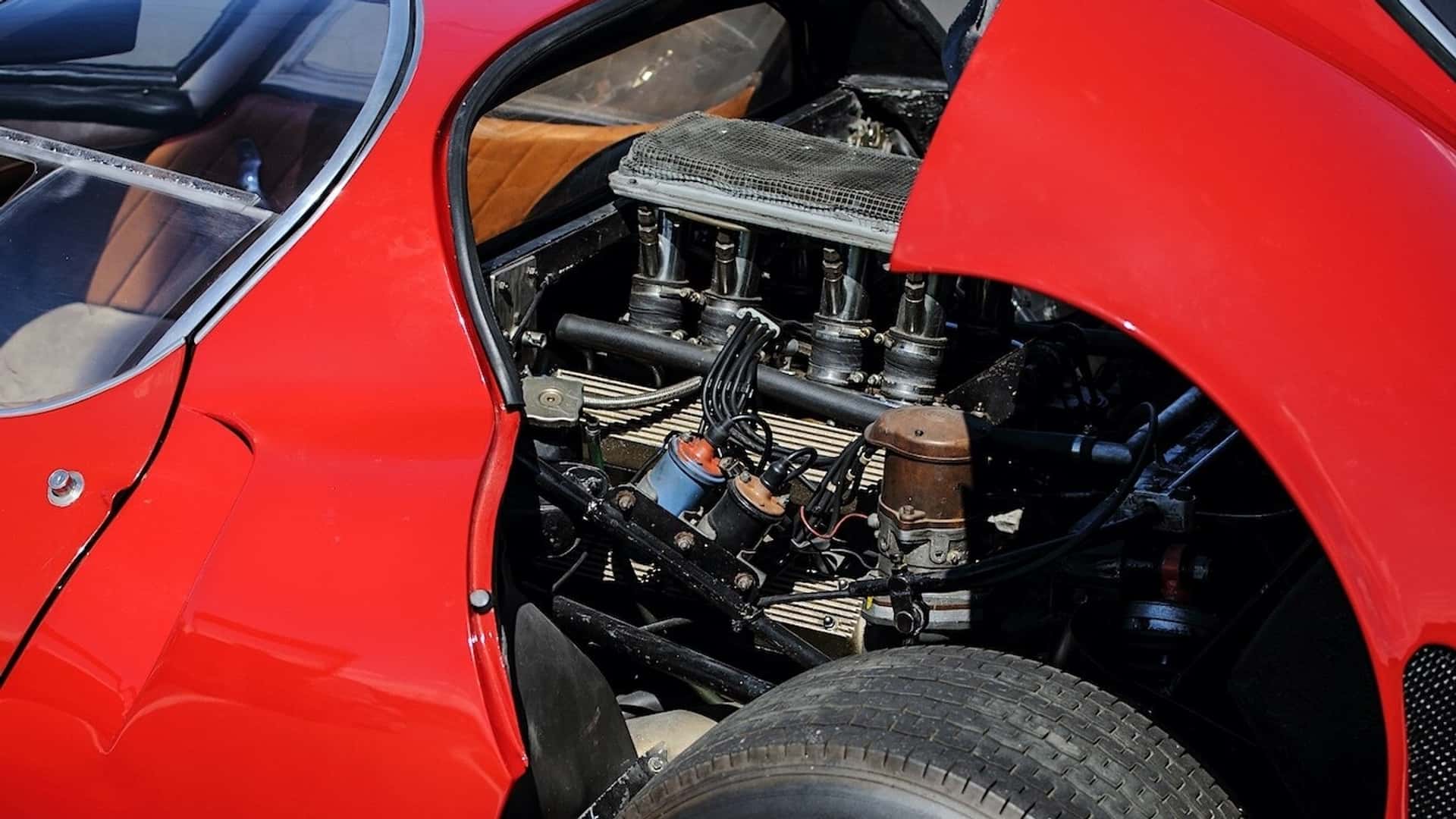
Autodelta’s compact, lightweight all-alloy 90-degree V8 was a complex piece of engineering. With two chain-driven overhead camshafts per bank, four ignition coils, dry-sump lubrication, fuel injection, and 16 spark plugs, the average Alfa dealer wouldn’t have known where to start. Displacing 1,995cc from a 78mm bore and 52.2mm stroke, the race motor produced 256 horsepower.
The Stradale motor was slightly detuned for road use. Compression dropped from 11.0:1 to 10.0:1, cam timing was altered, and Lucas injection was switched to a SPICA unit. Peak output settled at 230 horsepower at 8,800 rpm. While the Group 6 version used a six-speed Colotti gearbox with ZF limited-slip differential and single-plate hydraulic clutch, the Stradale came with a five-speed transmission.
Styling
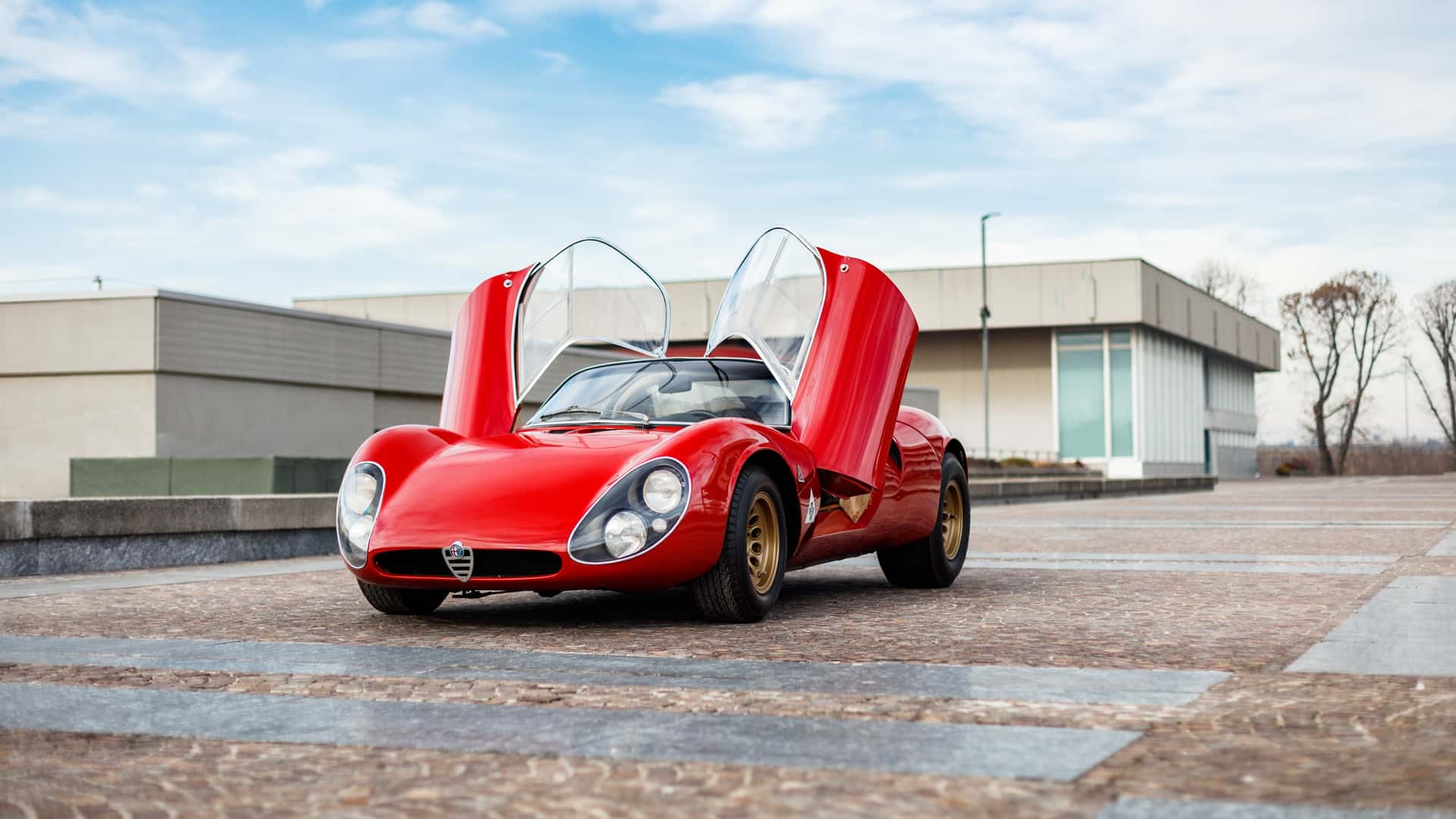
The original Tipo 33 racer had been styled in-house at Autodelta. For the Stradale, Alfa Romeo turned to Franco Scaglione’s design agency, Carrozzeria Sargiotto. The new bodywork was fabricated from aluminum instead of fiberglass, and Scaglione’s magnificent creation ranks among the greatest automotive designs of the 1960s—if not all time.
The first two prototypes featured twin headlights stacked vertically and mounted under clear plastic covers. Chassis 105.33.01 was the original prototype, while chassis 150.33.12 was intended for Le Mans but wasn’t completed until 1968. Both had bodywork manufactured under Scaglione’s supervision at the Autodelta works. Notable differences included the roof-mounted wiper on chassis 01 and rear wing air vents on chassis 12.
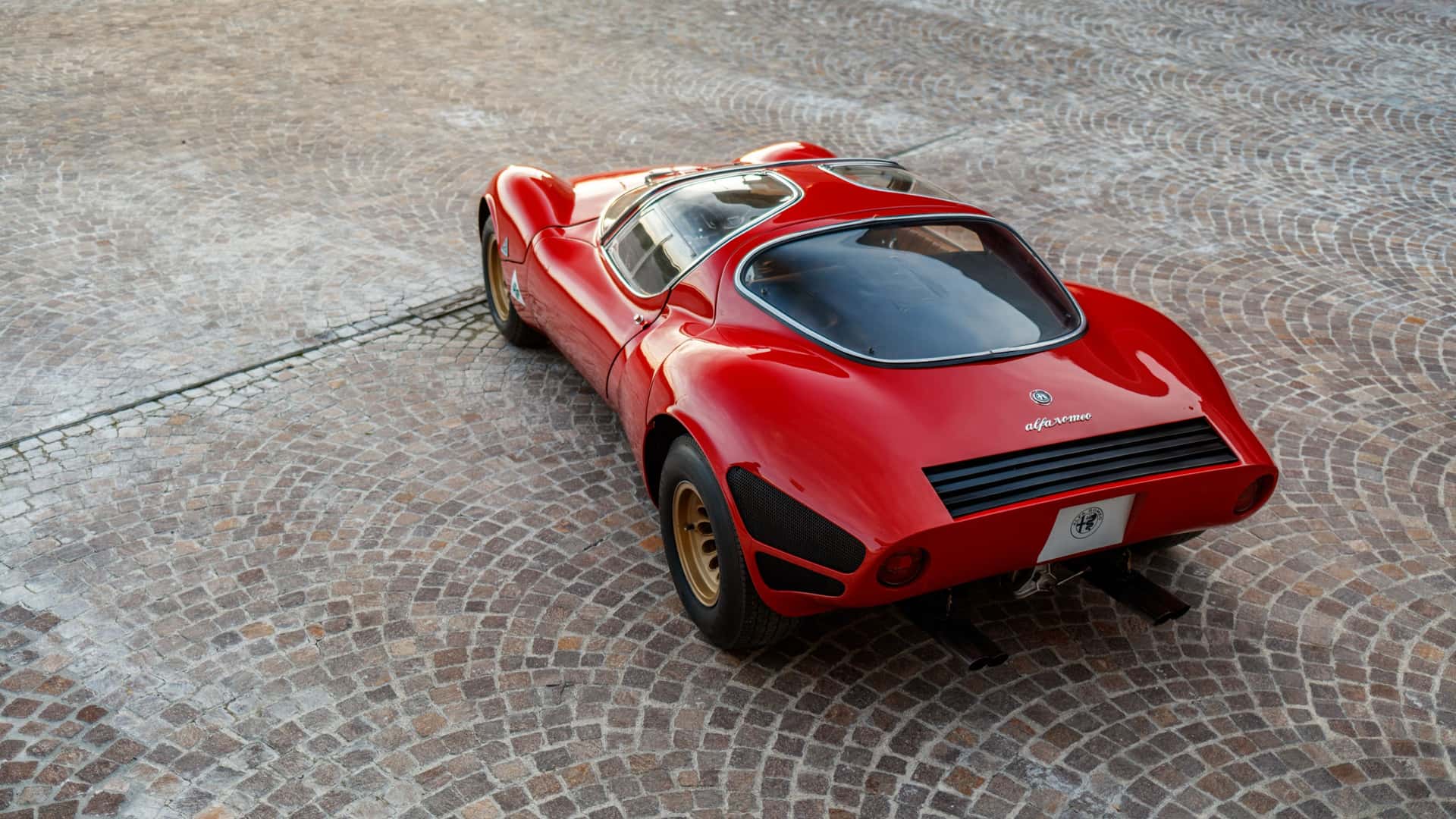
Production versions came with single headlights, their aluminum bodies fabricated and fitted at the new Marazzi coachworks in Milan—born from the remnants of the recently bankrupted Carrozzeria Touring. Cars arrived at Marazzi with drivetrains installed ready for bodywork. As each car was built entirely by hand, no two were identical.
The production car’s nose received a slimmer profile than the racer, appearing more delicately crafted overall. As the competition Spyder became a Berlinetta and both versions stood barely one meter high, access required careful consideration. The solution was elaborate dihedral butterfly doors hinged at the top of the roof, opening upwards and forwards—the first production vehicle to feature such doors. Panoramic side windows cut substantially into the roof and were split by a body-colored T-bar.
Some cars came with fixed single-pane windows, others had sliding Plexiglas inserts, but most featured split panes with wind-down side glass. Front and rear body sections were hinged at either end. The back featured a single-piece screen through which the injection trumpets were displayed. The tail had minimal rear overhang with single circular lights on each side and a bank of vents atop the trailing edge. Two large air vents carved out from behind each rear wheel arch improved air circulation.
Car-to-car differences appeared around the front indicators, trim for the nose-mounted intake, the shape and location of the front scuttle duct, windscreen wiper quantity and mounting locations, badging, wing mirrors, and rear deck air vents.
Competition History
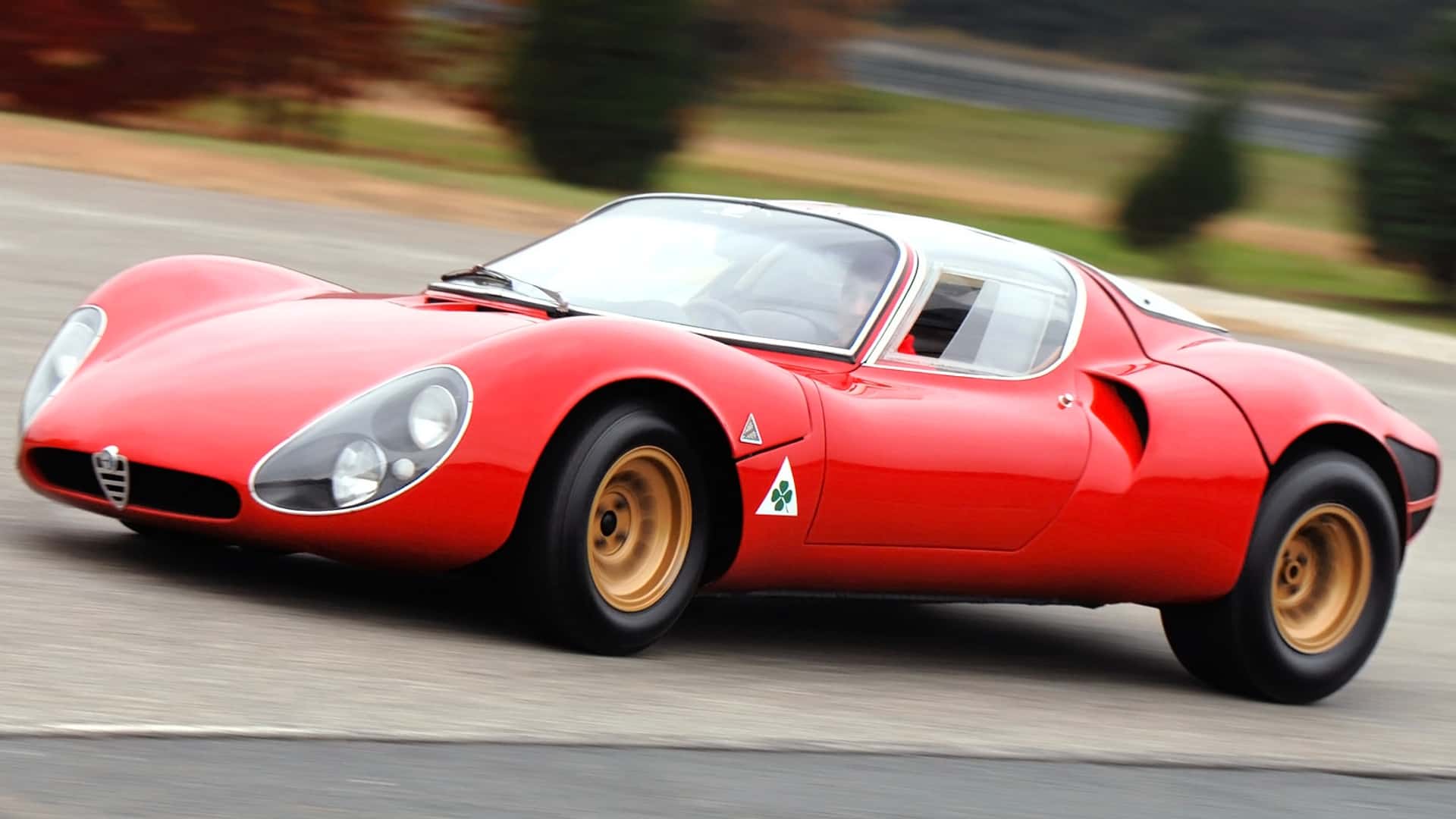
Although less expensive and more effective competition cars were available, at least two Stradales were purchased for sporting use. Chassis 103 was delivered to the SCAR Autostrada Alfa Romeo dealership in Florence, while chassis 106 was purchased by Paolo Laureati. Both featured lightweight interiors, sliding Plexiglas side windows, and single wipers, predominantly used in domestic hillclimb events throughout 1968 and 1969.
Interior
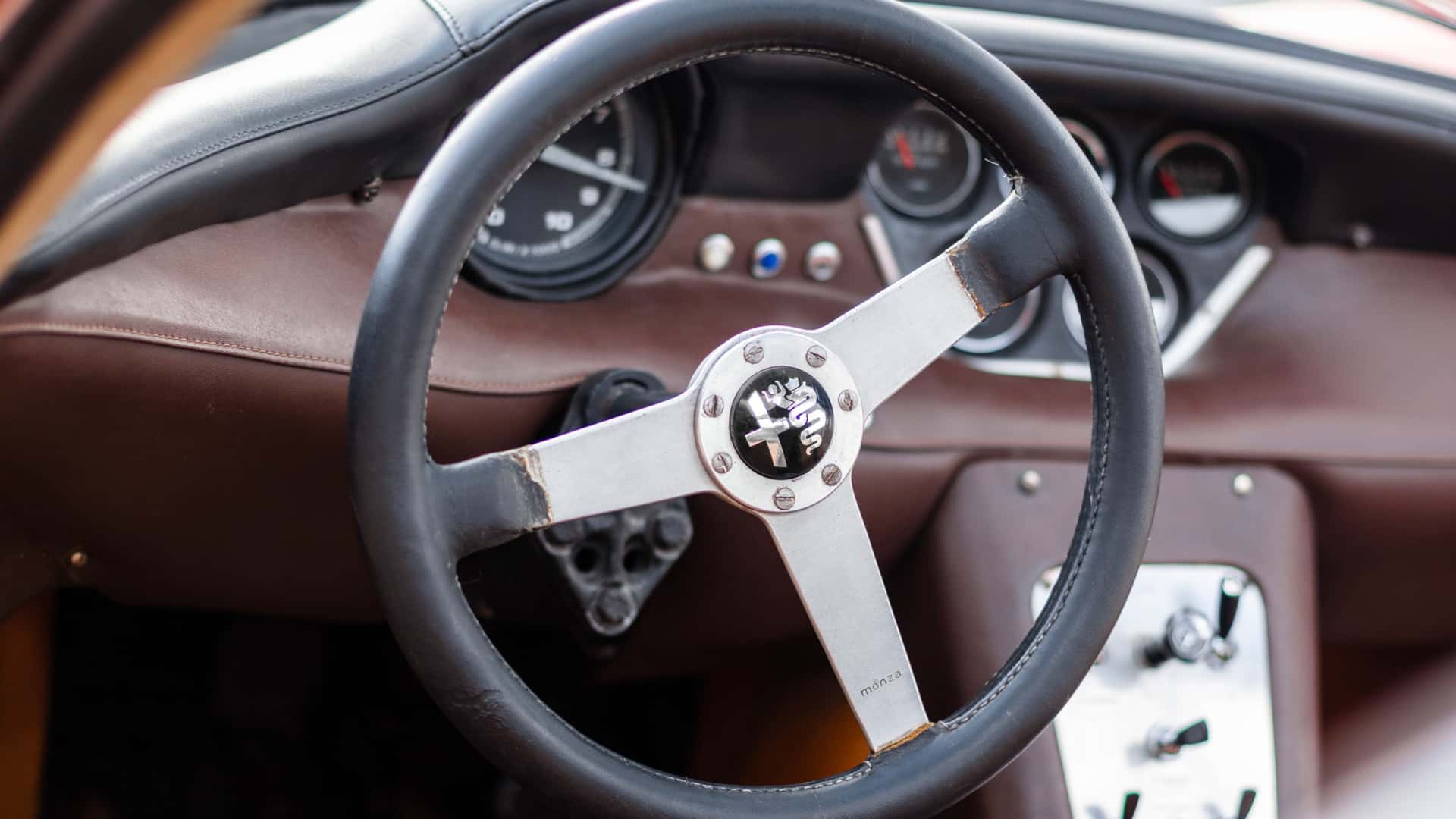
Interiors varied according to owner specifications. Seats were trimmed in either fabric or leather, with most examples receiving sound-insulating carpet. A simple vinyl-upholstered dash featured a 10,000 rpm tachometer behind the three-spoke steering wheel, with additional gauges for oil pressure, water temperature, and fuel positioned to the right. A central control panel housed switchgear, while a chrome ashtray sat at the back of the transmission tunnel. The stripped-down, functional approach reflected the car’s racing origins, prioritizing lightness over luxury.
Specifications
- Engine: All-aluminum 90-degree V8, 1,995cc (78mm x 52.2mm), DOHC per bank, dry-sump lubrication
- Power: 230 bhp at 8,800 rpm (10.0:1 compression)
- Fuel delivery: SPICA fuel injection (16 spark plugs, 4 ignition coils)
- Transmission: Five-speed manual, ZF limited-slip differential
- Chassis: Tubular steel perimeter frame, light-alloy side members doubling as fuel tanks, magnesium subframes
- Body: Hand-formed aluminum (Marazzi coachwork)
- Suspension: Independent, wishbones with helical springs, anti-roll bars front and rear, radius rods rear, adjustable telescopic dampers
- Brakes: Ventilated discs (inboard rear)
- Wheels: 13-inch magnesium (10-inch front, 12-inch rear)
- Wheelbase: 2,350 mm
- Weight: 700 kg
- Performance: 160 mph top speed, 0-62 mph in 4.9 seconds (fastest accelerating production car of its era)
- Price: 9.75 million Lire ($17,000 USD, compared to 7.7 million Lire for a Lamborghini Miura)
Production and Legacy
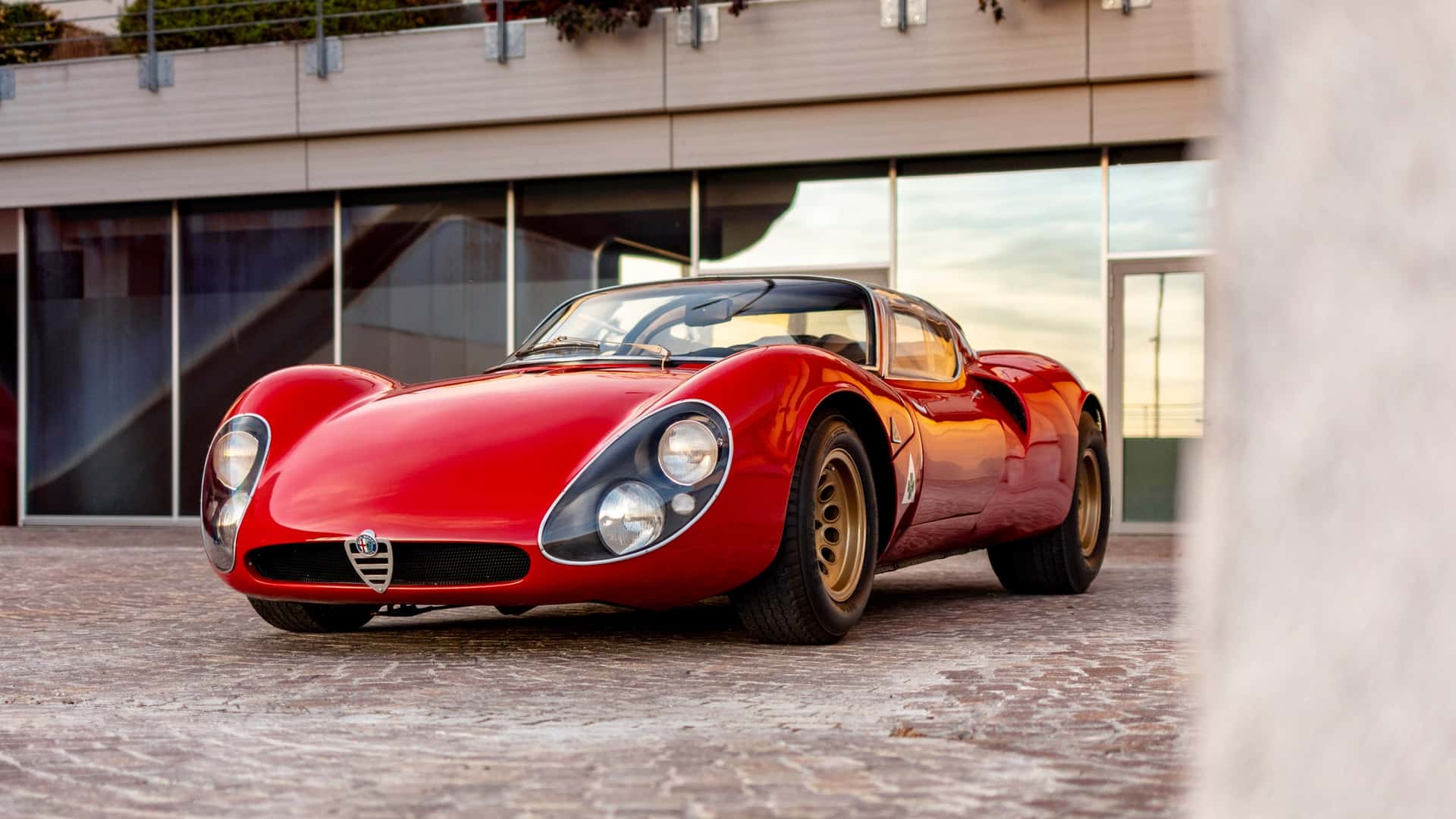
The first prototype was displayed at the Monza Racing Car Show following the September 1967 Italian Grand Prix, with an official presentation at the Turin Motor Show in November. The first single-headlight production version was unveiled at Autodelta in January 1968.
All but one Stradale was painted red. The solitary blue example, built on chassis 111, was ordered by Count Giovanni Agusta, who equipped it with helicopter seats supplied by his aviation company. In addition to the two four-headlight prototypes, nine more Stradales were manufactured over the next 18 months. Three additional examples may have left the works but remain undocumented.
The enormous price and labor-intensive construction process dictated that the original plan for 50 cars never materialized. Instead, Alfa Romeo focused on the front-engined V8 Montreal. The last Stradale was completed in March 1969.
Chassis numbers ranged from 750.33.101 to 118. Five were supplied without bodywork to coachbuilders who created showstopping concepts: two went to Bertone for the Carabo and Navajo, two to Pininfarina for the P33 Roadster and Coupe Speciale, and one to Italdesign for the Iguana. Chassis 113 was renumbered 133 for its superstitious first owner, while chassis 114 was never built as a Stradale, later used for homologation when Autodelta created a one-off 33/TT/12 for the 1975 Giro d’Italia.
Today, the Tipo 33 Stradale stands as one of the most coveted collector cars in existence, with pristine examples commanding well over three million dollars at auction. Its influence extends far beyond its tiny production run. The revolutionary dihedral doors inspired designs from the McLaren F1 to the Ferrari Enzo, while Franco Scaglione’s sensuous curves continue to captivate enthusiasts more than half a century later. As the purest expression of Alfa Romeo’s racing prowess translated to road use, the Stradale remains a testament to an era when beauty, performance, and exclusivity converged in truly extraordinary fashion.