

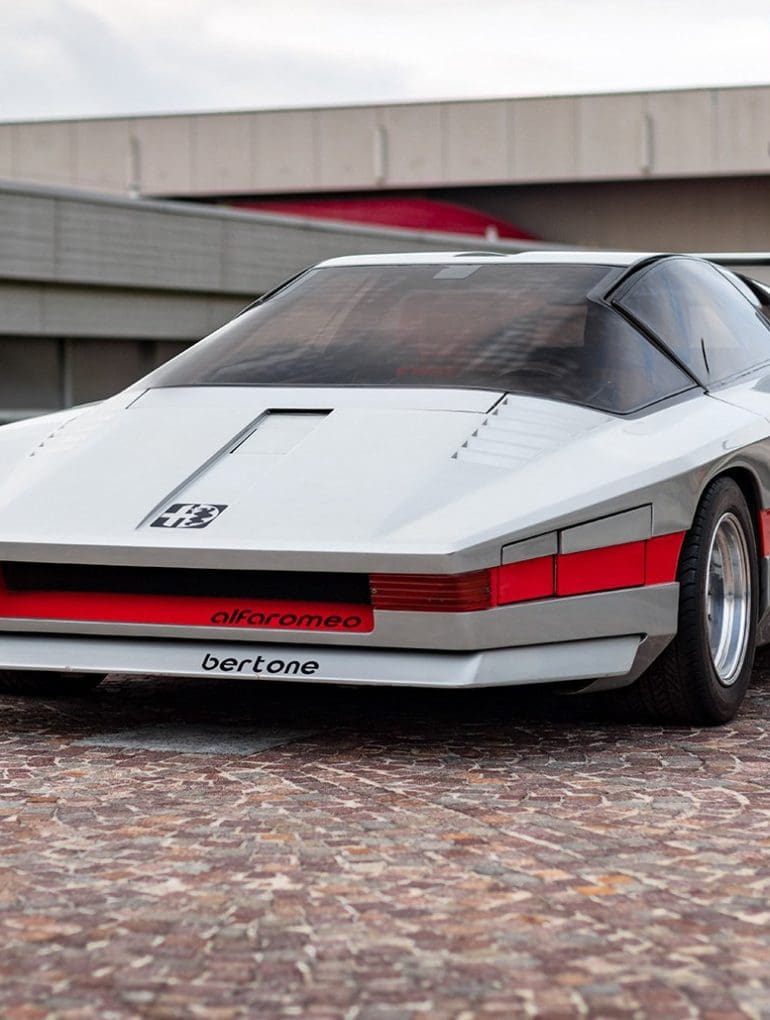

In 1976, the wedge-shaped supercar aesthetic had reached peak saturation. Every design studio in Italy seemed determined to out-angle their rivals, creating increasingly extreme concepts that prioritized geometry over grace. The Bertone Navajo represented the culmination of this trend. Built on the final unused Alfa Romeo Tipo 33 Stradale chassis and unveiled at that year’s Geneva Motor Show, it pushed the wedge concept to its absolute limits.
By examining this polarizing one-off, we explore how Bertone attempted to reinvent the wedge aesthetic and why the Navajo ultimately stands as both a fascinating time capsule and a cautionary tale.
Background and Origins
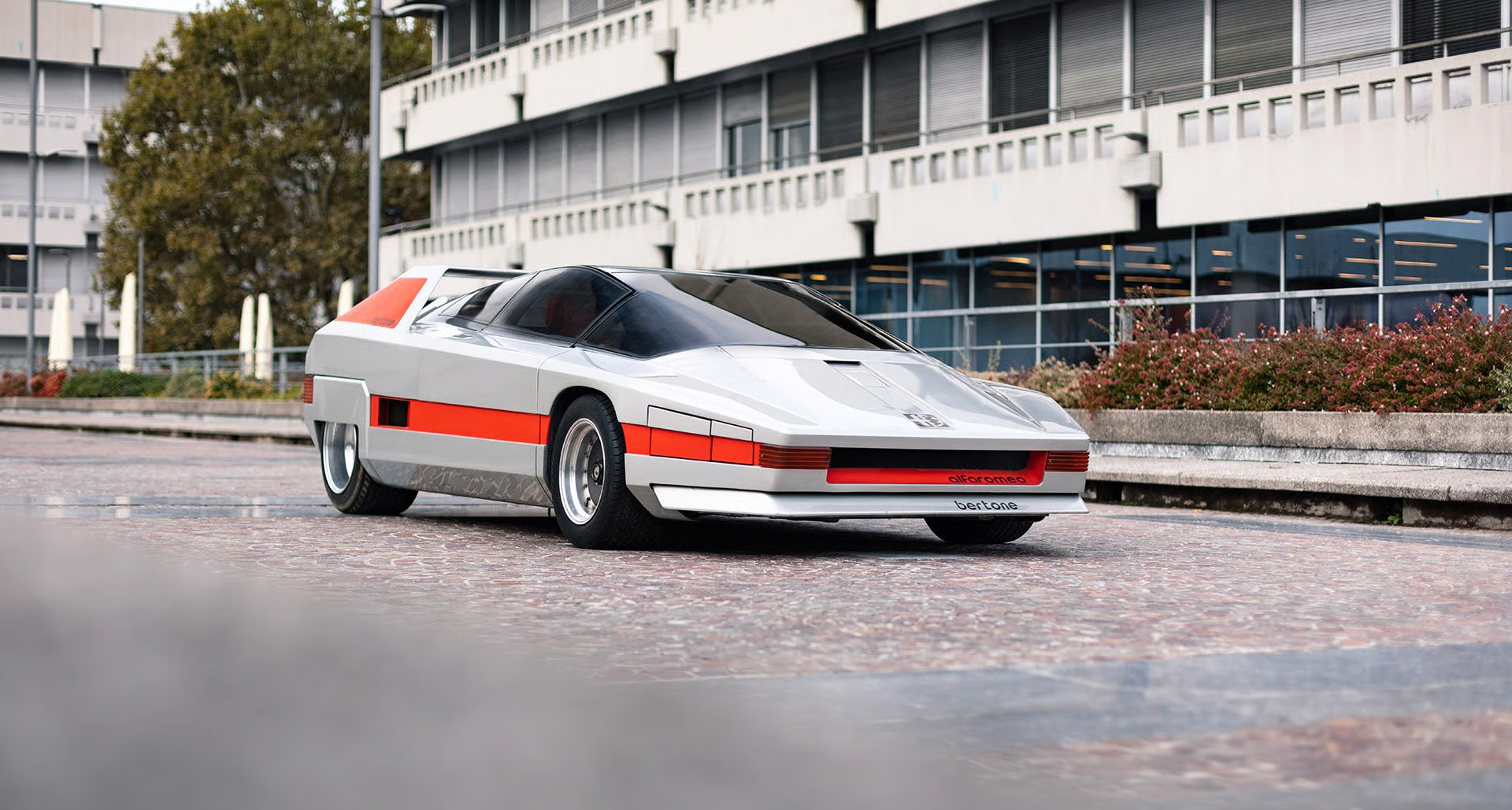
Five years had passed since the last Tipo 33 Stradale-based concept when Bertone unveiled the Navajo in March 1976. Constructed on chassis 750.33.117, it became the second example to receive Bertone coachwork, following the revolutionary and influential Carabo of 1968. However, where the Carabo had been beautiful, innovative, and trend-setting, the Navajo reflected the stylistic malaise that had begun to grip Italian design studios by the mid-1970s.
Named after a Native American tribe from the Southwestern United States, the Navajo arrived at a transitional moment for both Bertone and Alfa Romeo. The coachbuilder had recently stopped producing shells for Alfa Romeo’s Montreal, and the partnership between the two companies was seeking a new direction. Meanwhile, the original Tipo 33 Stradale had completed production in 1969, making the platform nearly obsolete by the time the Navajo was conceived.
The Navajo represented Bertone’s interpretation of where the wedge aesthetic should evolve. Marcello Gandini had pioneered this style with designs like the Lancia Stratos Zero and the Carabo. Designer Nuccio Bertone himself oversaw the project, applying the latest aerodynamic principles and pushing the angular, geometric styling to new extremes.
Design and Engineering
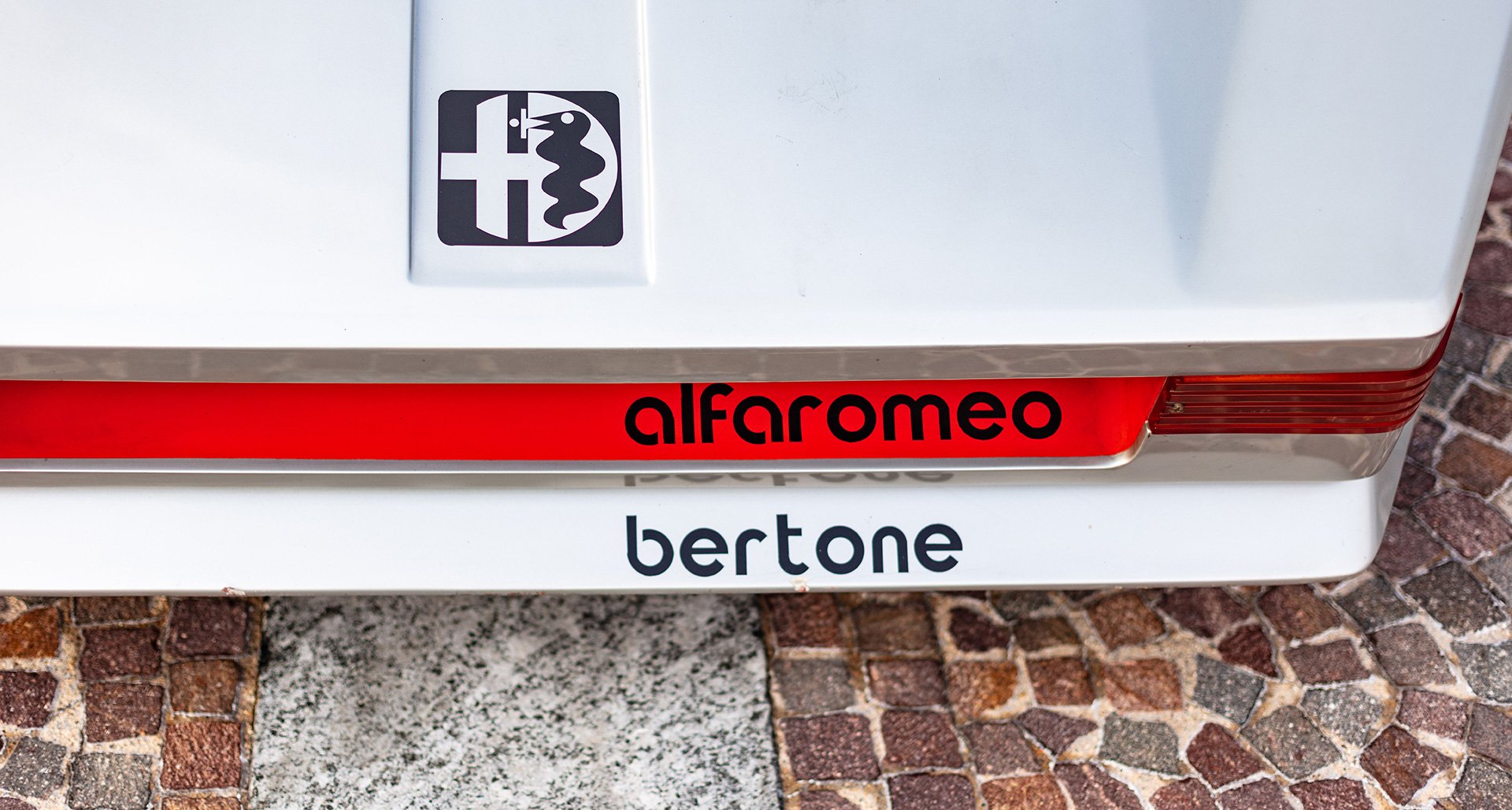
The original Tipo 33 Stradale’s tubular chassis was lengthened in the center section to 2,430mm, creating optimum room for two passengers while maintaining the car’s mid-engine layout. This 80mm extension beyond the standard Stradale allowed for a more spacious cockpit without compromising the mechanical package.
The fiberglass bodywork was constructed entirely at Bertone’s facilities in Turin. Despite the car’s larger appearance in photographs, the Navajo was actually diminutive in person, with the lightweight fiberglass construction keeping weight to just 870 kilograms. This represented a 170-kilogram increase over the original Stradale, but remained impressively light.
Mechanically, the Navajo retained the Tipo 33 Stradale’s sophisticated V8 powertrain. The longitudinally mounted 1,995cc all-aluminum 90-degree V8 featured dual overhead camshafts per bank and SPICA mechanical fuel injection. Output remained at approximately 230 horsepower at 8,800 rpm, transmitted through a six-speed manual gearbox, one more ratio than the standard Stradale’s five-speed.
The suspension, brakes, and running gear were carried over from the Stradale platform, though the extended wheelbase altered the handling characteristics slightly, prioritizing stability over the razor-sharp reflexes of the original.
Styling
The Navajo’s fiberglass body was a composition of straight lines and flat surfaces that looked like something from a mid-1970s science fiction movie. Some observers noted it previewed the Colonial Vipers from the 1978 Battlestar Galactica series. The heavily tapered front end was designed to minimize air resistance, creating an extremely sharp profile that appeared almost knife-like.
Perhaps the Navajo’s most distinctive feature was its retractable headlights, unusually mounted to emerge laterally from the front fenders rather than rising from the nose or hood. This unconventional solution became one of the few truly original elements in an otherwise derivative design.
Aerodynamics played a central role in the concept. Both the front spoiler and the massive rear wing featured electric actuation that varied their angle according to road speed. This sophisticated system wouldn’t become common until nearly a decade later when Bertone applied similar technology to the Alfa Romeo 90.
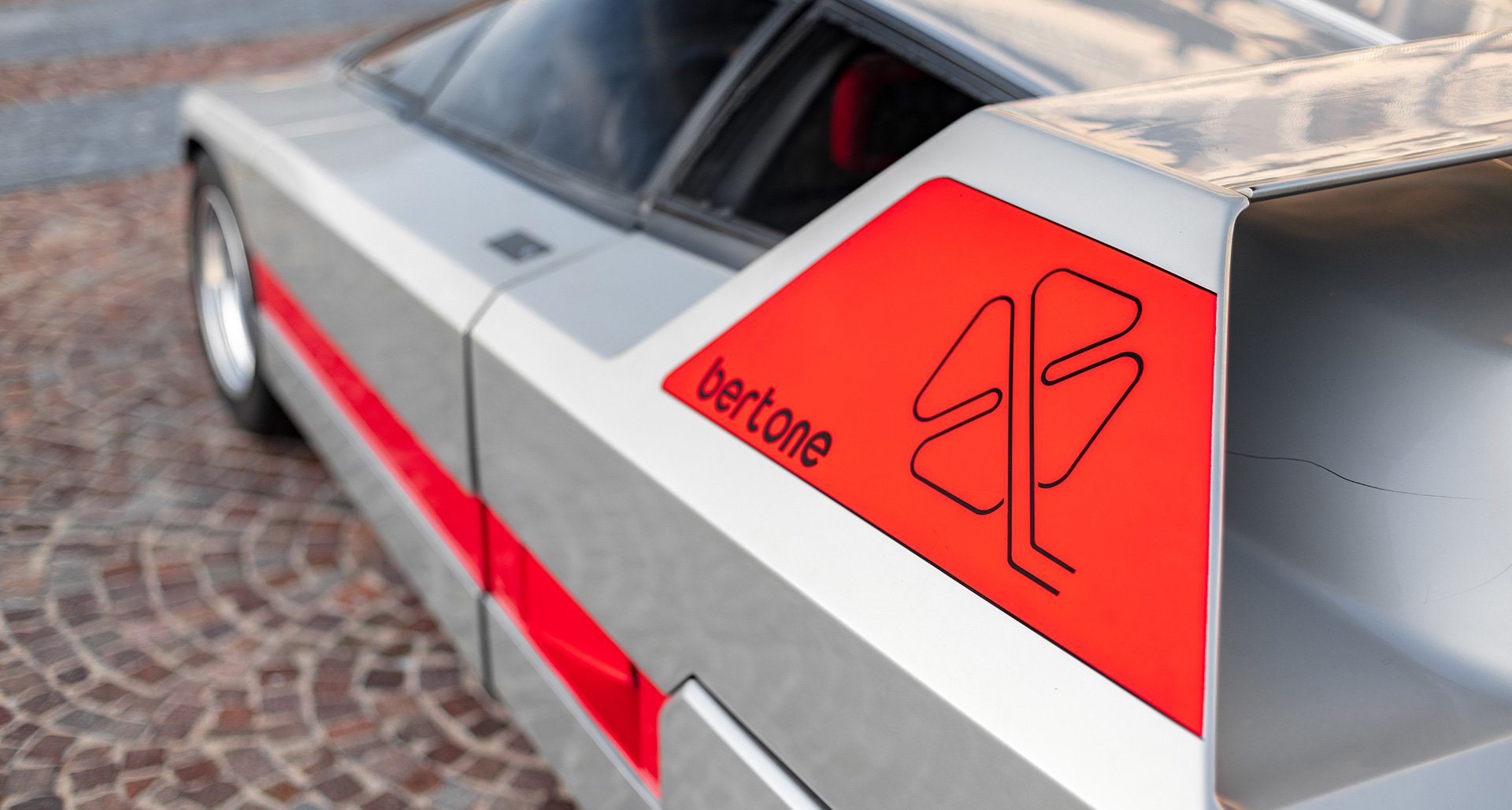
The rear wing itself was mounted on two huge trapezoidal panels emblazoned with Bertone script and the Alfa Romeo cloverleaf on a red background. The inner trapezoid served a functional purpose, drawing hot air away from the mid-mounted V8. This geometric motif had been borrowed from Giorgetto Giugiaro’s 1971 Alfa Romeo Caimano concept, though Bertone developed the idea further.
A matching red belly stripe wrapped around almost the entire car, only interrupted by the partially shrouded rear wheels. The unventilated center-lock split-rim wheels were shod with Pirelli P7 tires, the performance tire of choice in the mid-1970s.
Given Nuccio Bertone’s well-known affection for elaborate door mechanisms, demonstrated dramatically on the Carabo’s scissor doors, it was surprising that the Navajo featured conventionally hinged doors. This practical choice suggested the concept was intended to explore aerodynamic solutions rather than door technology.
Competition History
The Navajo was purely a show car, never intended for competition. After its March 1976 Geneva debut, it toured the international motor show circuit throughout 1976 and 1977. Unlike the influential Carabo, the Navajo failed to inspire production designs or generate customer interest. After completing its show career, it was retired to the Alfa Romeo Museo Storico in Arese, where it remains today alongside the other Tipo 33 Stradale-based concepts.
Interior
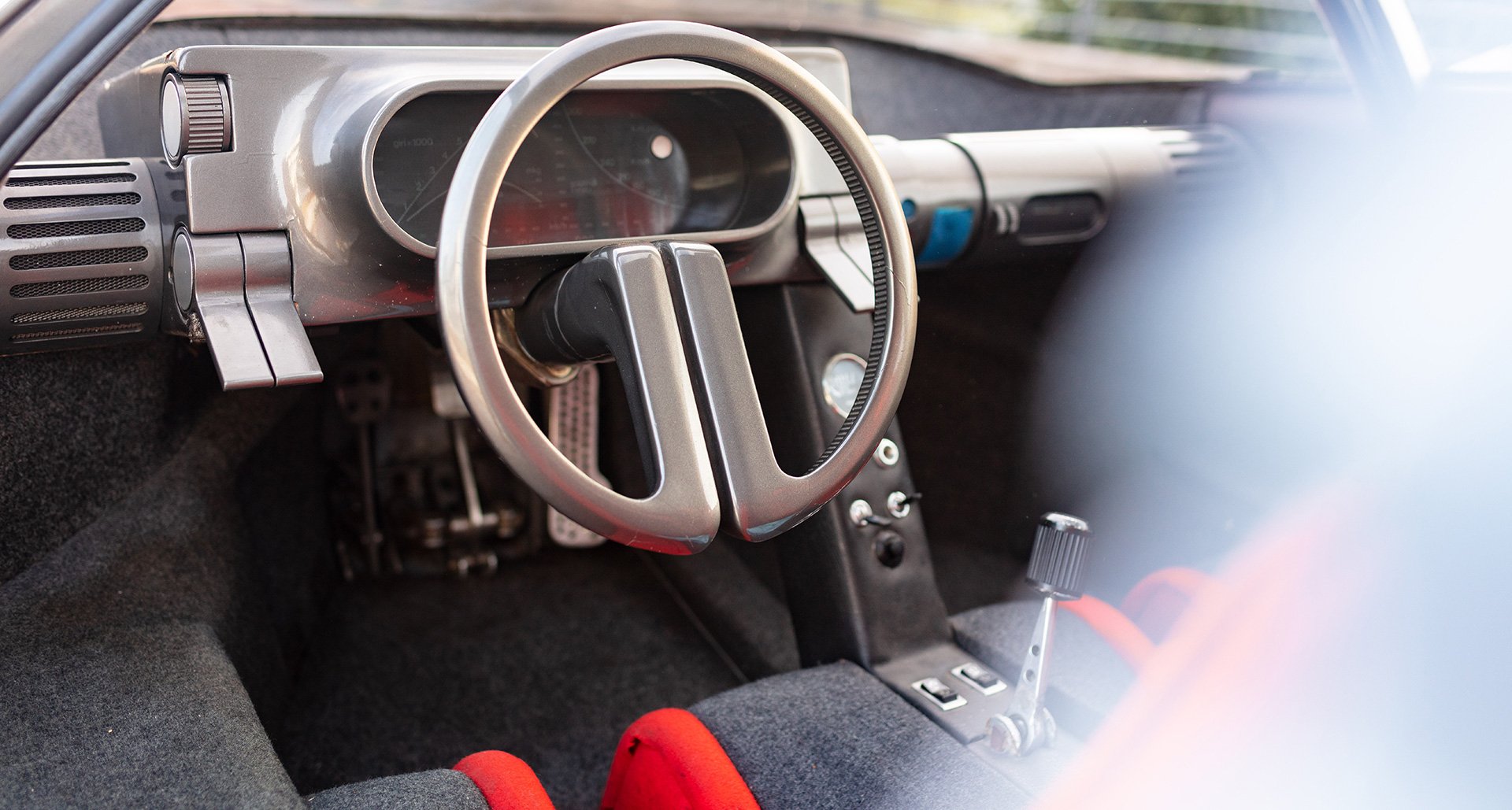
The cockpit featured a futuristic interpretation of driver-focused design. A single-spoke steering wheel sat in front of a completely digital dashboard, a rarity in 1976 when even the most advanced production cars still relied primarily on analog instrumentation. All major readouts were contained within the main binnacle, eliminating traditional gauges entirely.
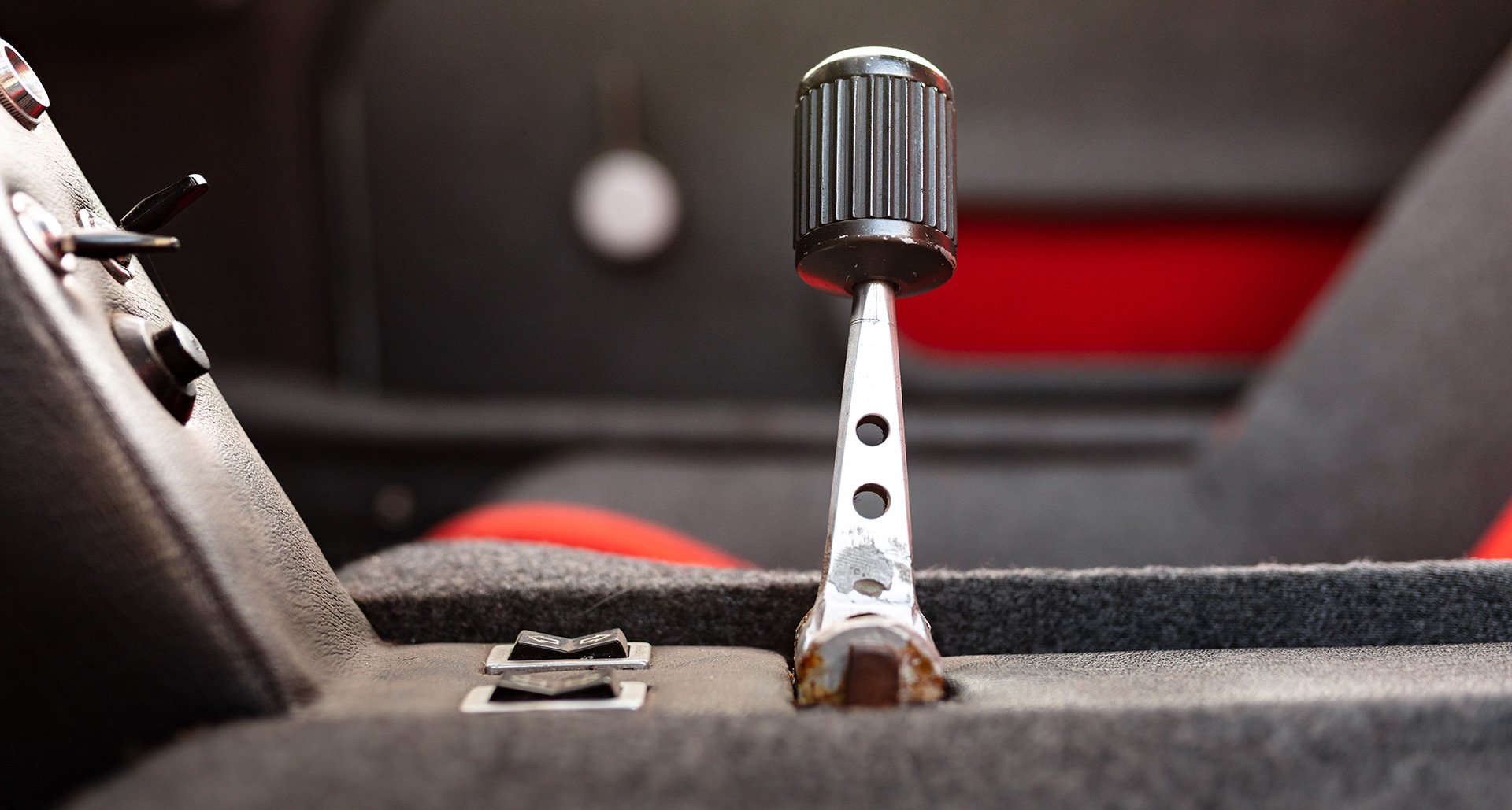
A floating tubular center console intersected the pair of fixed fiberglass seats, which were upholstered in grey fabric with red centers. Matching grey fabric covered the rest of the interior. Instead of conventional buttons, the Navajo employed levers to operate onboard controls, another futuristic touch that proved more conceptual than practical.
The fixed seating position meant occupants of different sizes would struggle to find a comfortable driving position, a compromise made in service of the dramatic interior styling. Comfort was clearly secondary to aesthetics.
Specifications
- Engine: All-aluminum 90-degree V8, 1,995cc (78mm x 52.2mm), DOHC per bank
- Power: 230 bhp at 8,800 rpm
- Fuel delivery: SPICA mechanical fuel injection
- Transmission: Six-speed manual
- Chassis: Lengthened tubular steel Tipo 33 Stradale chassis (2,430mm wheelbase)
- Body: Fiberglass (Bertone)
- Suspension: Independent, from Tipo 33 Stradale
- Wheels: Center-lock split-rim (Pirelli P7 tires)
- Weight: 870 kg
- Special features: Active aerodynamics (adjustable front spoiler and rear wing), lateral pop-up headlights, digital dashboard
Production and Legacy
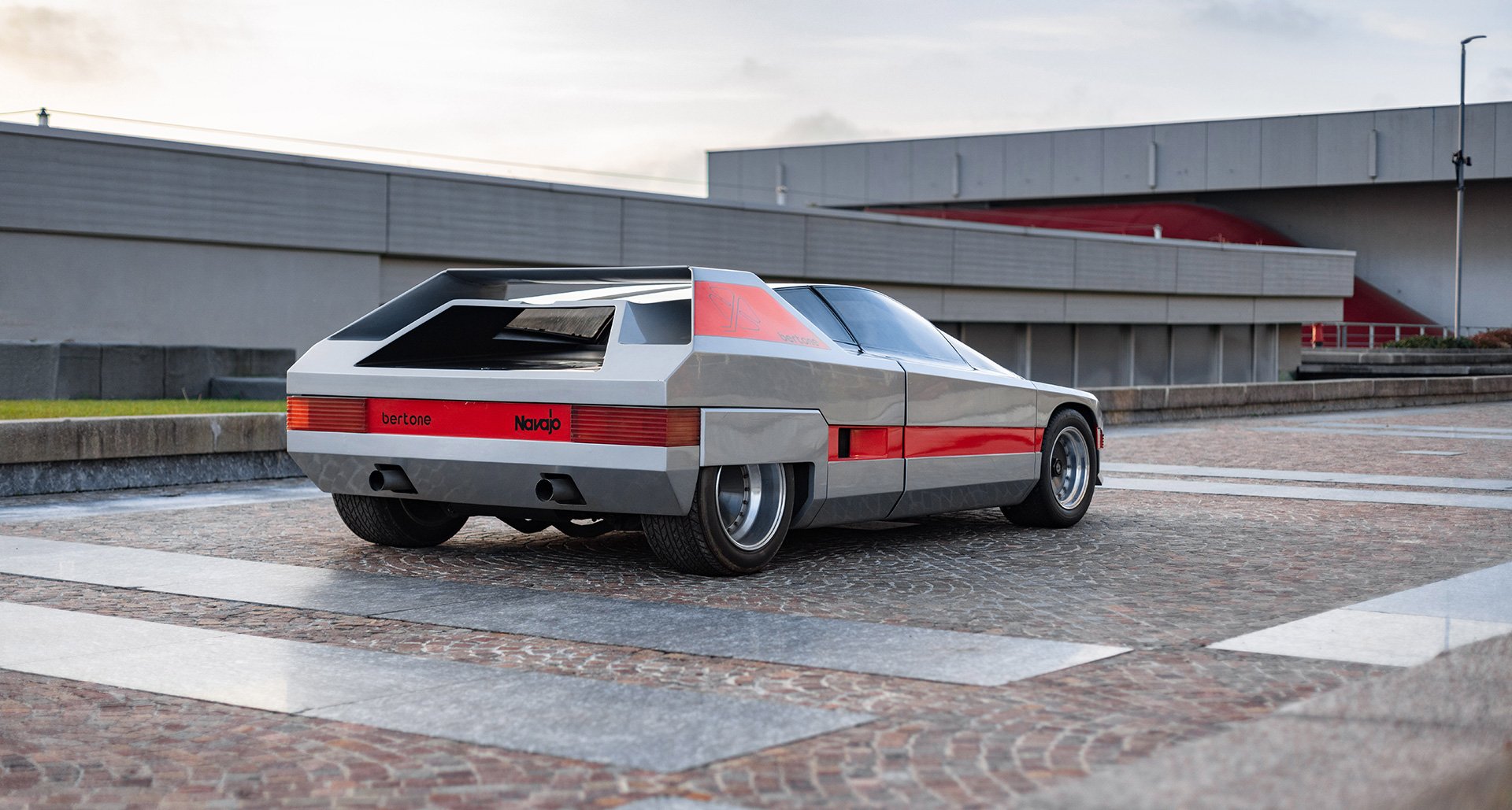
Only one Navajo was ever constructed. After its Geneva debut and subsequent motor show appearances, the car became part of Alfa Romeo’s Museo Storico, where it remains today alongside the other Tipo 33 Stradale-based concepts.
The Navajo was the last of six extraordinary concept cars built on Tipo 33 Stradale chassis between 1968 and 1976. The others included Bertone’s own Carabo, Italdesign’s Iguana, and three Pininfarina creations: the P33 Roadster, 33/2 Coupe Speciale, and P33 Spider Speciale Cuneo. Together, these six one-offs represented a remarkable period of experimentation and creativity in Italian automotive design.
However, the Navajo also marked an ending. Inevitable similarities with Bertone’s other supercar concepts of the era, including the 1974 Lamborghini Bravo and 1976 Ferrari 308 GT Rainbow, revealed that the studio’s most innovative work was behind it. As the 1980s dawned, Bertone’s designs would become increasingly derivative, never quite recapturing the brilliance of earlier masterpieces like the Carabo or Lancia Stratos Zero.
Today, the Navajo is remembered as both a fascinating artifact of 1970s excess and a reminder that even the greatest design houses can lose their way. Where the Carabo had influenced an entire generation of supercar design, the Navajo served as a cautionary example of pushing a successful formula too far. Yet for all its excesses, the Navajo remains an important part of automotive history. It stands as a bold experiment that tested the absolute limits of the wedge aesthetic and demonstrated that even failed concepts can offer valuable lessons about the evolution of automotive design.