

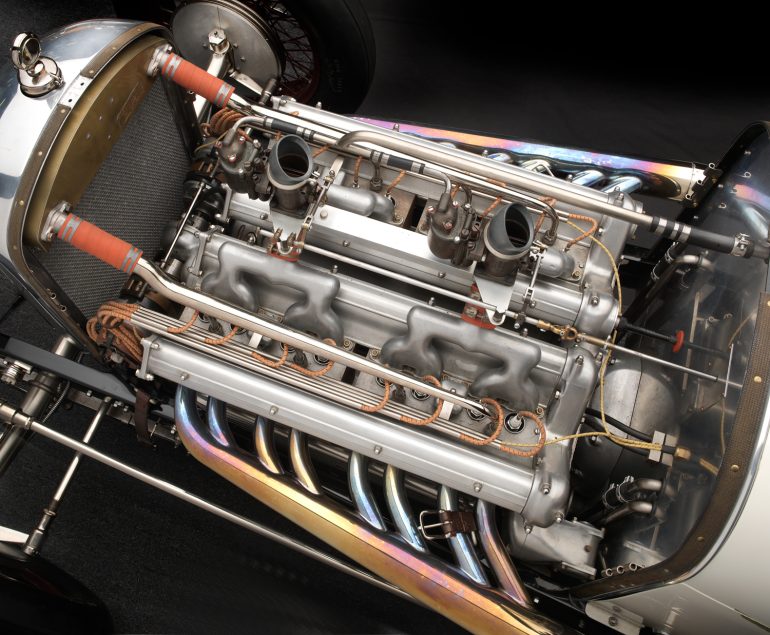

The dual overhead camshaft engine (DOHC) has had a profound impact in high performance motor development, dating all the way back to 1914.
A new video, produced by the Brumos Collection, examines how the dual overhead cam engine has evolved, citing its profound impact on racecars from three disparate and distinctive eras in motorsports competition:
1914 Peugeot L45
One of the first cars that featured DOHC technology, the Peugeot L45 was engineered by three drivers and a draftsman whose ideas were so radical, they were dubbed “The Charlatans” by other Peugeot engineers. This foursome created a technology that was so revolutionary, it would play a pivotal role in high performance engine development that is still used today.
1930 Miller Sampson Special
As the Peugeot L45 signified what was important about “The Charlatans” and their innovations, this Sampson Special exemplifies legendary racer, car designer and builder Harry Miller’s creativity and innovativeness. Miller’s influence on the DOHC engine was noteworthy, as DOHC-powered racecars won the Indianapolis 500 a total of 17 times between 1922 and 1938.
1963 Meskowski Dirt Champ Car
Taking cues from his employer Harry Miller, engine builder Fred Offenhauser developed a dominant 4-cylinder motor, which powered this Sprint car, which named in honor of the legendary racer’s crew chief and engineer Wally Meskowski. The dirt racer gained earned a place in motorsports lore when driver A.J. Foyt, whose race car did not show up, opted to drive it on the pavement in the Milwaukee Mile.
“This deep dive shows the connectedness of people and ideas through the early and mid-part of the 1900s,” explains Starks. “As we look at these historically significant vehicles from three very different eras, we see the unique bond they share through engine technology that has been a mainstay in automotive manufacturing for more than a century.”