
1927 Mercedes-Benz 680 S
Soon after the merger of Mercedes and Benz, the two started developing the world’s fastest sports cars. They were based on the heavy and powerful M06 engine designed by Ferdinand Porsche and became known as the White Elephants for their brute force. The 680 Type-S was the first of this series which would mature into a legendary line of racecars that had little comparable competition until years later.
Alongside the earlier Mercedes cars like the 400 and 630, the new 680 S featured a lower chassis, which meant its heavy engine could be pushed back and down in the engine bay. This was the existing SOHC 6.3-liter six-cylinder engine enlarged to 6.8 liters and fitted with a supercharger that only spooled up at high throttle. When engaged, the 120 bhp suddenly became 180 bhp (hence the old 26/120/180 nomenclature). In race tune the engine was up to 26/170/225.
These cars were initially campaigned by the factory and driven by famous drivers such as Rudolf Caracciola who won the 1927 Nurburgring race with one. However, since the chassis was relatively simple and robust, Mercedes-Benz made road-going bodies, and sometime shipped bare chassis to be re-bodied by a company of the customer’s choice. The race cars are easily identified as they have simple cycle-fendered bodies almost always painted in white while every road car was different.
The 680 evolved over the year, getting lighter and more powerful. The first major modification was made to the engine which was enlarged in 1928 to 7.0 liters for the 700 SS then 7.1 for the 710 SS, but the definitive version was the shortened 720 SSK which is a holy grail of car among car collecting.
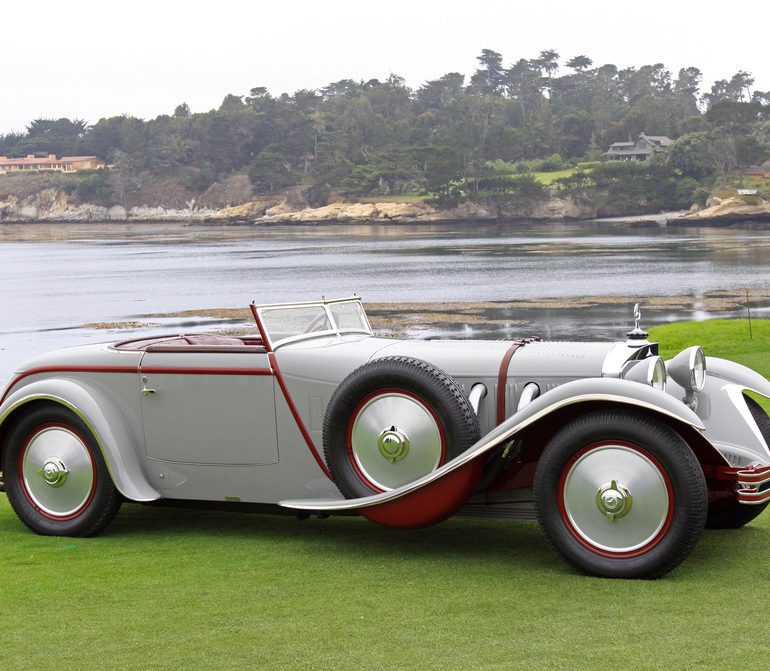
Torpedo Roadster by Saoutchick
Fortunately, some customers agreed to order Mercedes-Benz’s finest chassis to send it to Carrosserie J. Saoutchik, of Paris, France. Saoutchik described the car as ‘Torpedo-Sport 4 places, J.Saoutchik, type Cannes’.
At the time Mercedes-Benz had their own Sindelfingen factory for producing bodywork which was generally superior to anything else on the market. Saoutchik was probably the only independent body builder that could rival the best from Mercedes. He used exotic materials such as Purpleheart wood trim and lizard-skin upholstery.
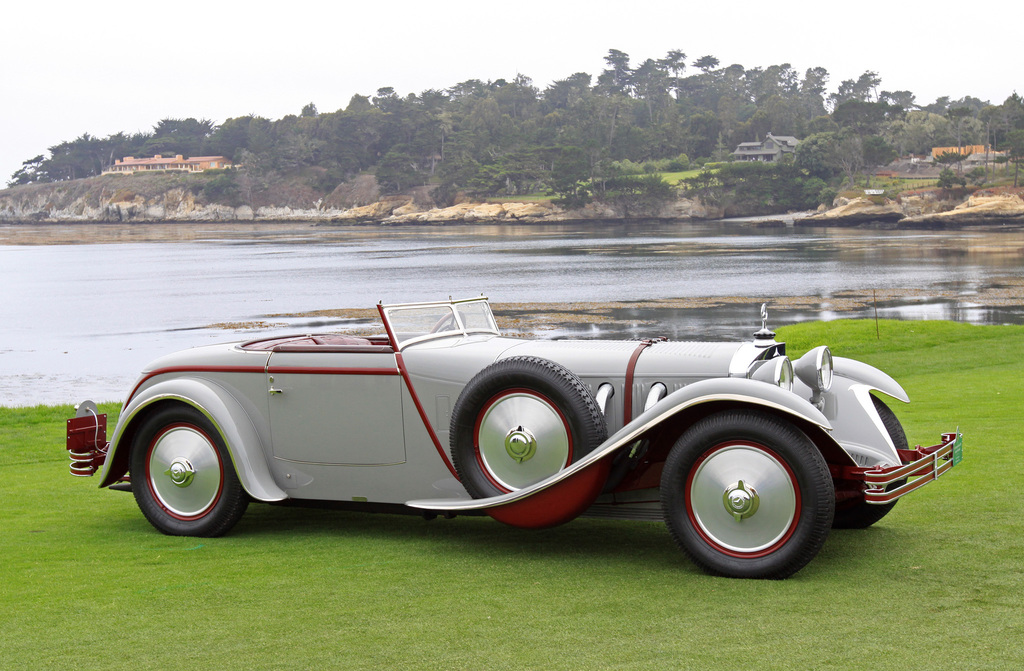
In Paris, Jaques Saoutchik created easily his most striking pre-war car on the 680 S-type chassis. The design took advantage of the Type 680’s low slung chassis and did without running boards. Furthermore a low windshield, tasteful copper-nickel alloy accents and a sophisticated disappearing top added dramatic effect to sporting character of the chassis.
Inside, these cars were crafted to include intricate wood appointments, a giant wood-rimmed Mercedes-Benz steering wheel and reptile-skin upholstery that required over 600 hides.
Originally Saoutchik bodied 18 Torpedo Roadsters, 12 on the 680 S-Type chassis and six rarer short-wheel-base verions on the SS-type chassis.
Feature Car
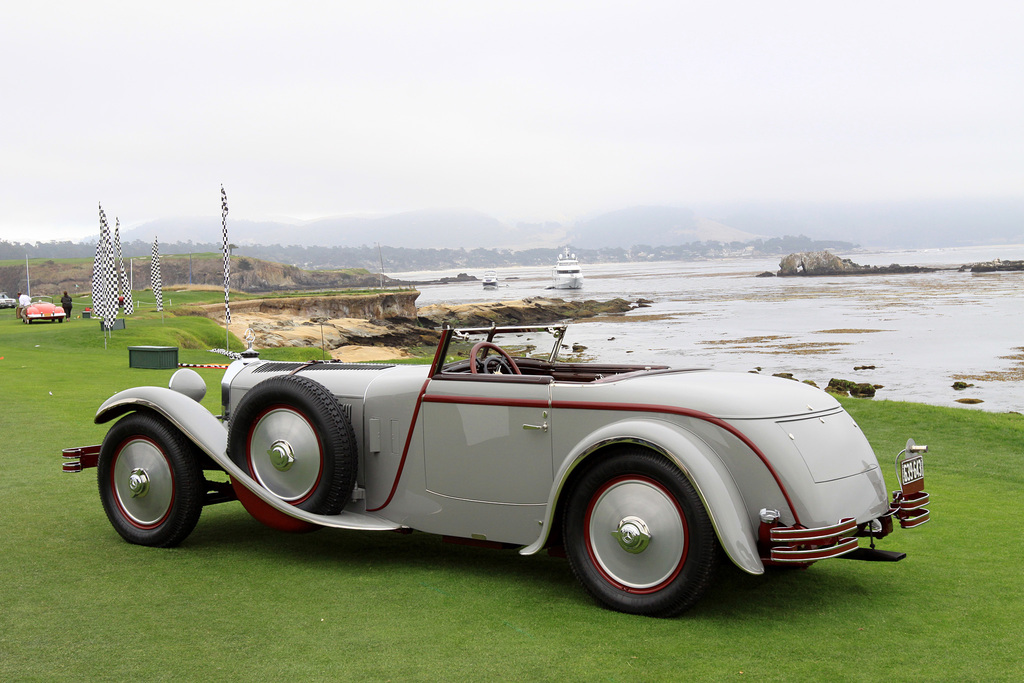
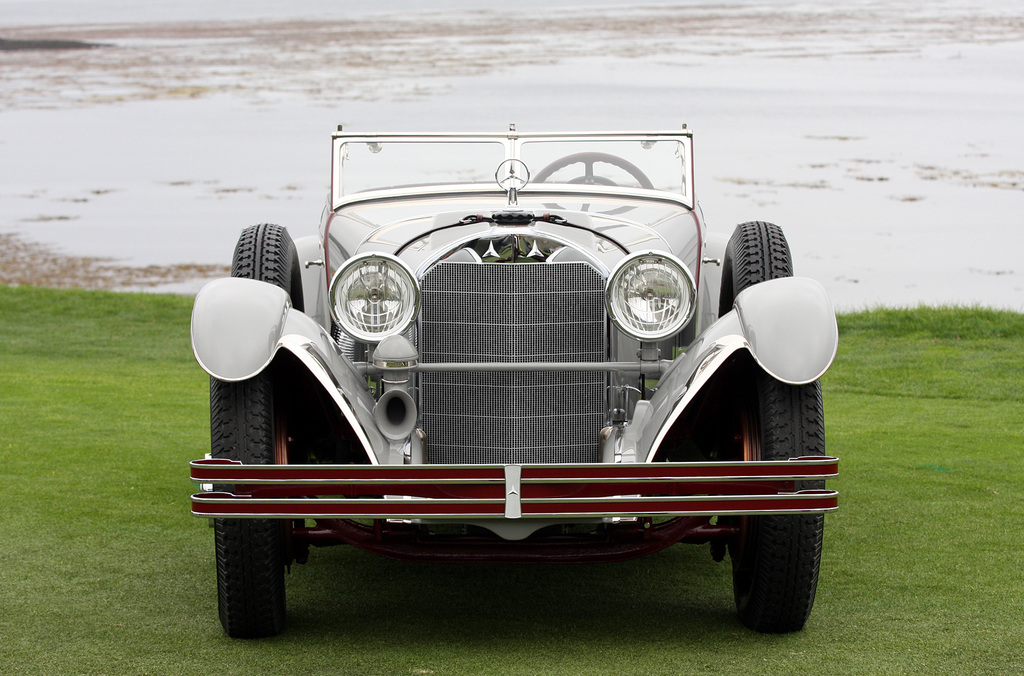
Our feature car was first built by Carrosserie J. Saoutchik in August of 1928, but didn’t find an owner until after it was displayed at the 1929 New York Auto Show. Afterward it was purchased by the Bedford family who retained it until the 1980s.
At that time the car was lightly restored by Gus Reuter for the Bedford family in the colors of yellow with plain red leather upholstery. It sat this saw for two decades in the Owls Head Transportation Museum and was eventually offered for public sale at Cristies Sale of Collectors’ Motorcars on August 17th 2006 at the Monterey Jet Center and sold for $3,645,000 USD. Later it was shipped to Europe and sold at the Bonhams’ 2008 Automobiles d’Exception at the Retromobile Salon for €2,100,000.
At this point an exacting restoration was started by Paul Russell and Company to return the car back to original specification in April of 2010. Before starting they found the car to be highly original, with matching numbers and correct Saoutchik stampings throughout the trim and wooden body frame.
Special attention was paid to recreate some of the trim in 80/20 copper-nickel alloy and researching two other cars to correctly match the lizard-skin interior.
The resulting restoration was shown at the 2012 Pebble Beach Concours d’Elegance where it was was awarded 100 points and went on to take the Best of Show title.
In Detail
| submitted by | Richard Owen |
| type | Series Production Car |
| production | 129 |
| engine | M06 Twin-Plug Inline-6 |
| position | Front Longitudinal |
| aspiration | Roots Stepped Supercharger |
| valvetrain | SOHC, 2 Valves per Cyl |
| fuel feed | Twin Updraft Carburetors |
| displacement | 6788 cc / 414.2 in³ |
| bore | 98 mm / 3.86 in |
| stroke | 150 mm / 5.91 in |
| power | 134.2 kw / 180 bhp @ 3000 rpm |
| specific output | 26.52 bhp per litre |
| bhp/weight | 94.74 bhp per tonne |
| body / frame | Aluminum over Steel Frame |
| driven wheels | RWD |
| front brakes | Mechanical Drums |
| rear brakes | Mechanical Drums |
| steering | Worm & Nut |
| f suspension | Rigid Axle w/Semi-Elliptic Springs, Friction Dampers |
| r suspension | Underslung Live Axle w/Semi-Elliptic Springs, Friction Dampers |
| curb weight | 1900 kg / 4189 lbs |
| wheelbase | 3400 mm / 133.9 in |
| front track | 1425 mm / 56.1 in |
| rear track | 1425 mm / 56.1 in |
| transmission | 4-Speed Manual |
| top speed | ~178 kph / 110.6 mph |
| designers | Ferdinand Porsche, Hans Nibel, Fritz Nallinger |
Auction Sales History
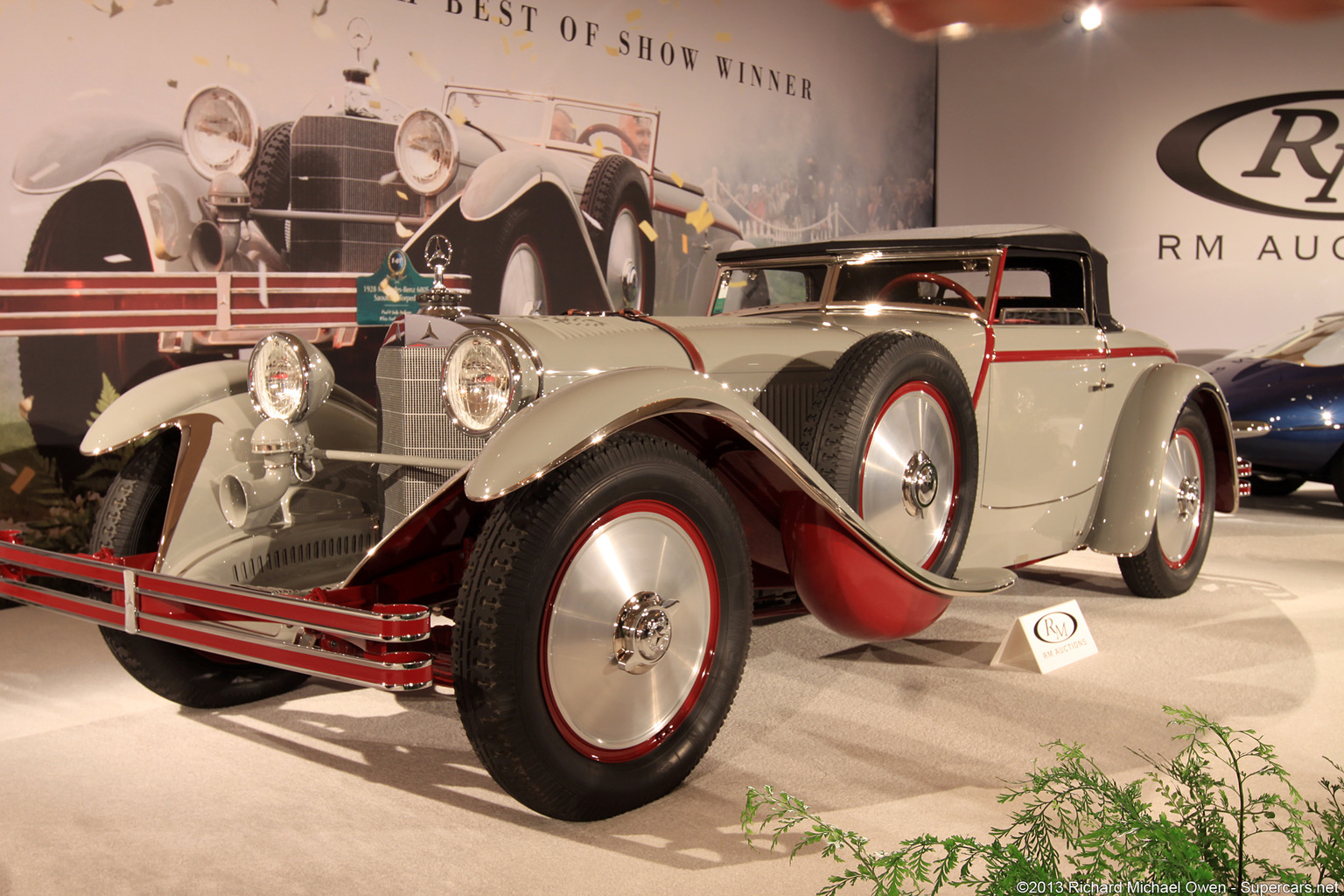
1928 Mercedes-Benz 680S Torpedo Roadster by Carrosserie J. Saoutchik 35949 – sold for $8,250,000 The 2012 Pebble Beach Best of Show winner. Meticulous restoration by Paul Russell and Company. Displayed at the 1929 New York Auto Salon. One of only three short-windshield examples built and the only known survivor.
Auction Source: 2013 Monterey Auction by RM Auctions
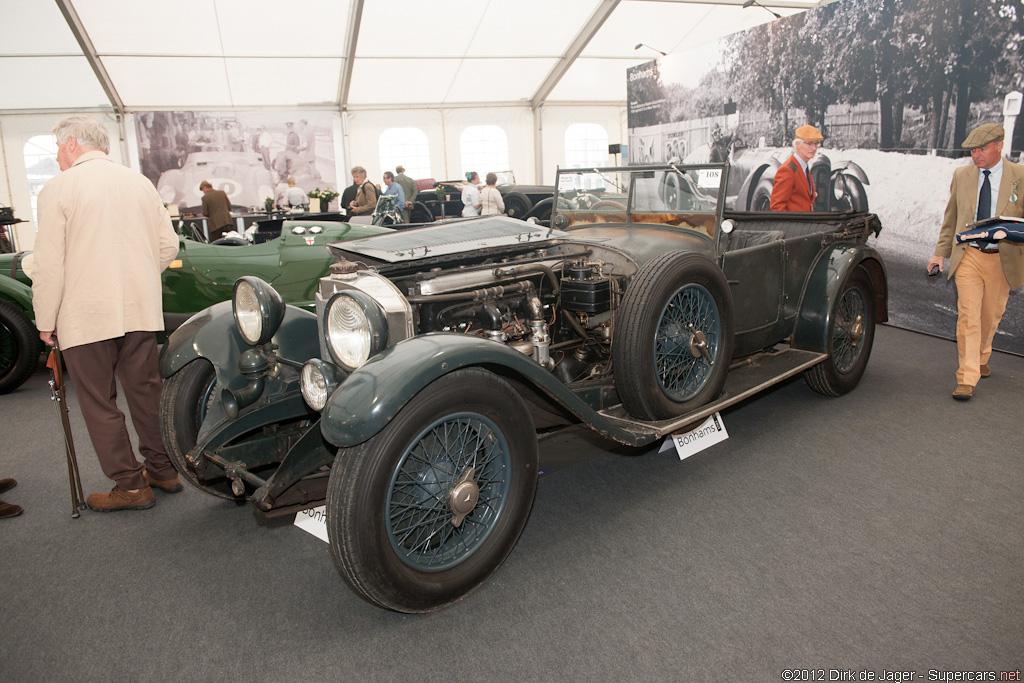
1928 Mercedes-Benz 36/220 6.8-litre S-Type Cadogan Four-Seat Open Tourer 35906 – sold for €3,500,000
Upon inspection the Mercedes-Benz S with chassis number ‘35906’ is in complete, original and unrestored condition. The original gearbox was exchanged, obviously no later than the 1930s, against a gearbox made by the British manufacturer Wilson. Chassis frame and rear axle torque tube were adapted accordingly, and additional members were mounted. The car is ready to move. The original paintwork shows patina to a large extent. The engine plate on the rear left engine mount is stamped with engine number ‘68657’. Vertical shaft, camshaft, rocker arms show very low wear. Thus, the mileage given on the odometer as 8,375 miles might be correct.
Auction Source: 2012 Goodwood Revival Sale by Bonhams
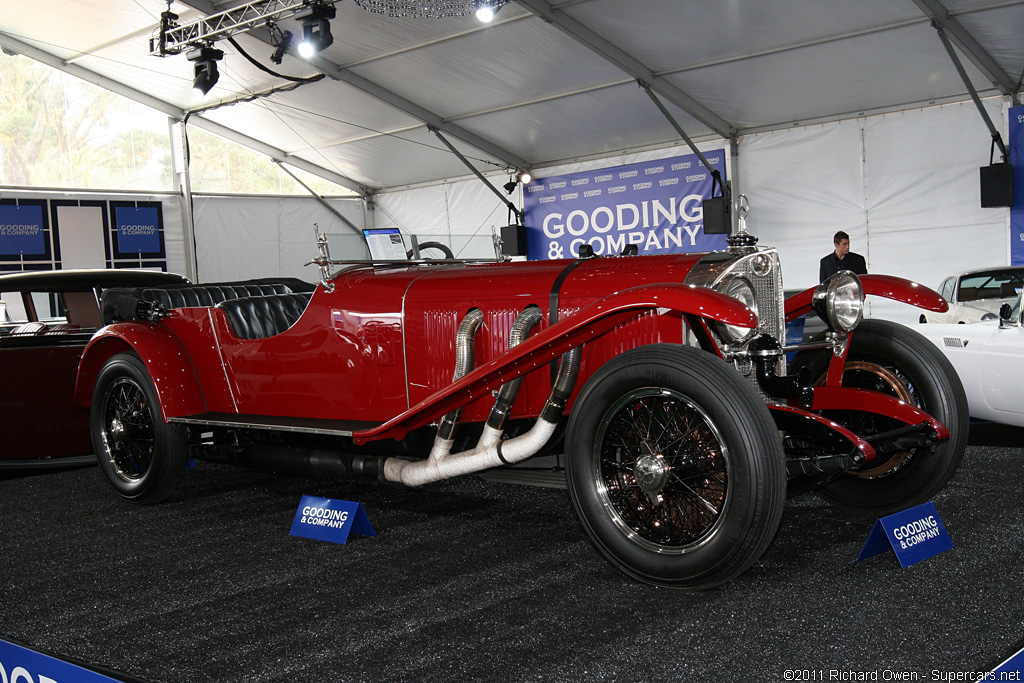
1927 Mercedes-Benz S-Type 26/180 Sportwagen – sold for $5,004,000 Formerly the Property of Alliston Boyer, David Tunick and Henry Petronis. An Exceedingly Rare Pre-War Mercedes-Benz Sports Car. Porsche-Designed Chassis with Supercharged Power. Originally Delivered to New York. Distinguished Provenance. Matching-Numbers, Original-Bodied Example. 2004 Pebble Beach Class Award Winner. Over 40 Years in the Petronis Collection. Eligible for the World’s Finest Motoring Events.
Auction Source: 2011 Pebble Beach Auctions by Gooding & Company
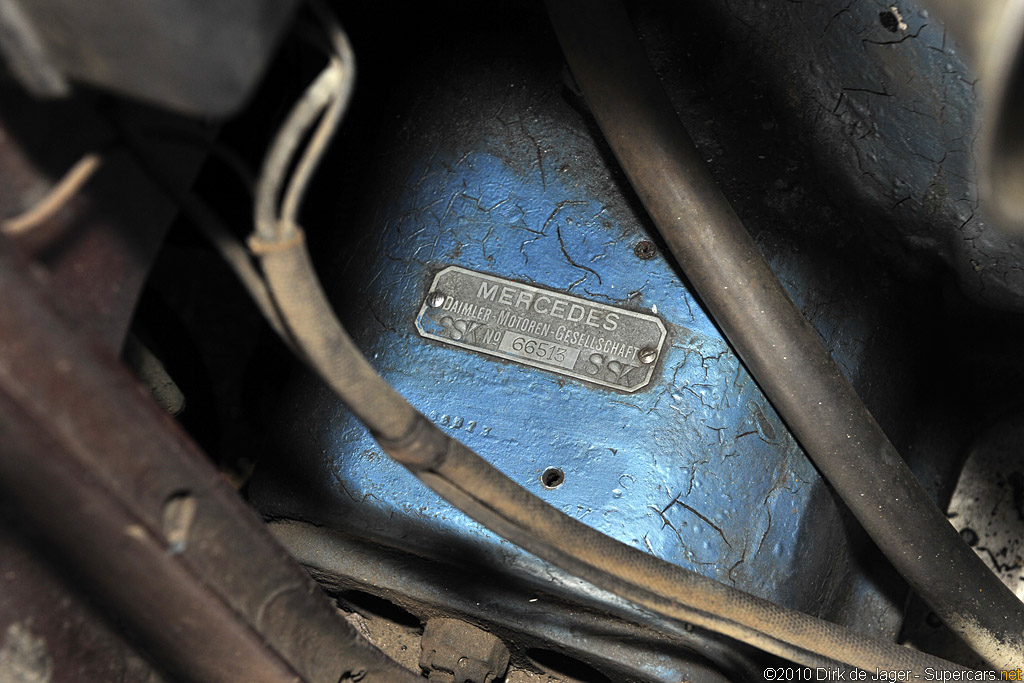
1928 Mercedes-Benz S 26/180 Murphy Boattail Speedster 35313 – sold for $3,740,000
Currently finished in white with blue pinstripes, the S-Type Speedster looks today very much the way it did when it ran at full speed along the dry lake bed in 1932. On the chassis as well as on several areas of the bodywork, the identification number is stamped and the engraved Murphy cap can still be found on the pivot point of the windscreen. It is an extraordinarily undisturbed example of one of the finest sporting Mercedes-Benz.
Although not currently fitted, the car still retains its original bobbed fenders as well as the Packard bumpers and Lincoln headlamps fitted in the 1950s. There is also a file that includes archival images, correspondence and ownership paperwork documenting the history of this magnificent machine.
Any S-Type Mercedes-Benz must be considered among the top rank in collector cars worldwide. To find an example that is so original, with sporting coachwork and a brilliant story, adds much to its cache and desirability. Its unrestored appearance, with all traces of age and use, is simply marvelous and imbues the Speedster with a vibrant, tangible charisma.
Its legacy extends into the early years of Hollywood extravagance, Southern California hot rod culture, the lost art of American coach-building, the great European marques and the hallowed reaches of automotive lore. The Marx Brothers’ S-Type possesses every quality that serious collectors search for: a mythical presence, a marvelous, irreplaceable patina and the kind of inimitable character and status that can only be crafted in Hollywood.
Auction Source: 2010 Gooding & Company Pebble Beach Auction