
1931 Miller V16 Speedster
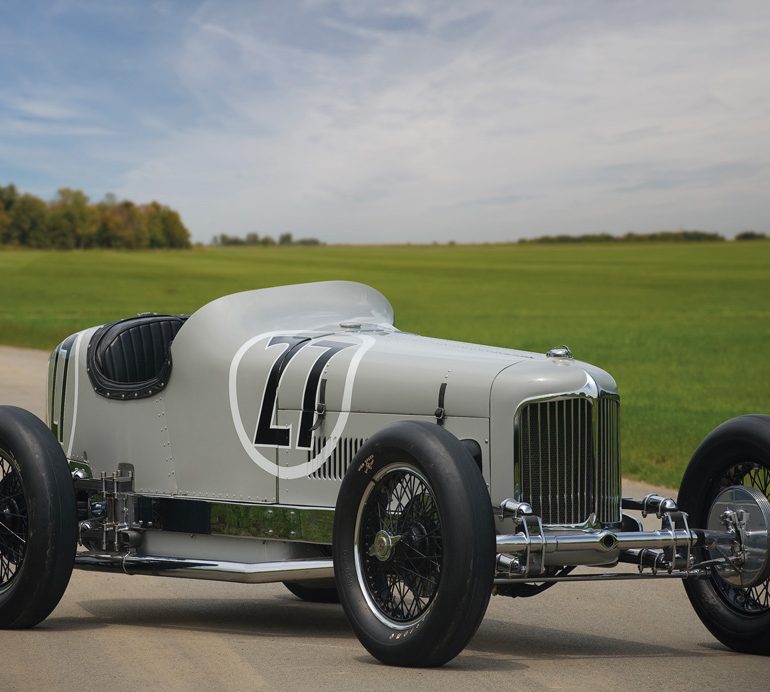
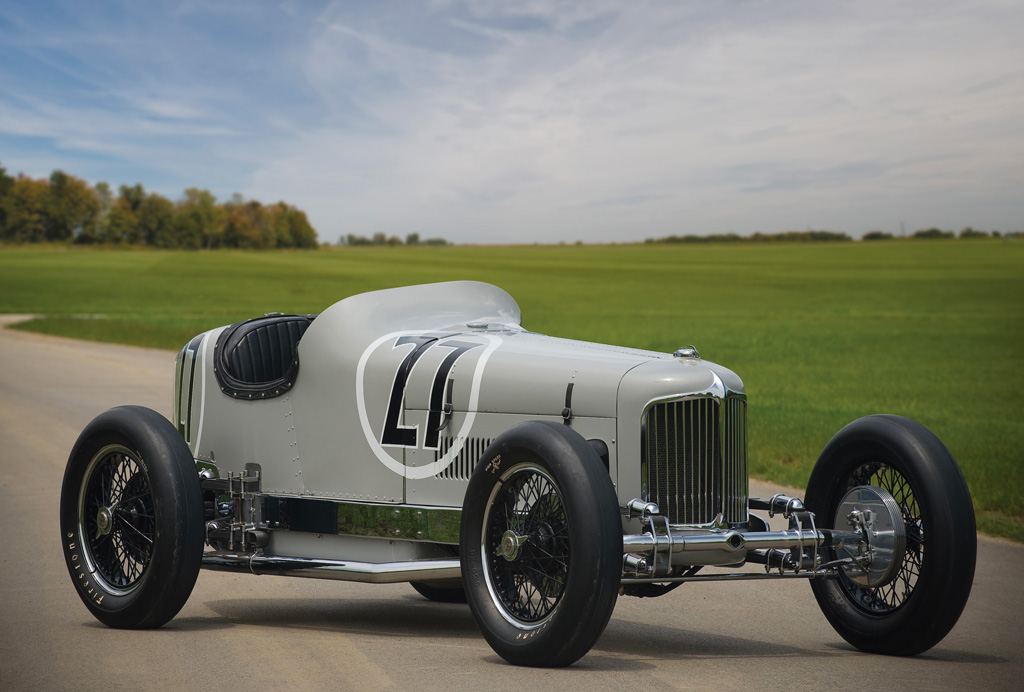
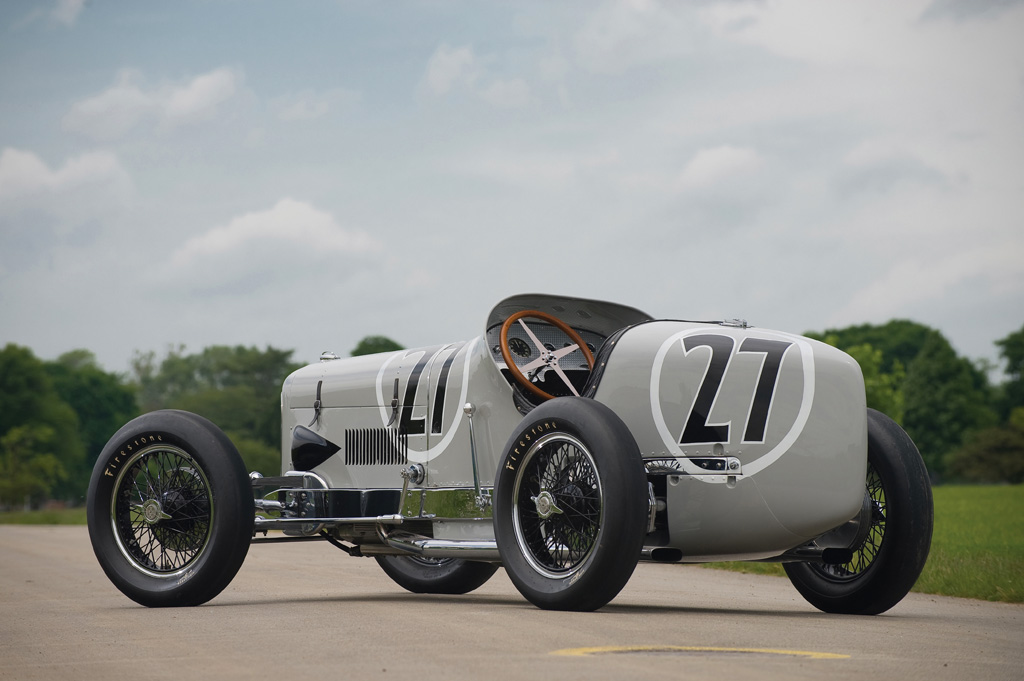
In 1931 Harry Miller decided to challenge both Cadillac and Marmon by building a sixteen cylinder engine. But unlike the these luxury-brand manufacturers, Miller’s engine was used to power a 1931 Indianapolis racecar. Miller prepared three cars for race, but only William S. White’s car had the unique V16 engine. Furthermore it also had the very high-standards of craftsmanship and design expected from Miller.
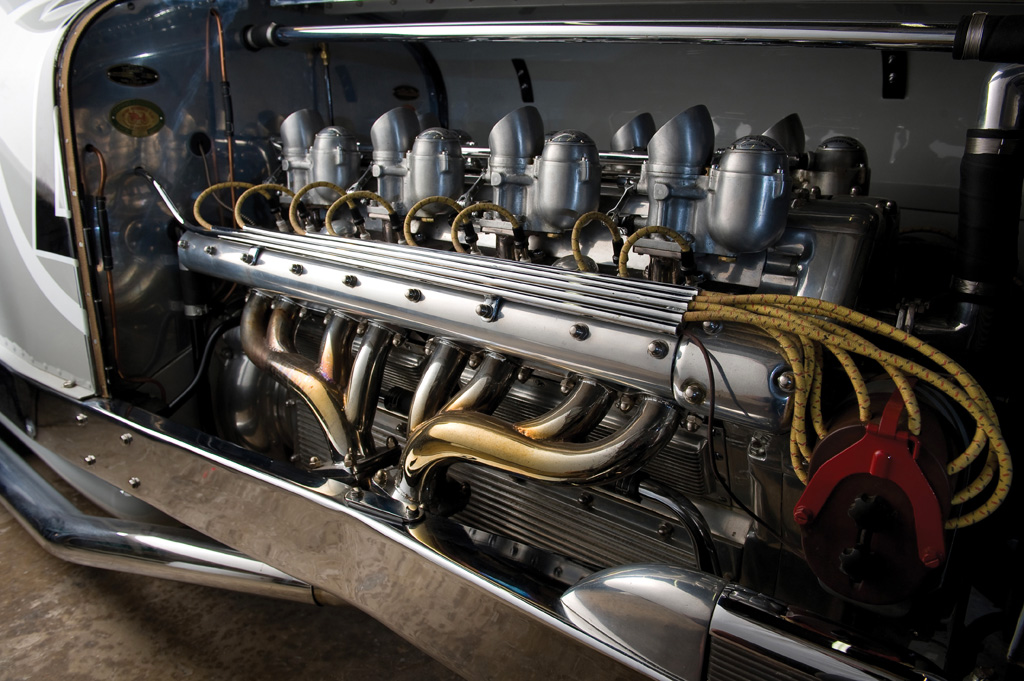
Prepared possibly as a supercar engine, Miller used his expertise pioneering front-wheel drive cars liuke the L29 for Cord. Taking the theme one step further, he decided to construct a new V16 engine that would again attach to the front wheels. The design uses two V8s end-to-end with four-piston cylinder blocks. Each of these has an integral cylinder head with dual-overhead camshafts. Eight Miller-Adamson carburetors feed the engine through siamesed intake ports.
This impressive setup achieved around 300 bhp for William S. White’s car which was simply known as the ‘Harry Miller Speedster.’ It used the complex de Dion Tube suspension to send power the front wheels. The rear was suspended in the same manner and both used pairs of quarter-elliptic leaf springs like the Bugattis of the period.
At Indianapolis Shorty Cantlon piloted this car with riding mechanic Duke Smale. They qualified 26th overall with a speed of 110.372 mph. During the first 40 laps Cantlon weaved his way through the field, reaching fourth place until carbureter trouble meant replacing all 16 spark plugs in the pit. Cantlon finished almost where he started in 27th place, but this wasn’t the last time the speedster would race.
Again the V16 Miller was prepared for the 1932 Indinapolis 500. Brian Saulpaugh known as ‘The Midwest Cyclone’ qualified 114.369 mph which was fast enough for the front row. The car was competitive, but dropped from the race after an oil line broke. Later, Harry Hartz and removed the complex V16 engine, replacing it with a four-cylinder unit for 1933 Indy. In this guise it raced until the war.
After the war, the car was basically ready for scrap. Someone had fitted a flat-head Ford, but Ed Shreve replaced it with a Maserati unit and fitted a new single-seat body. It was found this way, without it’s original engine or body for Chuck Davis and his restorer Dave Hentschel to complete. Fortunately, he was able to find the engine an engine block in two pieces and a proper crankshaft from a separate source. The rest of the castings were produced from original blueprints including the crankcase, camshaft boxes and valve covers. By the early 1990s Hentschel finished the car just in time for the 1993 Monterey Historic Races which were honoring the cars of Harry Miller.
V16 Timeline
1931-prepared for William S. White
1931-finsih 27th overall at 1931 Indy 500
1932-dnf at 1932 Indy 500
1932-sold to Harry Hartz after Indy
1932-fitted with 220in³ Miller 4-cylinder engine
1932-crashed during 150-mile event at Oakland
1933-repaired, fitted with 255 Miller 4-cyliner
1933-deadly crash at Indy 500
1934-sold to Earl Haskell
1934-10th place finish at Mines Field CA
1935-Floyd Roberts finished 4th at Indy 500
1936-Finished 6th @ Indy 500 owned by Clarence Felker
1937-Finished 13 @ Indy 500 owned by Joel Thorne
1947-Fitted with Flat-Head Ford
1947-Prepared for Indy 500, didn’t arrive
1950-Turned in ‘George Hoster Special’ with Maserati engine & new body
1950-Could not qualify at Indy 500
1973-Discovered by Bob McConnell
1980-Verified by Jim Brucker as the V16 car
1980s-Sold to Chuck Davis
1980s-Dave Hentschel restortion
1993-Restoration debut at Monterey Historics
1995-Miller Meet
2009-RM Auction Sale.
In Detail
| tags | indianapolis |
| submitted by | admin |
| type | Racing Car |
| production | 1 |
| engine | V16 |
| valvetrain | DOHC |
| power | 223.7 kw / 300 bhp |
| f suspension | De Dion Tube w/Twin Reverse Quater-Elliptic Leaf Springs |
| r suspension | De Dion Tube w/Twin Quater-Elliptic Leaf Springs |
| wheelbase | 2667 mm / 105 in |
| transmission | Miller 3-Speed Manual |
Auction Sales History
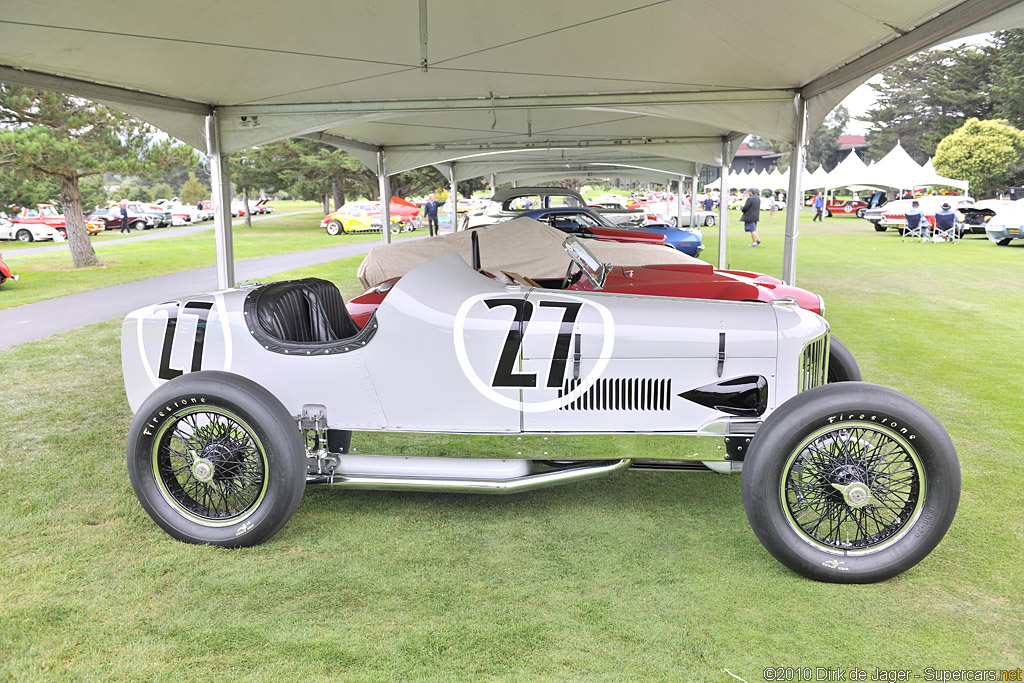
1931 Miller V16 Speedster – did not sell for $800,000
Raced at Indy in 1931 by Shorty Cantlon. Raced at Indy in 1932 by Brian Saulpaugh as the #27 car. Restored by Chuck Davis and Jim Ettner. Retains the original chassis from the firewall back. This is an original 1931 body from the sister car of its era. Engine restored and built using 1/2 of the original engine.
In 1973, collector Bob McConnell discovered the Miller, minus its V16 engine, in the small wood garage in Indianapolis that had housed it since 1950. McConnell’s research soon confirmed it was the sister car to the Hepburn-Shaw-Myer car he also owned, and he was soon persuaded by Chuck Davis of Chicago to sell him the old machine. Davis and noted restorer Dave Hentschel began the painstaking process of dismantling and cataloging the car in its entirety, and were elated to eventually confirm its provenance and history as the one and only V16 Miller race car.
Luck intervened then in the form of racecar historian Jim Etter, who had discovered what he thought was a Miller V-8 engine but soon realized was one half of the original V16, which had been cut in two to make a Sprint car engine. Etter was astounded to find that not only had almost all the severed components been saved, but a new spare crankshaft and webbings were also there for the taking. Etter bought the whole inventory and resold it to Speedway Motors owner and vintage racing engine collector Bill Smith. Ever the dealmaker, Chuck Davis eventually managed to buy the entire lot from Smith, who was notorious for resisting any and all efforts to part with even the most insignificant items in his vast inventory.
Chuck Davis had discovered that foundry expert George Parker of Monrovia, CA possessed a large group of Miller’s original wood foundry patterns and drawings, including those for the V16’s crank case, cam boxes and covers. Parker loaned the patterns to Davis, who sent them to patternmaker Art Bergstrom of Beecher, IL for reconditioning, after which they were used to pour new castings. The Bridgeview Machine Company performed the finishing work, while Dave Hentschel machined other new parts using the original Miller drawings. The completed components were then sent to Joe Gemsa of El Monte, CA, who assembled them into the brand new Miller V16.
The body panels represent yet another serendipitous chapter in the Miller V16 story. They were purchased in the 1950s by Louisville saloon owner Jack Richmond, who planned to use them in building a hot rod. Richmond never realized that particular ambition and the panels remained untouched and intact until the ever-fortunate Davis got word of their existence, tracked them to a Cincinnati collector, bought them and trucked them back to Chicago. All the pieces were there: the radiator shell, hood, cowl former and cowl panel, tail, gas tank, belly pan and rear axle tray. When Dave Hentschel affixed them to the chassis, they proved a perfect fit.
Junior Dreyer massaged the body panels back to proper form, after which Hentschel skillfully reapplied its Silver and Black 1932 livery. Dreyer also made a new gas tank and repaired the oil cooling tubes that also served a cosmetic function as the grill bars, one of the last items checked off, and not a moment too soon: the car’s astonishing journey from revolutionary race car to dismembered, scattered hulk to glorious, historical showpiece was literally completed with no time left on the clock before its reintroduction to the world at the 1993 Monterey Historic Races, where Harry Miller’s cars were honored for the very first time as the event’s annual theme.
Auction Source: 2010 Mecum at Monterey
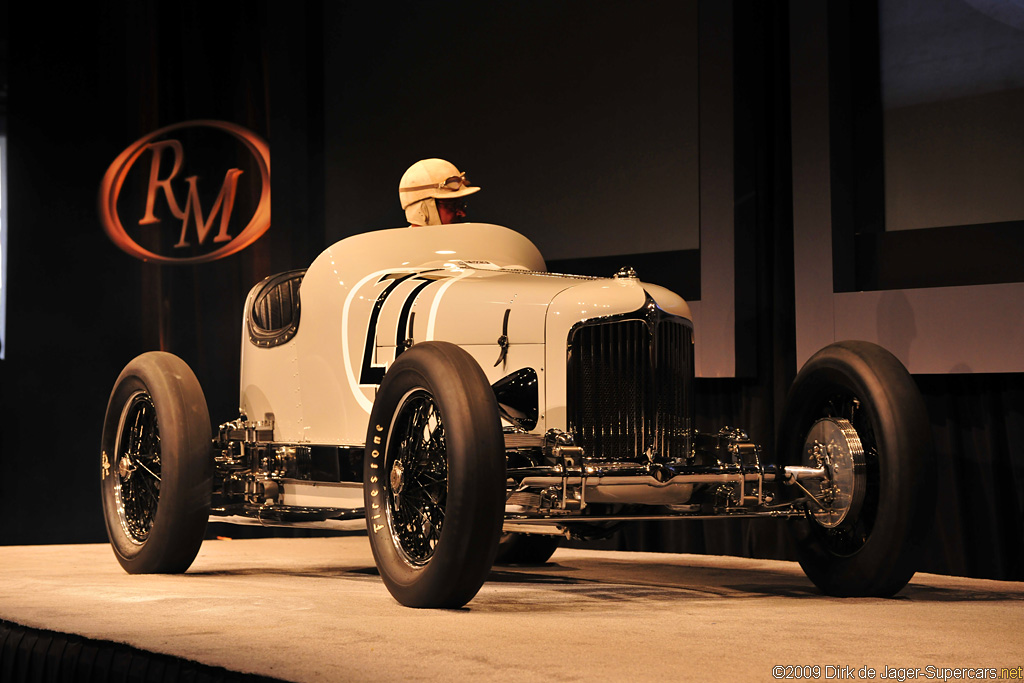
1931 Miller V16 Speedster – did not sell for $600,000 The chance to purchase a car of this caliber is a rare and unique opportunity. It is a one of a kind product of Harry Miller’s world-class creativity and design. A landmark of race car sculpture, it also is a testament to the enthusiasm and drive of Chuck Davis who played a pivotal role in the reawakening of the history of Harry A. Miller.
Auction Source: 2009 RM Auctions Sports & Classics of Monterey