

 Gabriel Voisin was born in 1880, in Belleville-sur-Saone. As a young man he studied industrial design in Lyons. In 1908, Voisin was credited with building Europe’s first manned, engine-powered, heavier-than-air aircraft capable of sustained flight.
Gabriel and his brother Charles started the company “Appareils d’Aviation Les Freres Voisin,” which became the world’s first commercial aircraft factory. At the beginning of World War I, the factory changed gears and supplied more than 10,000 aluminum planes for the war effort.
At the end of the war, Voisin had had enough of aviation. He next set his sights on building high-end luxury automobiles. During the ’30s, cars from Avions Voisin were some of the most exotic road cars of the time with many unique, aviation-inspired details. Along the way, he also created some very bizarre competition machines.
Times were, however, tough in the ’30s, and the company was eventually taken over by airplane engine manufacturer Gnome Rhone, just before World War II. After the war was over, Gabriel applied his design genius to a basic car for the everyman, the Biscooter. A multitude were built, under license in Spain as the Biscuter. But that’s not the car we are going to talk about.
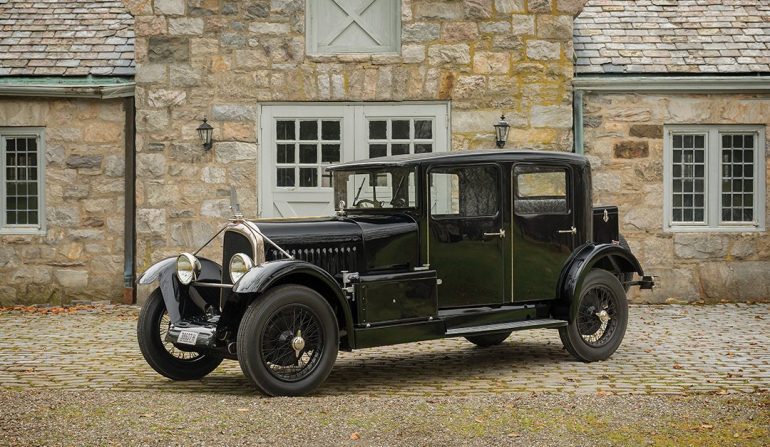
 We’re going to instead take a ride in a 1930 Avions Voisin C14 Berline. Upon first glance, the C14 looks like a large, heavy, ponderous car, but you have to remember, Gabriel Voisin understood lightweight aircraft construction well, and applied that knowledge to his designs. He created Cubist, aluminum monocoque bodies for his voitures. For the period, the C14 is quite nimble, powered by a Knight sleeve-valve, six-cylinder engine that is fully up to the task of moving you down the road. With this design, the engine is very stealthy, but it does swallow some oil, so you’re sending out French smoke signals as you tour the countryside. A pneumatic relay creates an overdrive that can be applied to all gears, turning the three forward gears into six and giving you a two-speed reverse. This was the very first type of overdrive ever offered on a car. Another unique feature was the “Dynastart,” a mechanism combining the generator and starter that was attached directly to the crankshaft, avoiding the noise of the starter motor.
 The ride is exceptionally comfortable considering the age of the car. As you travel along it’s best to keep your hands on the massive steering wheel and concentrate on the austere dash and the world outside the flat windscreen. If your eyes roam to the interior upholstery and headliner it may just trigger Art Deco acid flashback. With the Voisin of that period, you had the staid exterior color choices of grey, green-grey or black. The inside could be a whimsical, eye-spinning chaos of patterns, but somehow this divergent mixture of calm and storm work to announce you are witnessing a very different automobile.
Outside, the colors may be restrained, but the C14 is awash in a multitude of details, from the Flying Buttress-like braces meeting at the angular winged mascot at the front, to the delicate piano hinges and beefy handles on the doors with a completely original mechanism, to the “I hope they see them!” miniature brake lights at the back. All these things keep this very “Horseless Carriage” auto looking very modern for the day.
 These cars were built by a truly forward-thinking individual. An artisan of the highest order.
His creations stood out then and they definitely stand out now.
My thanks to Jim Chun for letting me take a drive into the past.
–Sean Smith