
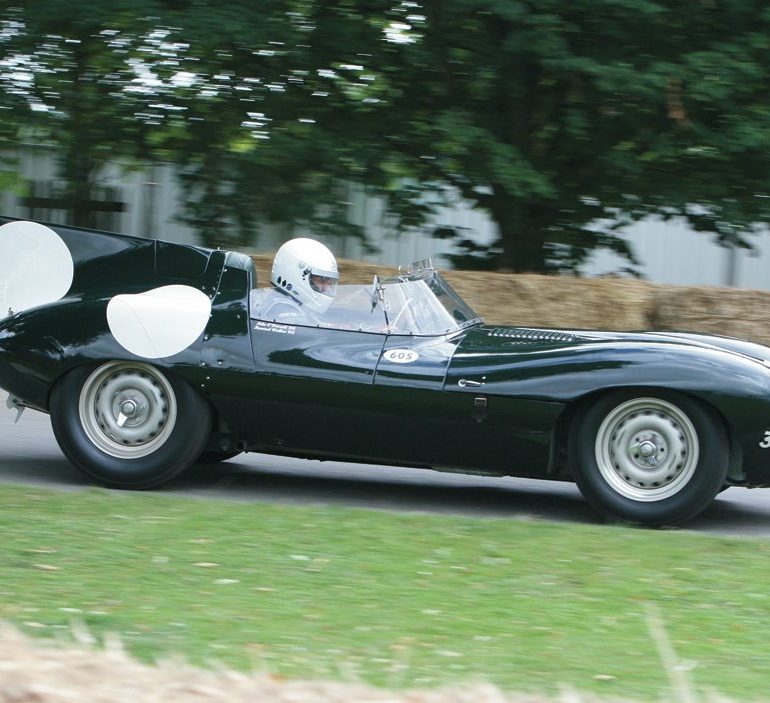
I worked for Jaguar from 1952 to 1986 as Chief Test and Development Engineer. Throughout that time I drove some really interesting and special cars, but nothing compares to the 1955 long-nosed D-Type Jaguar, a car that I drove flat out down the Mulsanne Straight at Le Mans—192 mph—passing Karl Kling in the Mercedes as I did so, what a fantastic feeling! For 1955, 192 mph wasn’t bad either, it was pretty quick. It was a beautiful car, of course, at Jaguar we’d done a great deal of work on the disc brakes, as at the speeds it was capable of it was good to know you could stop just as quickly. It must be remembered that 1955 was a terrible year for the Le Mans race with poor old Levegh getting killed in the Mercedes 300 SLR. Many have said that Jaguar was wrong and disrespectful for carrying on racing. My answer to that was, and is today, a race doesn’t stop until you see a black or red flag—that’s an indication that the officials wish to stop the race. A racing driver is programmed to race until the car lets him down, mechanically or by accident, or the officials stop the race in the proper fashion. There were no red or black flags following Levegh’s accident.
Mercedes-Benz carried on racing until they had a message from officials at their HQ to stop. While Mercedes withdrew from the race, I have always thought that it was totally disrespectful for them to leave the circuit prior to seeing and meeting the race officials. Apparently, the Le Mans race officials visited the Mercedes team hotel at around 5 o’clock on the Sunday morning, only to be told that the team had left…lock, stock and barrel. I’ve always asked myself what was that? Why did Mercedes run away? Those questions have never been properly answered. To me, Mercedes’ disappearance was far more disloyal to the situation than ever Jaguar was accused of. Many too, have tried to lay the blame and use Mike Hawthorn as a scapegoat for the accident occurring—especially the late John Fitch. He says he saw what happened, but how could he? He was in the pits a long way from the start of the accident and having his view well and truly obscured by the pits and grandstand buildings—it was impossible for him to see anything at all from his viewpoint. It most certainly wasn’t Mike Hawthorn’s fault, and if you care to see the film The Deadliest Crash, you will appreciate what I’m saying is right—no matter how John Fitch likes to think about it. I’ve been asked if Hawthorn was affected by the incident? My honest reply is, “No!” He was as affected as most of us were by the terrible loss of life through motor racing, but he was not the cause and shouldn’t have had to endure the finger pointing that followed.
Today, I’m an ambassador for Jaguar and still have the opportunity of driving some of the best vehicles they’ve produced. Nevertheless, and as I initially said, nothing compares to the 1955 Jaguar D-Type—my greatest racecar.
As told to Mike Jiggle