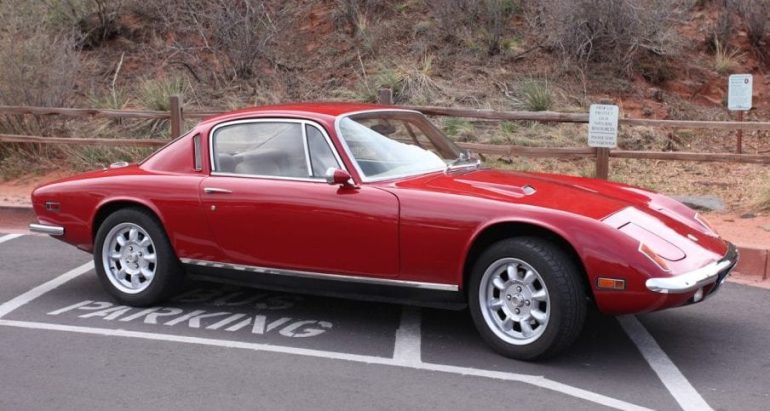
In May 1968, my former wife and I traveled by train, ferry and again by train from Pirmasens, Germany, to Norwich, England. Our purpose was to pick up our new 1968 Lotus Europa at the factory in Wymondham, near Norwich. We had a few adventures along the way, thanks to a train crash in Germany before we got on, that turned an 18-hour trip into a 36-hour one. We were quite happy to finally find a bed and breakfast in Norwich. The owners were wonderful and even called the Lotus factory to announce our arrival. The next day, a car was sent to take us to the factory to see our Europa in the last stages of its build. That car was a red Lotus Elan +2. I had never heard of, or seen, a +2, and I wondered if it was too late to exchange our Europa for one of those sleek beauties – it was. For nearly 50 years, the thought of that car remained lurking in my brain. As I aged, I wondered if I could get in and out of one. In April 2017, I found out, thanks to the excellent forums on the Lotus Ltd. Club website. I posted that I wanted to do an article on a +2 and found two nice ones in Colorado – one original and the other upgraded to a Zetec engine and Spyder chassis.
Lotus stand, circa 1967, showing the Elan, Europa and Elan +2.
The Type 50, or Lotus +2 as it was called in factory brochures, had a run from 1967 to late 1974. Nearly 5,200 were produced during that time. It was the first pure Lotus to have more than two seats, and it was the first Lotus without a kit version being offered. It was predated by the Lotus Cortina, but that was a Ford saloon modified by Lotus. The +2 was to be a “family” car, with seats for two children in the back, or in our case, one 5’6” woman sitting cross-wise. The +2 had a chassis that was 1-foot longer, track 7-inches wider, and overall length 23-inches more than the Elan. It had the same engine, comparable suspension and a similar, albeit longer, steel backbone chassis as the Elan. It was also 315 pounds heavier, but the effect on performance wasn’t nearly as bad as it might have been because the car was much more aerodynamic (Cd=0.30) than its smaller sister. Carburetion was initially by twin Webers and then by twin Dellortos at the end of production, although the U.S. federalized versions used Strombergs.
The latest supercar news, rumors, reviews and more delivered to you each week. Cool supercar stuff only. No crap, we promise.
Members only$29 / year
Keep going. This is where it gets good.
Supercars.net Membership is for people who'd rather know the spec sheet by heart than skim ten headlines. The rest of this story — and every other one like it — is a few seconds away.
Thousands of members-only stories
Deep dives, driven reviews and the full archive back to 2005.
No ads. None.
The whole site reads like a magazine, on every device.
Every car, every spec
Twenty years of models, numbers and history in one place.
30% off the shop
Every Supercars.net shirt and piece of merch, all year.
$29 a year. Cancel anytime, no hoops. Already a member? Sign in
BY CAR PEOPLE, NOT A NAMELESS MEDIA COMPANY. Your membership keeps a small independent team that celebrates the brands and cars that defined this industry doing this.