
Long before the Bugatti Veyron became the 1,001-horsepower machine that rewrote the rules of automotive performance, a handful of pre-series cars carried the burden of turning an impossible dream into reality. One of them, Chassis 5.1, has now stepped back into the spotlight, revealing one of the most fascinating untold stories in modern supercar history.

Presented at the 2026 Concorso d’Eleganza Villa d’Este by its new owner, the rarely seen pre-series Veyron is far more than an early prototype. It is one of the machines that helped shape the production Veyron itself, the car that effectively created the hypercar segment as we know it today.

Built as one of only six pre-series examples before customer production began, Chassis 5.1 served as a crucial development and validation platform during the Veyron’s formative years. At a time when Bugatti engineers were attempting to achieve what many believed was mechanically impossible, combining 1,001 horsepower, 400 km/h performance, luxury-car refinement, and everyday drivability, 5.1 became one of the program’s most important tools.

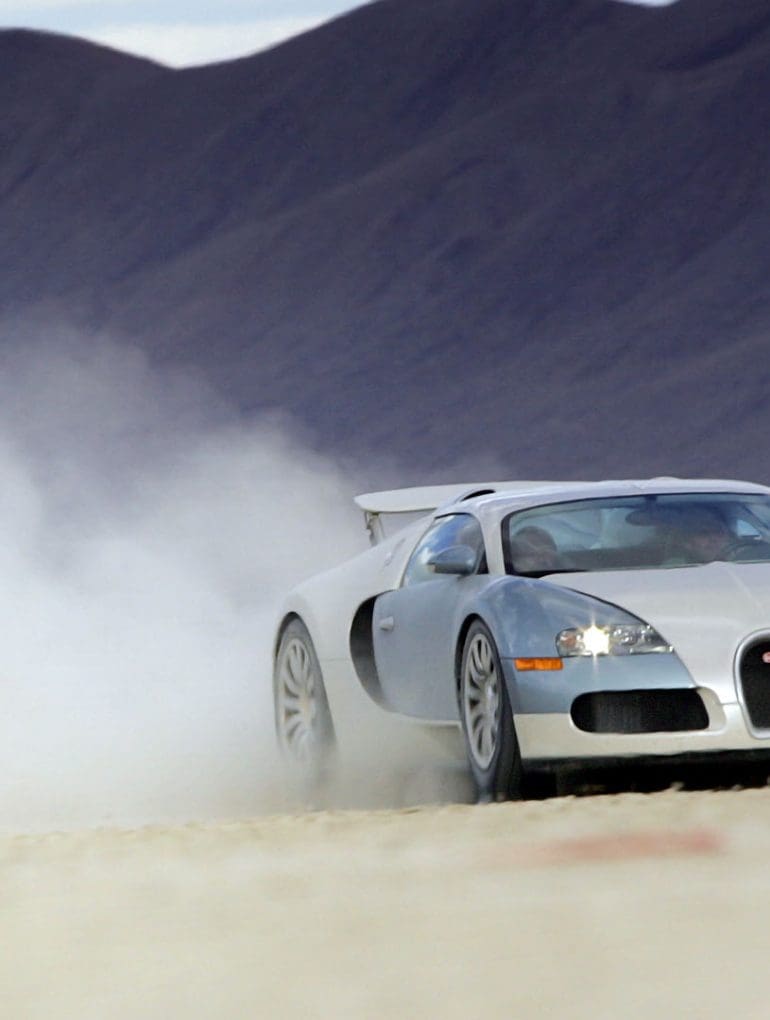
The car underwent brutal high-speed and endurance testing on Nevada’s salt flats, where extreme temperatures and relentless mechanical stress pushed the Veyron’s revolutionary engineering to its limits. Among the key figures involved during this phase was Dr. Wolfgang Schreiber, the engineer instrumental in developing the Veyron’s groundbreaking seven-speed dual-clutch DSG transmission, a gearbox capable of handling the monstrous output of the quad-turbocharged W16 engine.

By September 2005, Chassis 5.1 transitioned from pure development prototype to public ambassador. Registered in Germany, the car was dispatched to Sicily for the Veyron 16.4’s first major international dynamic media event. Journalists and clients from around the world experienced the Veyron on both road and track, while iconic photographs captured Ferdinand Piëch, the visionary behind the Veyron project, inside the very same car, witnessing his ambitious vision finally become reality.

Over the years, 5.1 evolved through several configurations as Bugatti refined the Veyron toward its final production specification. Interior trims changed, engine bay details evolved, and aerodynamic elements were updated to mirror the eventual customer cars. The prototype toured North America extensively, appearing at prestigious events including Pebble Beach, The Quail, and private Bugatti showcases, transitioning from development mule to rolling symbol of automotive excess and engineering ambition.

By 2008, after accumulating more than 21,000 kilometers during its intense working life, Chassis 5.1 returned to Molsheim for its final transformation. There, Bugatti fitted authenticated production-specification components, effectively turning the once hard-worked prototype into a customer-ready Veyron while preserving the historical traces of its extraordinary past.

Now, through Bugatti’s La Maison Pur Sang certification and heritage program, the complete history of Chassis 5.1 has been painstakingly documented and authenticated. Rather than restoring away its story, Bugatti chose to preserve it, the wear, configuration changes, testing history, and archival documentation all forming part of the car’s identity.

That authenticity made it one of the standout attractions at Villa d’Este 2026, where it appeared in Class H: “The Pace Race: The Supercar Comes of Age.” Surrounded by icons from every era of Bugatti history, including an EB110 GT, a Type 37, and a rare Type 57C Aravis, the Veyron prototype stood as the bridge between Bugatti’s historic legacy and the dawn of the modern hypercar age.

What makes Chassis 5.1 truly special is that it was never meant to become a collector’s trophy. It was built to solve problems, survive punishment, and help create a car that changed the automotive world forever. Today, it survives not simply as an early Veyron, but as a living witness to the birth of the hypercar era.