
A bespoke Fuoriserie masterpiece unveiled during the 2026 Mille Miglia pays tribute to the legendary Tipo 26 and the origins of Maserati’s iconic emblem.
As automotive brands increasingly look to their heritage for inspiration, Maserati has delivered one of the most meaningful commemorative projects of recent years. Unveiled in Modena during the passage of the 2026 Mille Miglia, the one-off MCPURA Cielo Tributo 1926 marks the centenary of the Trident logo with a stunning, highly personalized specification that bridges the gap between Maserati’s racing beginnings and its modern supercar era.

More than just a special paint scheme, the unique open-top supercar serves as a rolling tribute to the car that started it all: the legendary Tipo 26.
A Century Since the First Trident
The story begins on April 25, 1926. On that day, Maserati founder Alfieri Maserati lined up for the Targa Florio behind the wheel of the Tipo 26, the first car to carry the now-famous Trident emblem on its bonnet. That race marked the birth of Maserati as a motorsport manufacturer and launched a legacy that would span Grand Prix racing, endurance competition, and some of Italy’s most celebrated road cars.

One hundred years later, Maserati has chosen to honor that milestone with a bespoke creation commissioned through its Fuoriserie customization division. The result is the MCPURA Cielo Tributo 1926, a one-off supercar designed to embody the spirit, aesthetics, and significance of the original Tipo 26 while showcasing the capabilities of Maserati’s modern personalization program.

The timing of the handover was carefully chosen. The car was delivered to its owner at Maserati’s Modena showroom as the 2026 Mille Miglia passed through the city, connecting the brand’s past and present through one of Italy’s most revered automotive events.
A Design Inspired by 1920s Motorsport
At first glance, the MCPURA Cielo Tributo 1926 immediately stands apart from any standard MCPURA.
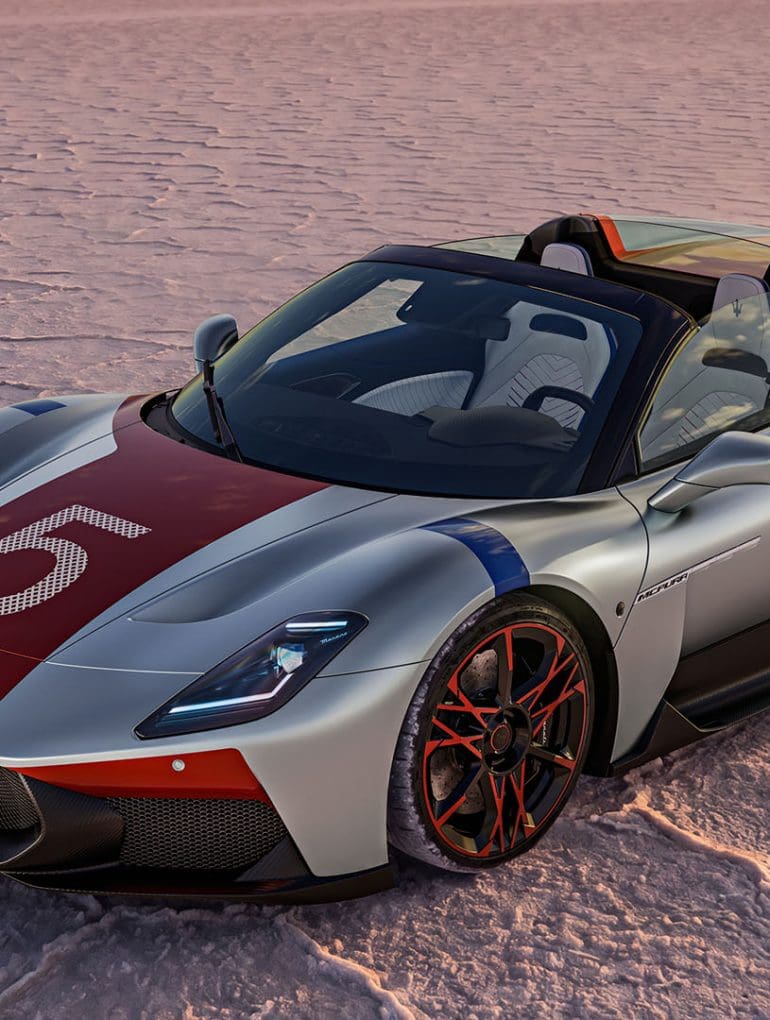
Its body is finished in Grigio Lamiera Matte, a sophisticated matte grey chosen to evoke the raw metal bodywork used on racing machines of the 1920s. The historic inspiration continues through a bespoke livery incorporating Rosso Capannelle, Blu Infinito, and Bianco Pastello, creating a visual identity that feels both period-correct and unmistakably modern.

The centerpiece of the design is the faithful recreation of the original Tipo 26 badge positioned on the bonnet. This detail establishes a direct visual connection between the racing car that launched the Maserati legend and the carbon-fibre supercar celebrating its centenary.
The historic Trident logo appears prominently on the nose, B-pillars, and various exterior elements in Bianco Pastello, accompanied by Fuoriserie branding finished in matching paintwork.
Further enhancing the car’s visual drama are diamond-cut 20-inch Cyclonic wheels featuring red-painted surfaces that mirror the livery’s color accents. Black brake calipers provide a subtle contrast, while visible carbon-fibre components from the Exterior Carbon Package reinforce the model’s performance-focused character.

One particularly thoughtful detail can be found on the tonneau cover, where designers combined two interpretations of the Trident: the contemporary logo and Mario Maserati’s original 1926 design. It is a symbolic representation of a century of evolution without abandoning the brand’s roots.
The tribute extends to the door badges, which feature the signatures of both Alfieri Maserati and legendary mechanic Guerino Bertocchi, key figures in the company’s earliest racing successes.
A Cabin Blending Luxury and Heritage
Inside, the MCPURA Cielo Tributo 1926 continues its heritage-inspired narrative while maintaining the premium craftsmanship expected from a modern Italian supercar.

The cabin features exclusive Fuoriserie specifications, including embroidered Trident logos on the headrests and an extensive use of carbon-fibre trim through the Interior Carbon Package. Luxury features include heated seats and Maserati’s premium 695-watt Sonus faber High Premium audio system with 12 speakers, delivering an experience that combines grand touring comfort with supercar performance.

Practical technology has not been overlooked either. The car is equipped with the Driver Assistance Pack and a front axle lift system, ensuring that the exclusive machine remains usable in everyday driving conditions.
The Power of Fuoriserie
While the Tributo 1926 celebrates the past, it also serves as a showcase for Maserati’s future-facing approach to customization.
The Fuoriserie program allows clients to work directly with Maserati’s design team to create highly personalized vehicles tailored to individual tastes and stories. From unique paintwork and bespoke interiors to one-off graphics and historical tributes, the division has become an increasingly important part of the brand’s strategy.

This project also falls under Maserati’s broader BOTTEGAFUORISERIE philosophy, which combines traditional Italian craftsmanship with modern technology and advanced manufacturing techniques to produce vehicles that are often impossible to replicate.
Celebrating the Year of the Trident
The MCPURA Cielo Tributo 1926 forms part of Maserati’s wider “Year of the Trident” celebrations, marking 100 years since Mario Maserati created the company’s most recognizable symbol.

Inspired by Bologna’s famous Fountain of Neptune, the Trident was conceived as a representation of strength, power, and ambition. It quickly became synonymous with Maserati’s racing cars before evolving into one of the most recognizable emblems in the automotive world. A century later, the logo remains at the heart of the brand’s identity—and few modern Maseratis embody that heritage more effectively than this extraordinary one-off creation.

The MCPURA Cielo Tributo 1926 is not simply a commemorative special edition. It is a carefully crafted bridge between 1926 and 2026, reminding enthusiasts that while technology, performance, and design continue to evolve, the spirit that defined Maserati’s very first racing car remains alive within the Trident today.