
1922 Duesenberg
More words have been written about Duesenberg per “car”-pita than any other marque in the history of the automobile. For an astonishingly short period of 25 years, and after producing fewer than 1,200 cars, the last of which was finished almost three quarters of a century ago, the Duesenberg has more than outlasted the test of time.
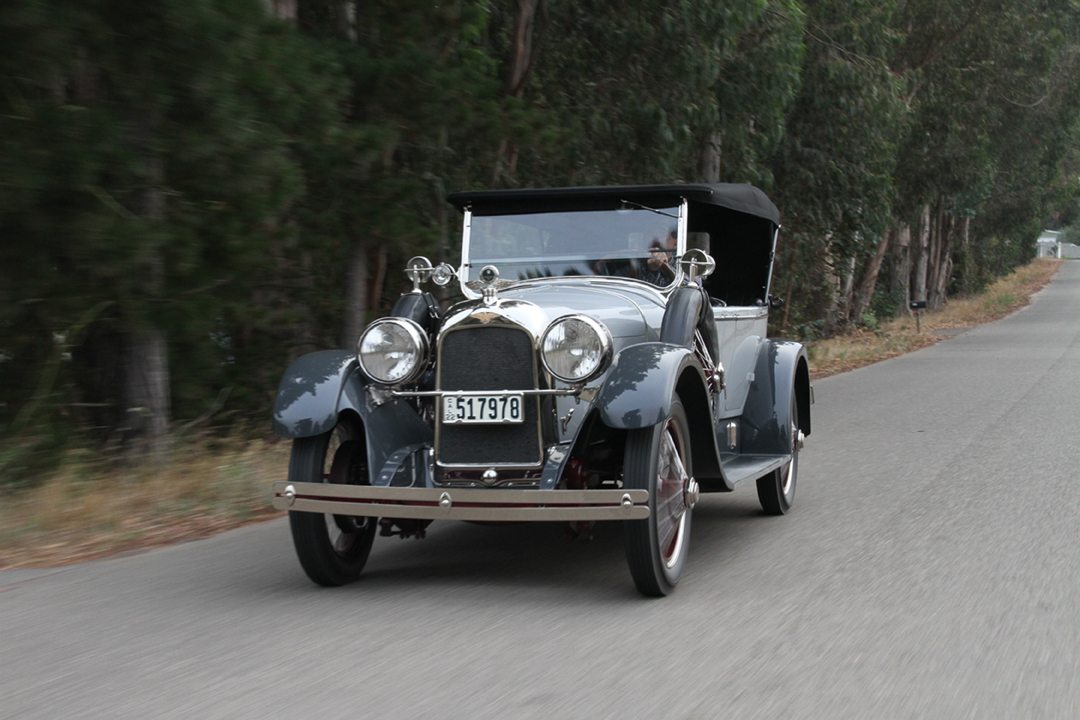
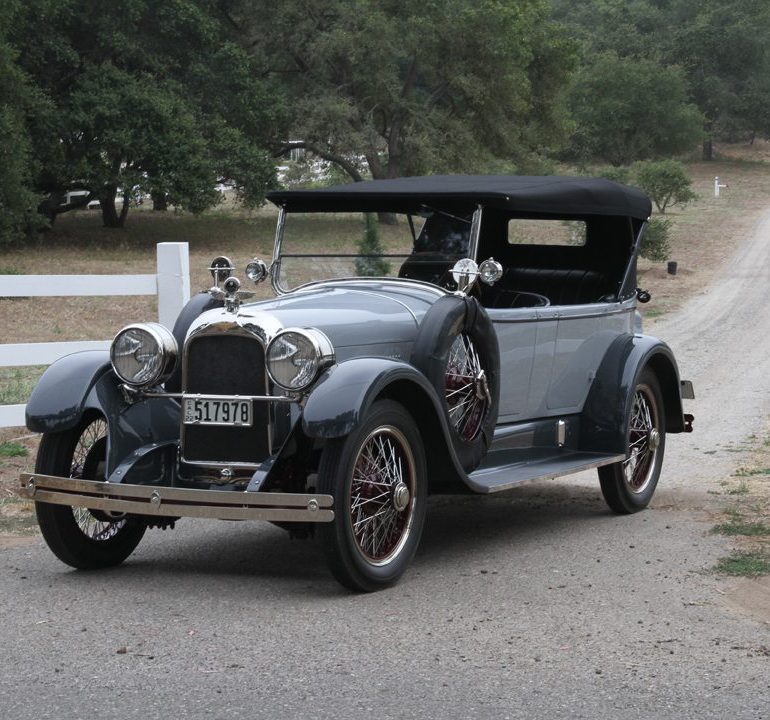
Our featured 1922 Duesenberg Model A—body number 798, engine number 1111—isn’t as sexy or as valued as its younger S, SJ or SSJ siblings but the Model A is considerably rarer, and probably the closest to Fredrick and August Duesenberg’s automotive vision of making a fast and reliable automobile.
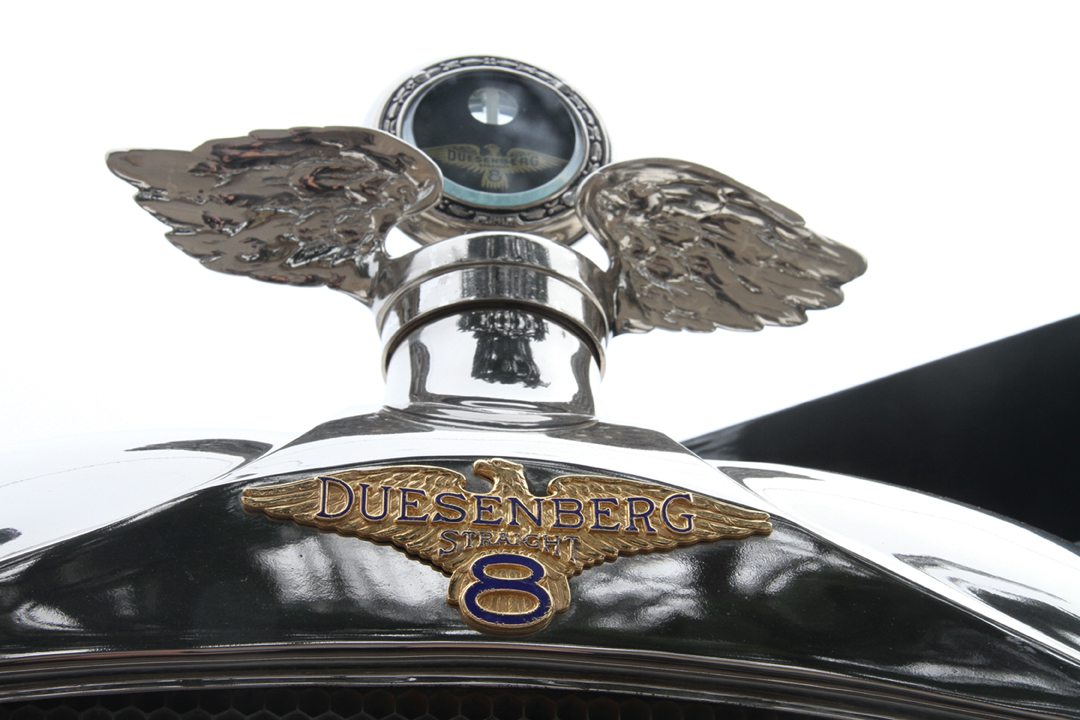 While Henry Ford created the assembly line for the Model T a decade earlier, the Duesenbergs used old-fashioned craftsmanship in the creation of their automobiles. Unlike the later J and SJ Duesenbergs whose engines were made to Duesenberg designs by Lycoming, the Model A’s engines were built completely by Duesenberg craftsmen. After the new engine was mated to the chassis, the bare chassis was driven at speed around the Indianapolis Speedway for hundreds of miles to make sure that the engine would withstand the scrutiny of their discriminating buyers. Only after passing this test would a finished car be assembled and given a warranty of one year; that is, so long as you paid the shipping to and from the Duesenberg facility if repairs were required.
To set the record straight, calling this series of Duesenberg a Model A is actually a historical reference and didn’t apply when the car was first sold. In 1922, a well-heeled buyer would purchase a “Duesenberg” or potentially a “Duesenberg Straight 8” or an “8-in-a-row,” but he would never have requested a “Model A.” Future automotive enthusiasts would start using the “Model A” designator after realizing that every component of the car was stamped with an “A” preceding the casting number.
 One advertised reliability test pitted a new Model A against a non-stop “cross country” trip. Duesenberg drivers raced a Model A around the Speedway track for the simulated 3,155-mile trip without stopping except for tire changes. Even then, the car’s engine was kept at 3,000 rpm to simulate a running condition. Imagine adding fuel or changing drivers without stopping. This is exactly what they did. At times reaching speeds in excess of 100 miles per hour and sometimes changing drivers at speeds slightly slower, they finished the trip 105 hours after starting, with an average speed of 30 miles per hour.
Prior to making any passenger cars, Duesenberg made racecars. From 1913 through 1934, at least one Duesenberg raced in every Indianapolis 500 race with drivers like WWI flying ace Eddie Rickenbacker and racing legend Ralph DePalma. On a glorious Memorial Day, in 1920, seven Duesenbergs started the Indianapolis 500. Five of the cars finished in an impressive 3rd, 4th, 6th, 9th and 10th place, besting even the great Ralph DePalma, this time driving a Ballot. For the next 14 years, Duesenberg answered the call for speed in Indianapolis, and at least one car always finished the race. On three occasions, Duesenberg cars won the race outright, and on what must have been an incredible Memorial Day race in 1922, eight Duesenbergs started the race and seven finished, taking seven of the top ten slots (2nd, 4th through 8th and 10th place). In this year, DePalma got smart and placed 4th in, what else, a Duesenberg. DePalma would never better this finish in his remaining Indy races.
 Today’s automotive consumer has maybe three dozen domestic and international car makers to select from when buying a new car. However, in 1922, there were literally hundreds of manufactures to choose from. Trying to get a buyer’s attention through traditional advertising was an expensive proposition and most of these new automakers didn’t have the money to elevate their brand above the noise. Duesenberg used a tactic that is very effectively used today by companies like Ferrari: let the news media, through racing results and hype, sell your product. Following its great success on the track, Duesenberg embarked on manufacturing cars for the average buyer. Well, maybe not average in that their cars were about 20 times the cost of the Model T of the day, and a Model T couldn’t be driven at 100 miles per hour.
The racecar engines were actually smaller than the 260-cubic-inch consumer engines, but they shared the same design with overhead valves and the philosophy that a small displacement engine at high rpm was better than a large displacement engine at low rpm. The Duesenberg brothers weren’t trained engineers, but they knew why certain things worked. For instance, the Duesenberg Model A was the first engine to utilize aluminum alloy pistons because they knew that decreasing rotational weight provides for increased horsepower, and if you have a car that is fast you must find an efficient way to stop it. This is why the Duesenberg Model A was the first car to employ four-wheel hydraulic brakes at a time when most manufacturers were still using two-wheel mechanical brakes. Finally, to save on overall weight, many of the engine components and car bodies were made out of aluminum. In hindsight, this decision would seal the fate for nearly all the Model A Duesenbergs, as two decades later most of the Model As would sacrifice a few hundred pounds of this precious metal to the war effort. Of the approximately 650 Duesenbergs made between 1921 and 1926, only 35 complete cars have been discovered. Let us hope that hidden in barns somewhere, a few more will eventually materialize.
 It’s incredible that this beautiful example came close to being lost to history as well. The original owner of this car is unknown and the known history of this car doesn’t start until after WWII, when it was known to have been used as a pickup truck with the rear body section removed. Then, at some point in the ’50s or ’60s, a hot rod of sorts was created by grafting the rear section of a ’26 Pontiac onto the front section after removing seven inches of the rear frame in the process.
For years, the car languished in a large collection until fate would turn its course when, in 2004, the car was eventually purchased, “sight unseen,” by the notable collector Robin Onsoien. Mr. Onsoien was attending an auction with the intent to re-purchase a formerly owned 1925 Cadillac. In the end, Mr. Onsoien didn’t purchase the Cadillac, but he did purchase a 1925 Duesenberg. Then, at the same event, he was approached with the opportunity to purchase the 1922 Model A seen here. This fortuitous pairing of dueling Duesenbergs allowed Mr. Onsoien to piece together the 1922 car while also restoring its 1925 shop-mate.
Once back in Southern California, Mr. Onsoien began the first part of any restoration project: research. It was quickly determined that the bodies on both Duesenbergs were made by Millspaugh & Irish Co. It wasn’t until the introduction of the J and SJ models that custom/ bespoke car designs became popular. With the Model A, a customer had limited choice of body styles from companies like Millspaugh & Irish or Fleetwood and Brunn. In many cases, the chassis was built and tested and the bodies were mated to the chassis at the Duesenberg facility before delivery to the customer.
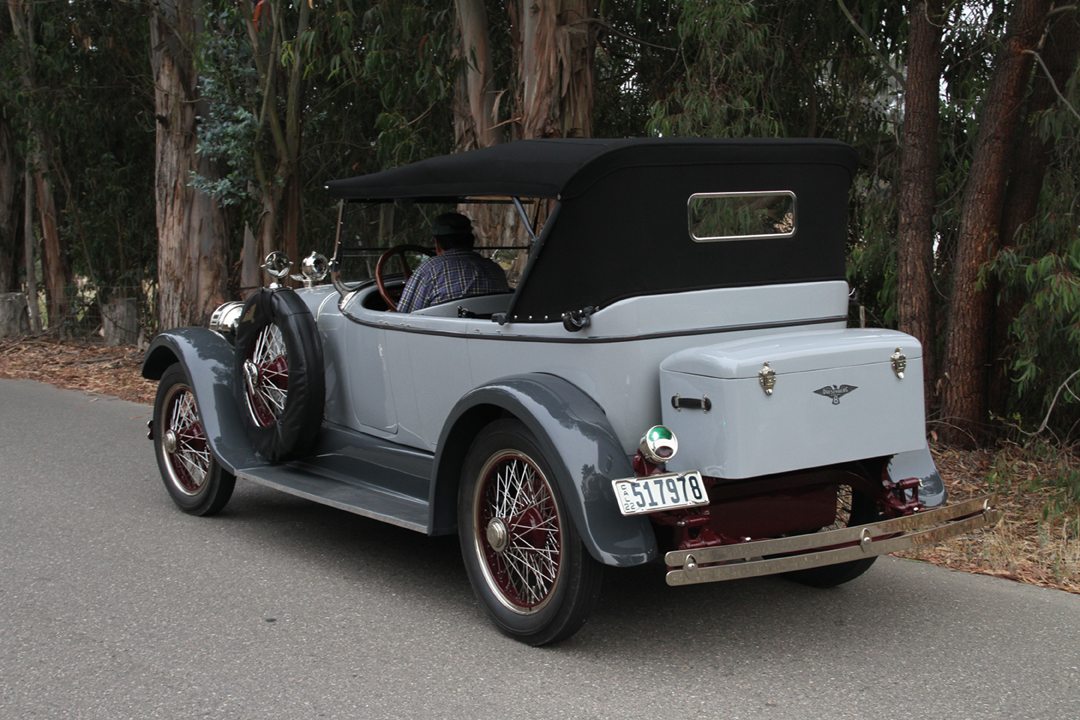 While Mr. Onsoien’s 1922 and the 1925 Duesenbergs were both phaeton bodies, there were enough differences that he couldn’t simply copy the one to complete the other. Undaunted, Mr. Onsoien found the appropriate sample to act as a pattern for the rear section. With the car completely disassembled and the correct front section set aside, the missing seven inches of frame needed to be recreated and welded back to the front section of frame. Luckily, whoever attacked this car with a saw 50 years earlier must have liked the differential and braking system of the original Duesenberg because it was still being used. Elongating the frame and driveshaft was considerably easier than finding a correct Duesenberg differential, axle and rear brakes.
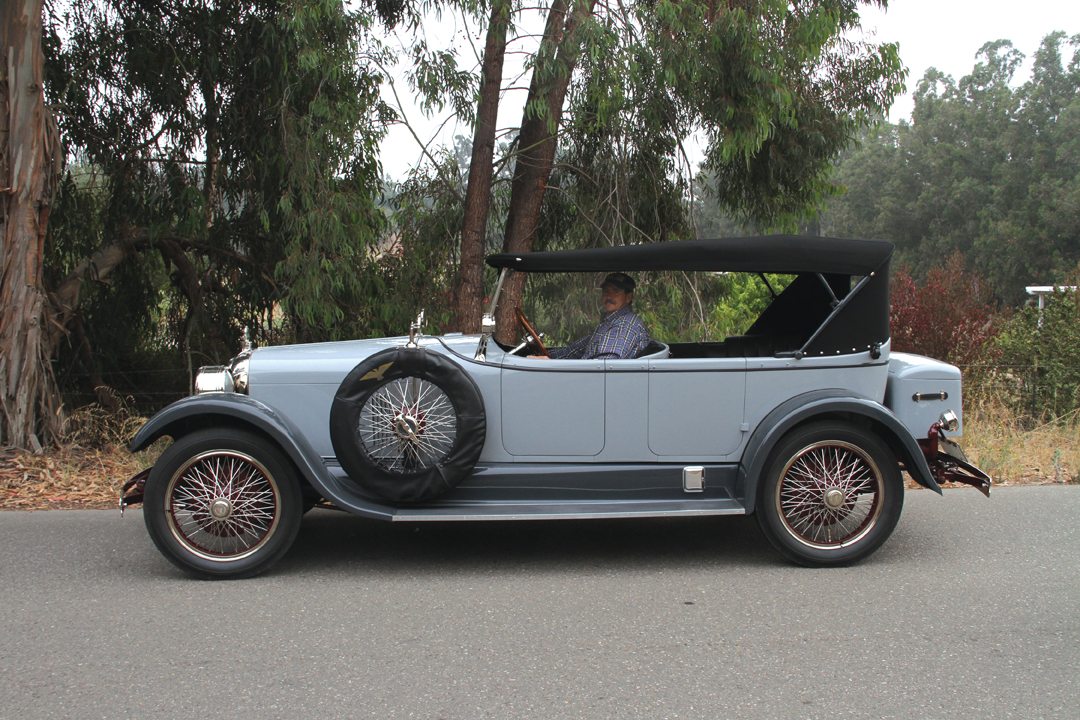
With the car sitting on its original 134-inch wheelbase, the entire rear section of the Duesenberg was authentically recreated with traditional aluminum over wood framing and painted in a correct two-toned grey/dark grey finish. The top, on a nickel-period phaeton, is typically a structure of complexity, geometry and frustration. For most restorations, the fabric is replaced, the wood is refinished and the cast-iron parts are repainted. Since no remnant of a top survived, all of the components needed to be refabricated and fitted for both the up and down position. This is a task only to be undertaken by a person with a doctorate in mathematics and a more than casual interest in origami.
Following a six-year restoration, Mr. Onsoien displayed the 1922 Duesenberg at the 2010 Pebble Beach Concours alongside other notable nickel-era cars. When competing with the best of the best, perfection is often objective and in this case, a disagreement on polishing was the difference between receiving coveted ribbon and/or simply enjoying the honor of recognition and experience of the world’s greatest car event. Regardless of the outcome, there is no doubt that this car is spectacular, and as Mr. Onsoien has shown over a dozen cars at Pebble Beach and has taken home many awards, this outcome was rather superfluous.
 To drive a Duesenberg Model A is to step back in time with perfection. I was surprised at how easy it was to drive this car. Even though this car is less than a decade away from its centennial anniversary, I was soon driving a very civilized and surprisingly modern-feeling vehicle after going through a short list of pre-starting steps.
Later Duesenberg models were known for their extensive instrumentation. This Duesenberg was more minimalistic with a need-to-know view of information. The most curious gauge, however, is something you don’t see on cars very often: a brake pressure gauge. To understand its function, you need to understand the public image of this new fangled method of bringing vehicle to a halt. For literally centuries, a fulcrum and friction was used to stop a rotating object. The application of pressure to the fulcrum increased the amount of friction to said object resulting in the object stopping (or in most cases, slowing it down at least). The cause and effect of this simple mechanism was completely understood by even the simplest of folk. When Duesenberg introduced hydraulic fluid into this mechanism, a third element, water, came into the pictured that couldn’t be seen or heard, so how do you know it’s working? The brake pressure gage was the mechanism by which a driver could test this unseen element to be assured that when the brake pedal was pressed, friction would be appropriately applied and the car would stop. Prior to driving the car, I pressed on the brake pedal to make sure that 500 pounds of pressure could be maintained. The things we take for granted today weren’t always that way.
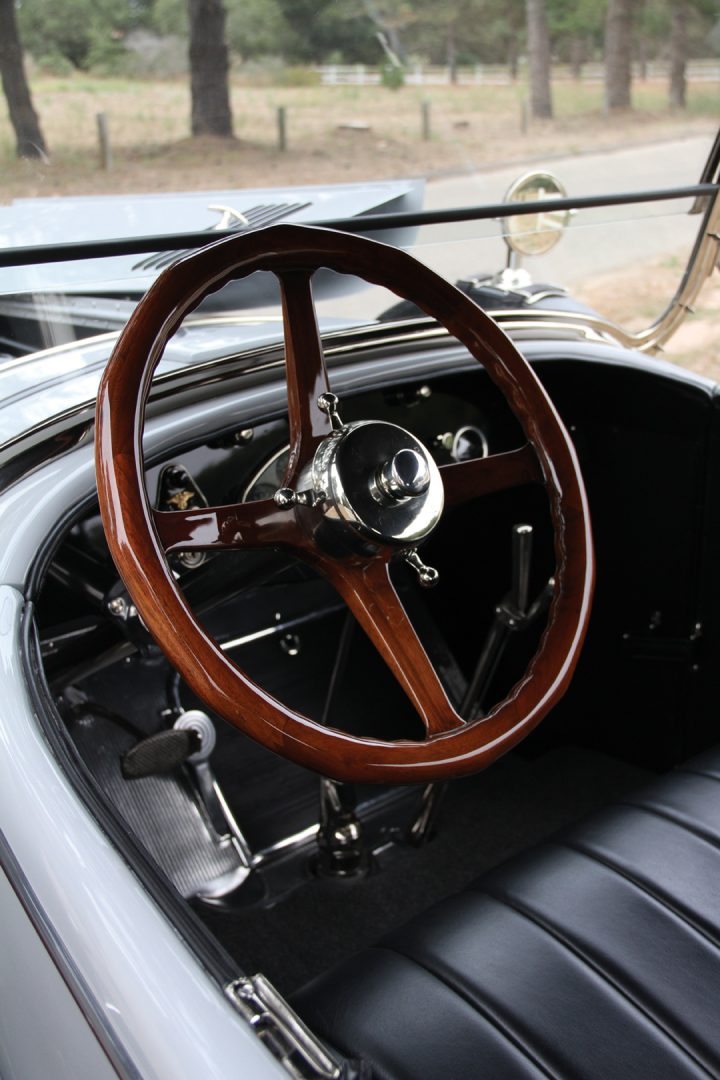
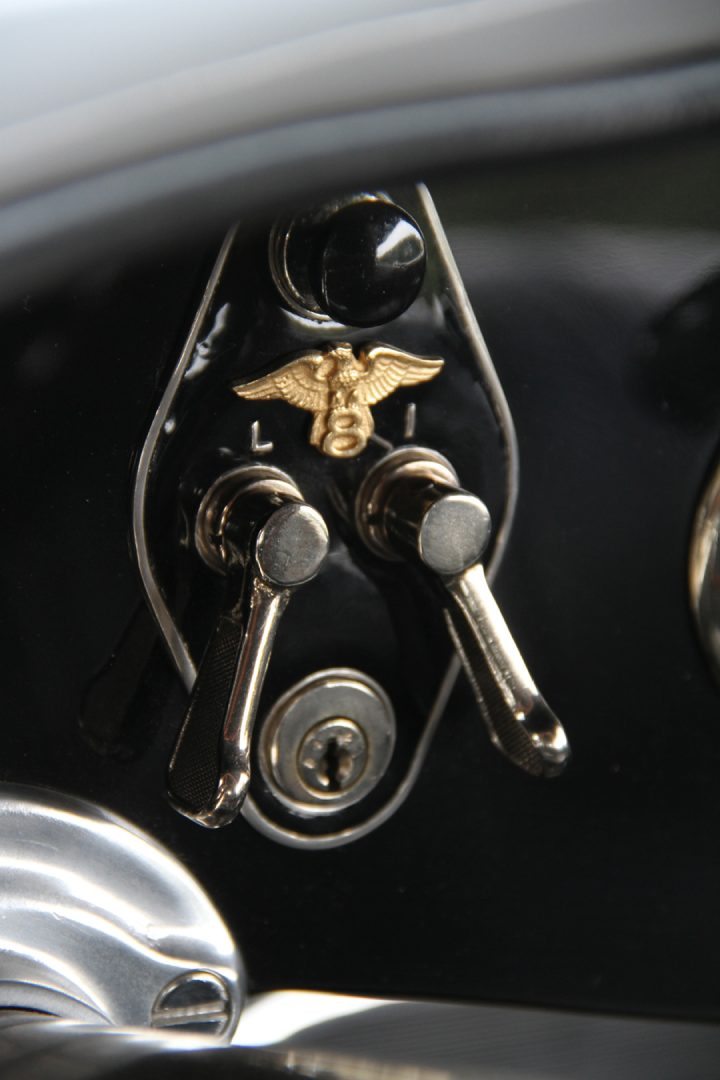
With the assurance that I’d be able to stop this grand vehicle, I turned the dash-mounted ignition switch to on. While the switch does have a key, the key is used only to prevent the ignition switch from turning. With the ignition on, I pulled the choke knob, retarded the spark advance on the steering wheel-mounted lever, pressed the floor-mounted starter switch with my right foot while feathering the throttle pedal with my left foot. With very little effort, the engine burst to life. With some additional practice, I’ll bet I could operate the starter switch and pedal with one foot.
I immediately set the spark level to full advance where the mechanical advance mechanism took over the spark timing. After letting the car warm up for a minute or two, I pushed the choke knob into the dash. With very little leg strength, I depressed the clutch and maneuvered the shift lever into first gear. The mechanical clutch engaged between one and two inches off the floor. Without any hesitation, the 91-year-old car moved forward with a grace and acceleration you’d expect from one many decades newer. It’s hard to imagine that at the time when this Duesenberg was made, Ford was still producing the Model T. No automotive comparison can be made with today’s vehicles to illustrate the differences in performance and handling between these two ends of the automotive spectrum in 1922. Only after WWII could cars be compared appropriately to the abilities of this vehicle.
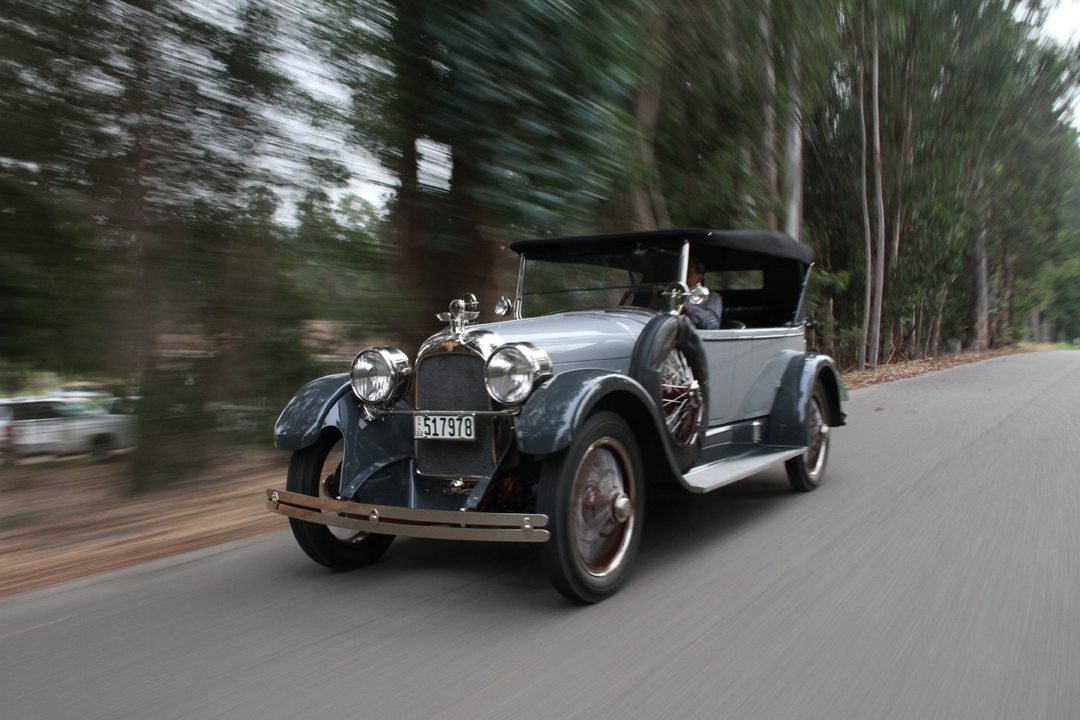 At about 20 mph, I shifted the car into second gear and again enjoyed the sound and acceleration of the straight-8 engine. At around 40 mph, I shifted into the third and final gear. Although the top speed of the Duesenberg was advertised at 100 mph, they obviously never tested that speed with the top up. At around 60 mph, the top starts to assume the characteristics of a wing. Driving at 60 or 70 miles per hour in the ’20s was probably a rarity, but today it would be quite common, and while the engine, transmission and brakes serve this car well, the folding top is another matter. Before driving on the freeway, the top must be stowed, lest you risk having it removed like a toupee in a wind storm. At 60 mph, the tachometer showed 2,000 rpm. With another 2,000 rpm available, it’s easy to see how 100 mph could have been comfortably attained.
With the car at speed, I was able to test the braking power of the hydraulic brakes, and I could see how a driver could easily lock up all four wheels were he to apply enough pressure. In 1922, a car skidding to a stop must have been greeted with thoughts of extreme mechanical failure rather than purposeful design. With the confidence in stopping afforded the driver by a braking system of this type, it’s hard to believe it took a few more decades of automotive evolution before most drivers experienced this level of braking power.
 In 1922, if you wanted a luxury car, you purchased a Rolls-Royce. If you wanted a performance car, you purchased a Duesenberg. With this Duesenberg, there are very few nods to luxury: there is no heater, only one vacuum windshield wiper, no interior lighting of any kind and the front seat cannot be adjusted. To make it “weather-tight” takes the application of eight side panels. Each door has its own side panel that opens with the door. As there are no interior door handles, Millspaugh & Irish was thoughtful enough to equip each door panel with a small access door through which one could slip their arm enough to reach the outside door handle. As advanced as this Duesenberg is, you have to wonder why someone didn’t think of inside door handles.
The most complicated portion of the interior is the steering wheel. As stated earlier, the steering wheel contains a spark advance lever, but there is also a throttle control that was typically used for starting purposes, but could be used to maintain a certain speed on a level surface. On this multi-function steering wheel there is also a dimmer level that adjusts the intensity of the headlights. Drivers for decades have been used to adjusting between high beams or low beams, but this is quite different. The driver can dim the headlight like they’d dim the lights inside their home. I’m not sure why this was important, but it was an interesting feature in a car lacking features.
 The Model A is a very nimble driving car thanks to its reduced weight due to the excessive use of aluminum. Turning the wheel of any car while moving is rarely difficult. Most power steering-equipped modern cars gradually reduce the power assist as speeds increase. In older cars, it’s the turning of a wheel when not in motion that separates the well-designed car from the one driven by a circus muscle man. The Duesenberg is definitely in the former category. I was pleasantly surprised at how easy it was to maneuver this car in any condition. After a while, I became quite comfortable driving it and almost forgot that I was driving a car made when Warren G. Harding was president. Weather-worthiness aside, I could see driving this car around town on a regular basis, and would only miss my satellite radio.
After years of service as a passenger car, years of toil as a pickup truck, years of excitement as a hot rod, years languishing in a field and years being reborn, this beautiful rare Model A will now spend years being admired and studied for generations to come.