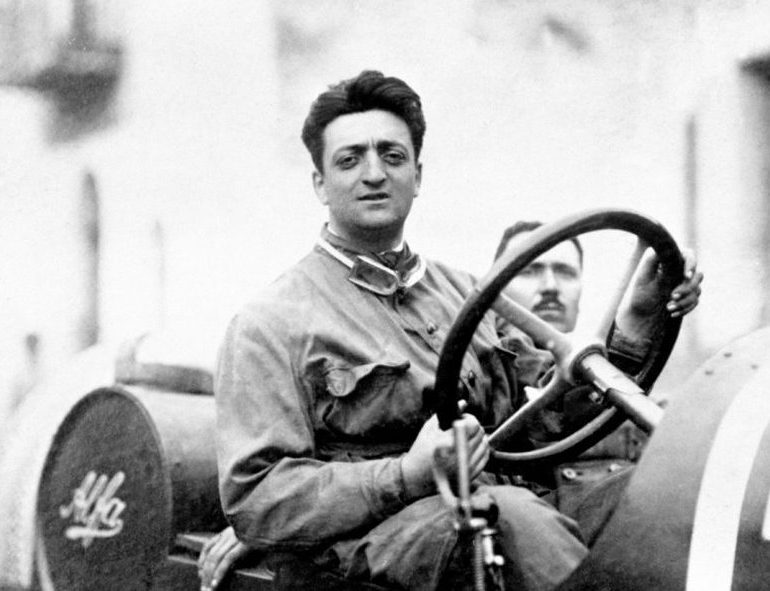
With Ferrari being the featured marque at this month’s Monterey Historic Automobile Races, we thought it would be interesting to take a somewhat unconventional look at what is perhaps the world’s most famous racecar manufacturer. As such, in this issue we examine the history of Ferrari’s first 3-liter Grand Prix cars, the influential role that Luigi Chinetti’s NART team played in the creation of the Ferrari name, and the unusual politics and intrigues suffered by many Ferrari drivers, as seen through the eyes of Derek Bell and 1964 Ferrari World Champion John Surtees. However, it is nearly impossible to examine the history of the cars without also taking time to explore the man who created them Il Commendatore, Enzo Ferrari. However, this always posses certain complications.
Ferrari was born the son of a structural engineer near Modena, Italy on February 18, 1898. Though his early ambition was to become an opera singer, by age 10 he had attended his first race and was soon committed to becoming a racecar driver. After World War I, Enzo landed a job with CMN (Construzioni Meccaniche Nazionali), which afforded him the opportunity to occasionally fill in as a test driver. By 1919, Ferrari had competed in his first race, the Targa Florio, in which he finished 9th. By the following year, Ferrari had moved to Alfa Romeo as a driver and soon began winning races, including an underdog victory in the 1923 Circuit of Ravenna, after which the parents of Italian flying ace Francesco Baracca presented him with a shield bearing the now-famous prancing stallion, which was Baracca’s flying insignia. Ferrari was so honored that he used the “cavallino rampante” on the foreground of the shield of Modena, and the rest became automotive history.