

From 1964-1978, a series of flat-bottomed formula cars were manufactured to serve as stepping stones to Formula One and the upper echelons of open-wheeled racing. In the late ’50s, Formula Two and Formula Three were consolidated into Formula Junior, but with that category’s demise at the end of 1963, F2 was reformed utilizing highly developed 1000-cc, fuel-injected engines until 1966. From 1967 to 1971 racecars manufactured for F2 were equipped with a more powerful gear-driven Cosworth FVA engine, while in the U.S. many of the same chassis were being outfitted with Lotus twin-cam engines for what was known as Formula B. By 1972, F2 graduated up to 2-liter displacement, with engines being manufactured by firms such as Cosworth, Hart and BMW. During this same period, Formula Atlantic replaced FB, both in the U.S. and overseas, with similar chassis to the F2 cars, but running the belt-driven 1600-cc Cosworth BDA or BDD engine.
Though various models were sold in both F2 and Atlantic form, the F2 cars today command a much higher value due to their more sophisticated and expensive engines. The value of these F2 variants is also bolstered by the fact that they were usually driven by some of the greatest current or up-and-coming F1 drivers of the day, names such as Jackie Stewart, Jochen Rindt, Niki Lauda, Emerson Fittipaldi and the like.
1972 McLaren M21 F2
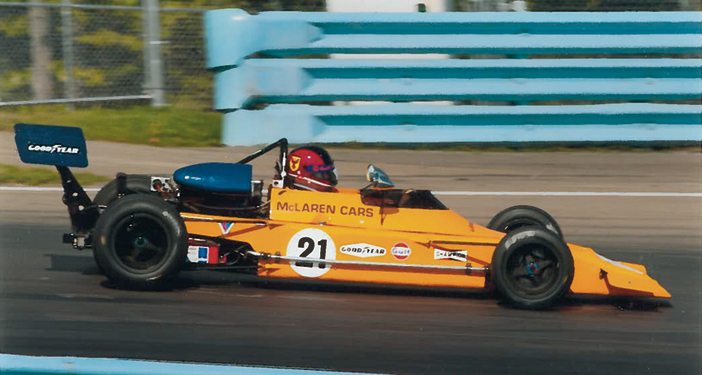 From the humble beginnings of Bruce McLaren Motor Racing in 1963, the McLaren racing team and Grand Prix car constructor emerged to win numerous drivers and constructors Grand Prix World Championships. In that time there were some outstanding, but less recognized, cars designed by some brilliant designers and driven by some rising stars. One such car was the beautiful 1972 McLaren M21 Formula Two car that took McLaren back to the F2 series in 1972. It was designed by Ralph Bellamy, at the time part of the Gordon Coppuck design team along with a young John Barnard. Keep in mind Bellamy was also responsible for the M14 and M19 Formula One cars, not to mention the talents of the other designers. The M21 was a monocoque design with a sleek angular body with front and rear wings. Suspension, shocks, brakes were outboard with lower wishbones front and rear. The engine was a Cosworth BDA unit, and the gearbox a Hewland FT200. Just one car was entered by McLaren for a young South African talent, Jody Scheckter. Scheckter drove brilliantly to win at Crystal Palace and secure a racing future in Formula One. Formula Two was a very competitive series with cars entered by March, Brabham, Tecno and Lotus, and driven by numerous future World Champions. In this context, the M21 was not just a beautiful car, but a winning car and an example of the engineering and design skills of Team McLaren.
1971 Palliser-Winklemann WDB FB
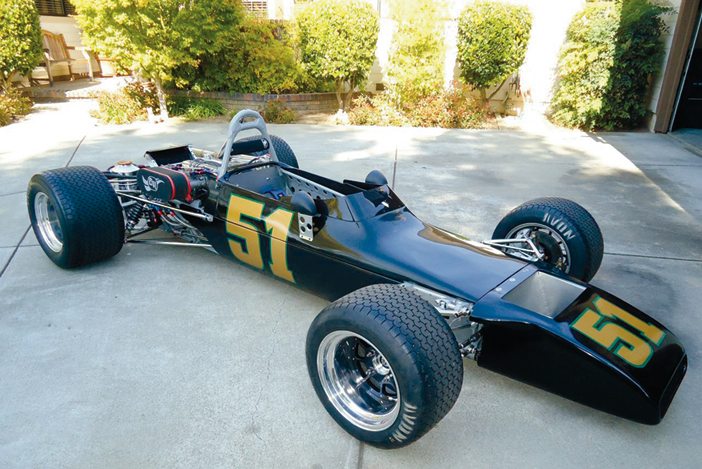 The Palliser-Winklemann single seat racecar started in a little garage in London, yet full of ingenuity, talent and passion and, with finance from noted English driver and airline pilot Hugh Palliser Kingsley Dibley, it grew to have its own degree of racing success in England and the USA! Former Brabham and Lola designer Len Wimhurst designed a sturdy tubular space frame single-seat chassis in 1967 that would accommodate a tall driver. It was called the Palliser after Dibley’s middle name, and Palliser Racing Design was formed. Dibley, a friend of northern Californian racer Robert Winklemann, formed an agreement to have the racecars sold in the USA as Winklemann’s through Robert Winklemann Racing Ltd. The initial car, a Formula Libre, was followed by the WDF1 a Formula Ford, and then later the successful WDB Formula B, which stood for Wimhurst-Dibley Formula B. The tubular space frame was well built, power was from the Lotus 1.6-liter twin-cam mated to a Hewland 5-speed gearbox. Suspension was outboard, wishbone and adjustable. In England in 1971 Vern Schuppan won the Formula Atlantic title against Brabham, Lotus and March, putting the little company on the racing map. In the USA the cars went to a variety of racers from Winklemann and Phil Reilly in California, Carson Baird in the north west and Rudolfo Junco in Texas—all of whom are historic racing enthusiasts today. As the oil crises of the early 1970s came about, Hugh Dibley sold his interest in the company to Robert Winklemann who in turn sold the company in 1973 to Mark Konig and Ian Heath who had the Nomad company. So the Palliser became the Winklemann, and the Winklemann became the Nomad, and the rest is history. For more information on these great cars one can go to www.pallisercars.com. If you see one at the track, please cheer the owners on as they are an example of a great time in motorsports history where the creative spirit was unleashed and success followed.
Criteria Used For Assessing Valuations for this Guide:
- Degree of Originality
- Overall Condition, Restoration
- Technology, Design, Coachbuilder
- Production Numbers/Rarity
- Competition History
- Ownership History, Documentation
- Modern Event Eligibility
Regional Variances
The prices stated in this guide are based on U.S. values. The values of historic racing cars can vary as much as 25%-35% in other countries, depending on local market appeal, currency rates, import duties, and VAT. Most of the time, we are able to document known sales or closed escrows, as they say in real estate. When this is not possible, a logical estimate of the car’s value is given, based on its sales history and relationship to cars of its type.
The prices stated in this guide are based on U.S. values. The values of historic racing cars can vary as much as 25%-35% in other countries, depending on local market appeal, currency rates, import duties, and VAT.
LEVEL |
VALUATION CATEGORIES |
|---|---|
I |
The best combination of all criteria. |
II |
Satisfies mid-range of criteria. |
III |
In need of restoration. Meets only a few points of criteria |