

At Northern California’s famed Thunderhill Raceway, automotive journalist Jason Cammisa assembled three of the most technologically advanced supercars on the market to answer a fascinating question: has electrification fundamentally changed the formula for performance supremacy?
The contenders could hardly be more representative of the modern supercar landscape. Lamborghini’s all-new Temerario arrives as the successor to the Huracán, abandoning the naturally aspirated V10 that defined the brand’s entry-level model for more than two decades. In its place is a 4.0-liter twin-turbocharged flat-plane-crank V8 paired with three electric motors, producing a staggering 907 horsepower.
Ferrari counters with the 296 GTS, a plug-in hybrid powered by a turbocharged 3.0-liter V6 and rear-mounted electric motor generating a combined 818 horsepower. Standing apart from the hybrid revolution is the McLaren 765LT, a lightweight, rear-wheel-drive supercar that relies solely on its twin-turbocharged V8 and minimal mass to deliver performance.
Using Thunderhill’s level front straight and scientifically instrumented testing methods, the trio were subjected to a series of drag races on standard, non-prepped asphalt. The results highlighted how dramatically performance engineering has evolved.
The Lamborghini immediately established itself as the benchmark. Its sophisticated “Thrust Mode” launch control system combines preloaded electric motors, boosted turbochargers, and all-wheel-drive traction to deliver explosive acceleration. The Temerario blasted to 60 mph in just 2.2 seconds and completed the quarter-mile in 9.6 seconds at 146 mph, placing it among the quickest internal-combustion-powered production cars ever tested.
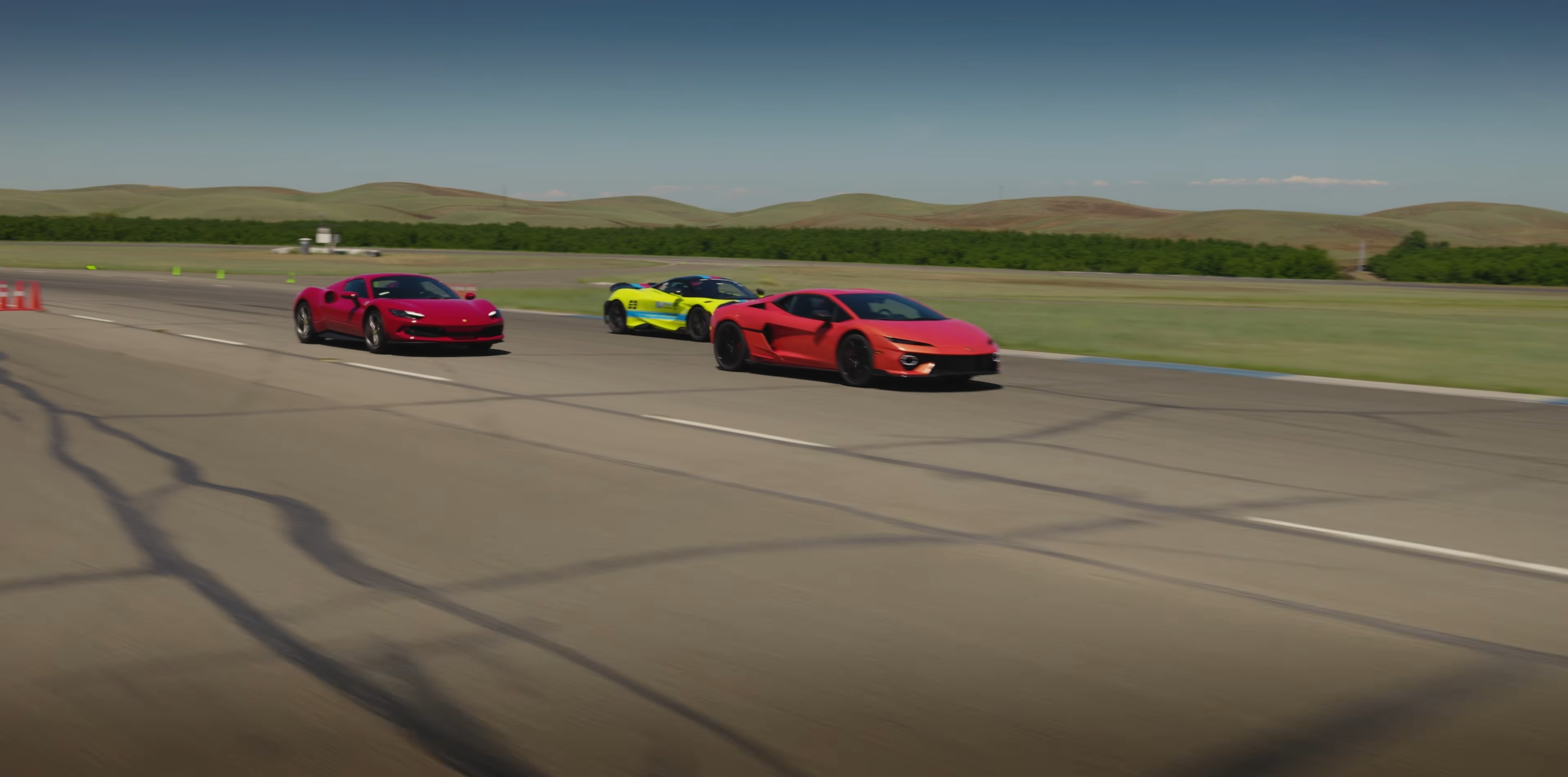
While the Ferrari 296 GTS could not match the Lamborghini’s devastating launch, it proved remarkably competitive once underway. Analysis of the acceleration data revealed that, beyond the initial traction advantage, the Ferrari accelerated at nearly the same rate as the Temerario. Its hybrid-assisted V6 delivered exceptional power density and impressive mid-range thrust despite sending all 818 horsepower exclusively to the rear wheels.
The McLaren 765LT demonstrated the enduring advantages of lightweight engineering. Weighing roughly 1,000 pounds less than the Lamborghini, the British supercar actually held a slight edge in power-to-weight ratio. However, its rear-wheel-drive layout left it vulnerable during the critical first moments of acceleration, ultimately determining the race outcome.
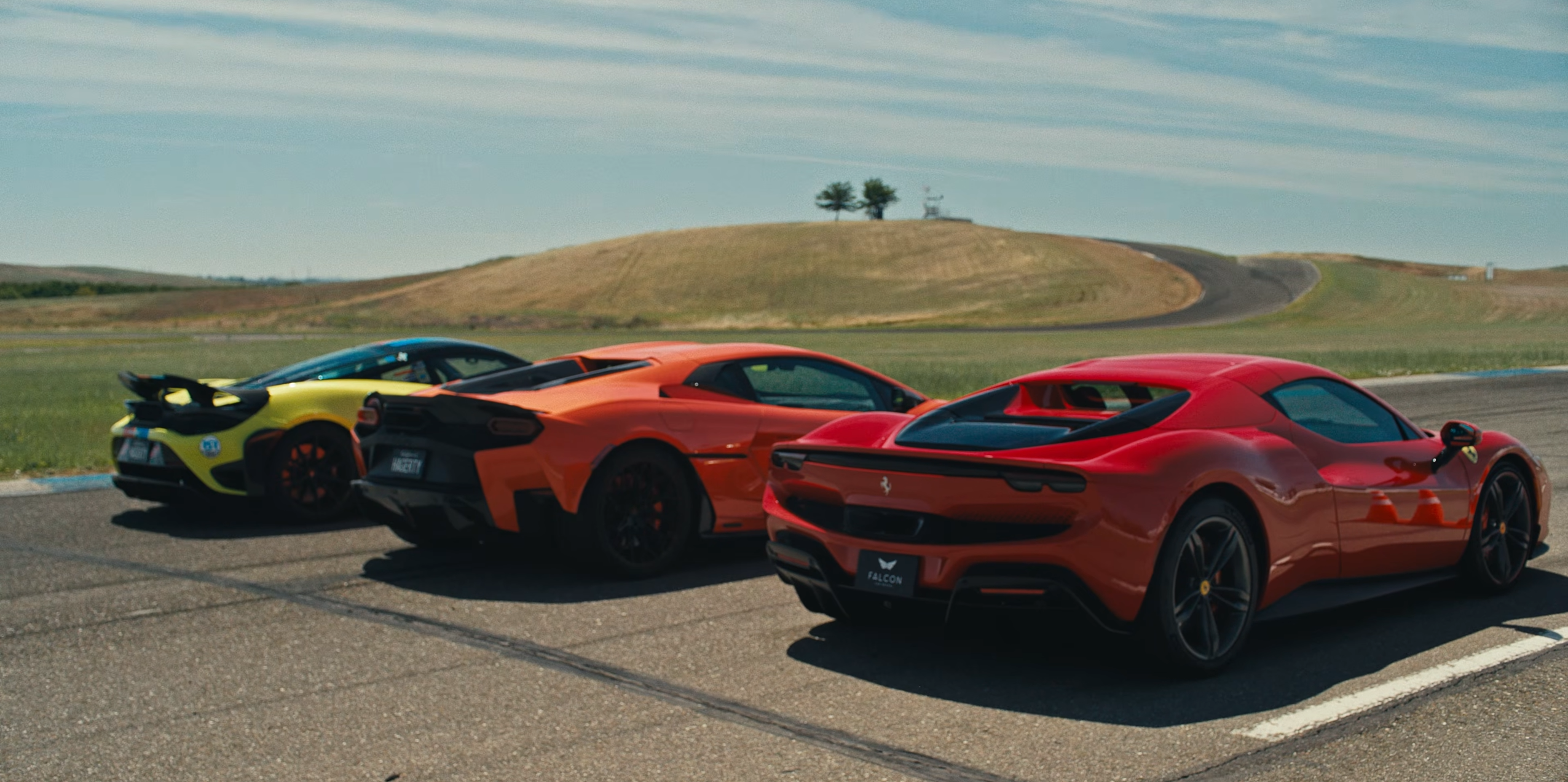
The comparison underscores a defining trend in modern performance cars. Electrification and advanced launch-control systems have become powerful tools for extracting unprecedented acceleration, even as vehicle weights increase. Yet the McLaren’s performance also proves that lightweight simplicity remains a formidable alternative. The future of supercars may be increasingly electrified, but Thunderhill showed there is still more than one path to extraordinary speed.
Source: Hagerty