

Rob Walker Biography
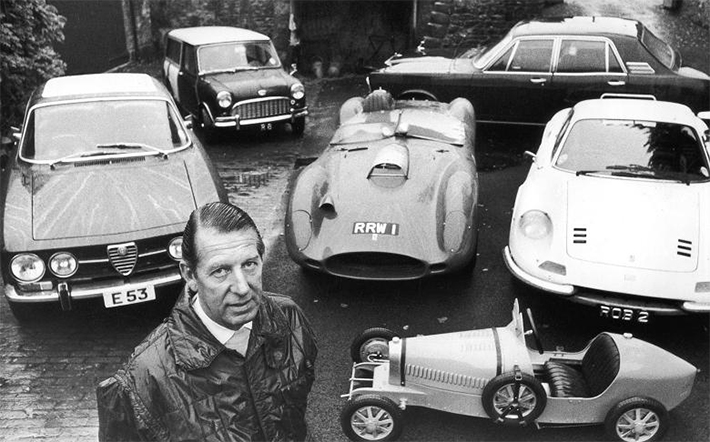
On his passport, under occupation, it read simply Gentleman, a description, a description to his many friends, one never more fitting. Someone once described him as “self-unemployed.” but never idle. Robert Ramsay Campbell Walker was born on August 14 1917. His father Campbell Walker was an heir to the Johnnie Walker whisky fortune, and his mother, Mary Marshal Ramsay, came from a family with business interests in tea and rubber trading. His father died in 1921, aged just 32, and his mother subsequently married the much older Sir Francis Eden Lacey, long-time secretary of the Marylebone Cricket Club; thus Rob and his older brother John grew up on the Sutton Veny estate near Warminster, Wiltshire, which his mother and stepfather had bought at the time of their marriage. The main house had a hundred rooms, included several staff cottages and a 270-acre tenanted home farm but the feature most prized by young Walker was the long driveway.
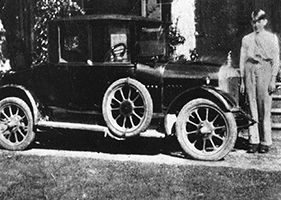 His fascination with fast cars stemmed from a visit, aged seven, to the 1924 Boulogne Grand Prix. The preliminary event was won by B. S. Marshall, whose wife happened to be seated in the grandstand beside young Walker; she explained every move to him. When he was 10 years old he persuaded his indulgent mother to buy him his first car, a Bullnose Morris, which due to his age he was limited to driving on their estates driveway. “We had a long drive at home of a mile or so, and my mother gave me the old Bullnose Morris for Christmas to keep me quiet,” Walker said in a television interview in the 1980s. “From that moment on, my life was dedicated to trying to break my record on the one-mile drive.” He had a pit manager too, in the form of the family’s ‘second chauffeur’, whose responsibilities largely revolved around teaching Walker how to drive and maintain cars, and to try and keep the spirited boy from doing himself mischief. Walker lived to reach college age without suffering any lasting harm.
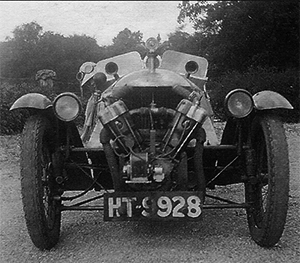 Rob was educated initially by a governess, then sent to Sherborne School. He was, by his own admission, “academically hopeless” which almost seems to be a prerequisite for involvement in motorsports. While attending Sherborne he obtained a driver’s license that permitted him to drive a motor cycle or three-wheeled car on the road. He duly bought a used Morgan three-wheeler but kept it at a local cycle shop because students were not allowed to have a car. Powered by a 10hp engine the Morgan was quick but unstable with virtually no brakes. The car was reputed to have killed four of it’s previous owners!
While at Magdalene College, Cambridge, Walker somehow qualified as a private pilot; but he was soon banned for life for “jumping the course” in a Tiger Moth biplane. A local policeman took his tail number and reported him to the Civil Aviation Authority for low flying. Walker would keep this little episode a secret from the military. For his 21st birthday he received a Coupe des Alpes Delahaye, so called because of its success in the Alpine Rally. This was also the 21st motor car that the young Walker had owned! Later trying to prove that his Delahaye, which had four speeds in both forward and reverse, was just as fast either way, he overturned it at around 60mph – going backwards. In spite of all of this Walker survived his youth and managed to finish Cambridge with a degree.
While playing truant from Cambridge; “I was walking down the road when I saw through a window the most beautiful Delahaye I had ever seen,” Walker recalls of his fateful stroll down London’s Park Lane. “This was the Competition Type-35. At the time the car held the lap record in the TT and it had lapped Brooklands at 119 mph, which was not bad. Within hours I owned the car [on finance]. Of course my mother knew nothing about this, and the next thing, I had entered it into Brooklands. In my first race I was winning until the last corner and then I went and spun the thing. I did win in it later that year and I would take it to Le Mans.”
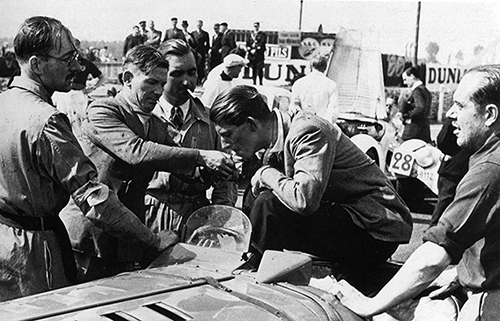 In 1939, Rob and his friend Ian Connell partnered to race the 3 1/2-liter Delahaye Type 135S Course at the 24 Hours of Le Mans. It had always been one of Walker’s dreams to race at Le Mans, having followed the exploits of the famous Bentley Boys at the French classic. It was decided that the more experienced Ian Connell would drive the first four-hour stint. Since Walker’s stint would start at 8pm he thought it only proper for a gentleman to dress in a suit at that hour and so he jumped in his car wearing pinstripes.
The Delahaye was running flawlessly except for a leaking exhaust gasket that spewed hot gasses through the floorboard. By the time Connell handed the car back to Walker for his second stint his feet were so badly burned that he could not continue. This left Walker to drive the last twelve hours and after every pitstop Walker would jump into a bucket of water. About two hours before the end of the race, Walker was signaled in to pits so that he could share the last remaining bottle of champagne the crew had brought for the event! Rob and Ian managed to finish 8th overall and 3rd in class, running at an average speed of 78.3 mph.
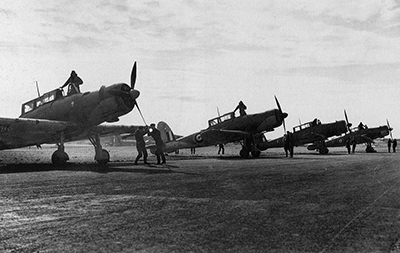 Rob Walker joined the Navy on December 6th, 1939. Walker was accepted for training as a Fleet Air Arm pilot, though he had concealed his earlier flying exploits. The following year when Walker married his wife, Betty, in 1940, part of the deal was that after wartime service in the Fleet Air Arm, he would give up racing. Walker received his flight training at Elmdon near Birmingham and would go on to fly Gladiator, Skua, Roc, Swordfish and Fulmar aircraft during the war before being grounded due to deficient night vision. When the war ended Walker formed a partnership with Guy Jason-Henry. Remembering the agreement he made with his wife the plan was for Jason-Henry to become the primary driver and mechanic while Walker would be the team manager and secondary driver allowed to compete in sprints and hillclimbs.
In 1949 he entered his Delahaye in the first post-war Le Mans with Tony Rolt serving as Jason-Henry’s co-driver. Rolt, a war hero was captured by the Germans at the battle of Calais. Rolt escaped seven times from German prisoner-of-war camps before eventually being sent to the maximum security prison, at Colditz Castle before being rescued by advancing American troops before he and fellow prisoners could complete their famous glider escape plan..
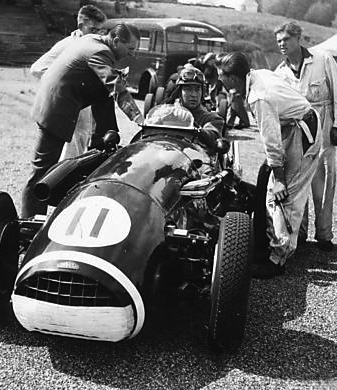 In the race, the Delahaye was forced to retire while in fifth place due to engine failure. Later that year, at the French Grand Prix which was held for sport cars the car finished a well deserved 3rd. The partnership ended when Jason-Henry attempted to smuggle more than 3,000 watches back to England from France in a false tank which he had added to the Delahaye. With their racing car now impounded, Walker was forced to pay £300 to get it back.
With Tony Rolt now his sole driver Walker turned his attention to single seaters without much success until the team bought a nearly new A-Type Connaught, the 1953 season brought a slew of victories in the UK including the Coronation Trophy at Crystal Palace. In 1954 Tony Rolt retired from racing and was replaced by Peter Collins and the team would now compete in Formula Two. Collins was the first true professional driver employed by Walker but still the results were missing. From 1954 to 1956 the team won only one race, that at Brands Hatch with Tony Brooks doing the driving. Brooks at the time was driving for the Vanwall Formula 1 team and only race for Walker at selected races. A series of other drivers would race when Brooks was not available. Walker considered Brooks a fabulous and safe driver, who probably never drove to his absolute limit.
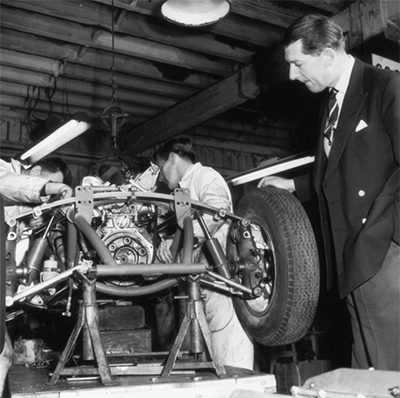 In mid-1956 Cooper Cars introduced their new Cooper race car powered by a 1100cc Coventry Climax fire pump engine. The sight of it piqued a lot of interest, especially that of a certain Rob Walker. The car was an immediate success and soon the engine was increased to 1500cc to make it competitive in Formula Two, then a very popular series. Walker called his friend Reg Parnell for his opinion which was positive as well, In the same conversation Walker was told that Alf France had left Stirling Moss and was available for hire. Ordering both a Cooper and bringing on the renowned mechanic Walker’s team gained instant credibility. Walker would later say that these were “the most important decisions l ever made in my racing career”. Alf was soon off to Surbiton, Coopers team workshop to construct their new race car along side Jack Brabham who was doing the same on his. The car was not finished until just a few days before the next race at Oulton Park. Forgetting to have the tires scrubbed before the race effected the handling greatly. After the tires scrubbed themselves in during the race Tony Brooks was able to finish 2nd to Roy Salvadori, someone he could have beaten easily had the tires been properly scrubbed. At Brands Hatch, with well-scrubbed tires Brooks was able to easily beat Salvadori and Jack Brabham for the win.
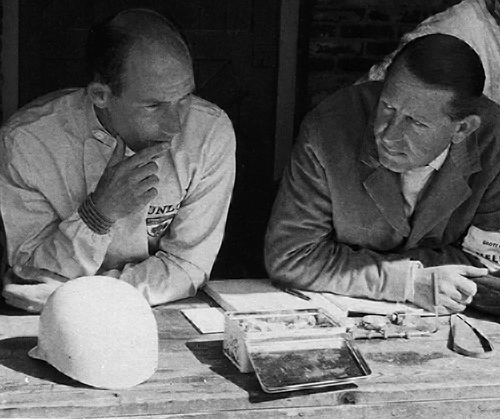 In those days drivers salaries were not what was available now or even thirty years ago. A driver needed to maximize their income through race appearances based of course on their popularity brought on by past results. No one was more popular than Stirling Moss but even he scrambled for more seat time. Moss approached Walker on the off chance that he could drive for the team when not contracted by his works drive.
Walker did not need convincing. Throughout his historic and productive association with Stirling Moss (from 1958 to 1962) they were never committed to one another by a written contract, merely by a handshake. With Moss driving, Walker’s privately-owned and privately-prepared cars claimed victories in Formula One, Formula Two, InterContinental, Tasman and GT racing up to World Championship level. The small team, based at Dorking, Surrey, was the perennial underdog, yet a thorn in the side of the works teams, especially Ferrari – a role which both relished.
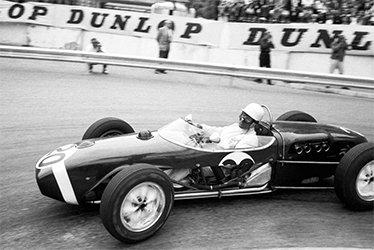
Driving the Cooper in the first GP of the 1958 season at Argentina, Moss and Alf Francis decided to do the unthinkable and run the entire race without a tyre stop, something no other team considered. With tyres worn to the canvas, Moss won the race. It was not just Walker’s first Grand Prix win, it was also Cooper’s. Later the duo, along with chief mechanic Alf Francis, managed to post THE first-ever win for Lotus (1960) Grand Prix cars. “I loved going racing with Rob,” Moss said. “A small team, very relaxed, yet very professional. It meant buying cars from another company, of course, but that really appealed to me — trying to beat the factories. And quite a few times we did.” In 1961, F1 adopted the new 1.5 L engine regulations, and Walker flirted with the idea of building his own chassis, but retained the year-old Lotus 18 for the following season.
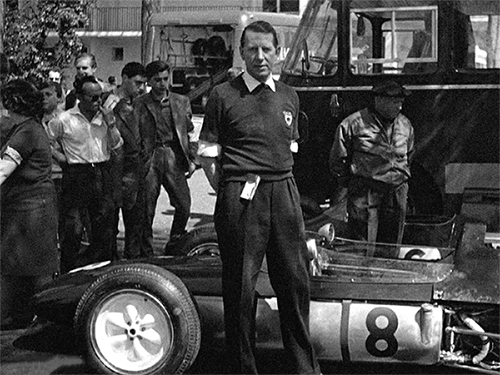
At the season opening Monaco Grand Prix Stirling Moss put Walker’s old, under-powered Lotus 18 on pole alongside Richie Ginther’s Ferrari and Jim Clark’s new Lotus 21. With his car suffering cooling problems and the race run in hot weather Moss removed the side-panels of his Lotus. As Moss was getting his car in position on the starting grid, he noticed a crack in one of its frame tubes. Alf Francis came over immediately with a welding torch and repaired the frame crack there on the grid – with the Lotus full of fuel – just before the start! For the race, Richie Ginther led at the drop of the flag but after 14 laps Moss and Jo Bonnier in a Porsche slipped past him.
However, Bonnier’s race was over a few laps later when his car crawled into the pits. Moss spent the rest of the race fighting off a strong challenge from Phil Hill who had maneuvered himself into second place and reduced Moss’s lead to just 3.5 seconds at the half-way point. In the closing stages Ginther re-passed his fellow American and closed further on Moss, with Wolfgang von Trips, also in a Ferrari, taking up fourth place. For lap after lap , the three Ferrari drivers constantly changed positions, harrying the little blue Lotus while Moss drove ever harder. The checkered flag fell for the Lotus after an unforgettable display of virtuosity, Moss collecting his third Monaco victory, a feat no other driver had ever accomplished at the time.
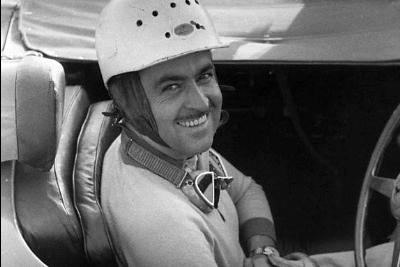
For 1962, the plan was for Moss to race a Ferrari, prepared at the factory, but operated at the races by the Walker team, whose blue-and-white colours it would carry. It was an astonishing concession by Enzo Ferrari. But everything came to naught when Moss crashed at Goodwood on Easter Monday. “I was devastated, of course,” Rob remembered. “The team carried on, with Maurice Trintignant, but it was not the same. With Stirling, anything had been possible, because he was so much better than anyone else.” By then, Trintignant was well past it and the spark had gone out. As Rob Walker remarked: “He was 45, just a couple of months younger than me. I know Fangio won his fifth world championship when he was 47, but Maurice was no Fangio. He could string together half a dozen quick laps, but he no longer had the stamina or the concentration to drive competitively for the full race distance.”
In 1963 Jo Bonnier would drive for the Walker team. After some recent tragedies involving young drivers it was felt that they should employ a more experienced driver for the team. Besides being a fairly competent driver, Bonnier also came up with the lucrative idea of using a second race car as a “rental” available for local drivers to race at their national events. While making business sense, this seemed to counter their focus on experienced and safe drivers.
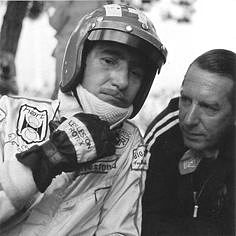 In 1965, Jo Siffert partnered Bonnier, and although the more experienced Swede was fastest, it was the Siffert who managed to score 5 championship points. With constant mechanical failure plaguing him, Bonnier’s best result was a third place at the non-championship Race of Champions.
“Betty [Rob’s wife] and I adored `Seppi’, who joined us in 1965 as number two to Jo Bonnier, who’d been with me for two years. I don’t think Bonnier liked being beaten by his team mate, and at the end of the year he suggested I should revert to running only one driver in 1966.” ‘I quite agree with you,’ I said, ‘and it’s Siffert‘.
With the new 3.0 L regulations starting in 1966, Bonnier left Walker to restart Ecurie Bonnier, and Siffert remained alone with Walker, with the Maserati-engined Cooper T81. The car was uncompetitive in 1967, and in 1968 Walker, now partnered with London stockbroker and entrepreneur Jack Durlacher, purchased a Cosworth-powered Lotus 49. At the British Grand Prix Siffert qualified on the second row behind Colin Chapman’s works Lotuses of Graham Hill and Jackie Oliver and Chris Amon’s Ferrari. On the 27th lap, Hill retired with a broken driveshaft and Oliver’s car lost so much oil that Siffert had to drop back, only to be passed by Amon. Then Oliver retired with transmission failure and Siffert re-passed Amon to lead a World Championship race for the first time. Amon attacked again and again, but lost tyre grip in the closing stages, allowing Siffert to win by 4.5sec. He had established a new lap record for the Grand Prix circuit at 1min 29.7sec. The win was his his first ever Grand Prix and Rob Walker’s first victory in seven years and also his last. The Ferraris of Amon and Ickx came home second and third. “Of all my dreams,” Siffert told Betty Walker, “the best one was that I had won the British Grand Prix, in the home of motor racing.”
Chris Amon would remember that: “I think wings were decisive that day. Lotus were just starting to use that huge rear-mounted thing, whereas we had a smaller, centre-mounted, one, which didn’t give anything like as much downforce …I still think if we’d had a bigger wing on the back of the car we’d have won the race”. Siffert left the team at the end of 1969, having convinced by Porsche racing manager Rico Steinemann to take a spot with March thereby keeping his star Porsche driver out of Ferrari’s clutches.
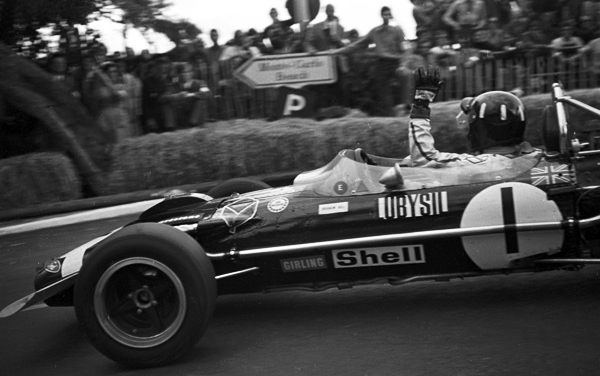
Rob Walker Racing Team competed for the last time in 1970, entering a Lotus 72 for driver Graham Hill, who was now 40 years old, and refused to retire after a major accident the previous year with Lotus. Colin Chapman had the much younger Jochen Rindt driving for him which made Hill, still the defending World Champion surplus. Chapman would like nothing better than to hedge his bets and have Hill drive for Walker. If he should win it would be a victory for one of Chapman’s cars and if he lost it would be because he was with the underfinanced Walker Racing Team! Hill’s best score was a 4th placement at the Spanish GP.
Though technology allowed the British teams to compete with the likes of Ferrari, the small British teams, the Garagistes as Enzo Ferrari once called them were growing up and F1 racing was getting more and more costly. The prize and appearance money that could be won was nowhere near enough to cover expenses and England after the was was a “small” country. At the same time John Surtees and his team were having similar problems and suggested that the two join forces. Walker was concerned about his employees but eventually decided that his team would merge with Team Surtees under the continued sponsorship of Brooke Bond Oxo for the 1971 season. After seeing the workload that Surtees was handling Walker quietly suggested that Surtees turn over the driving to someone else. This other driver would be Mike Hailwood who like Surtees had been a World Champion on two wheels.
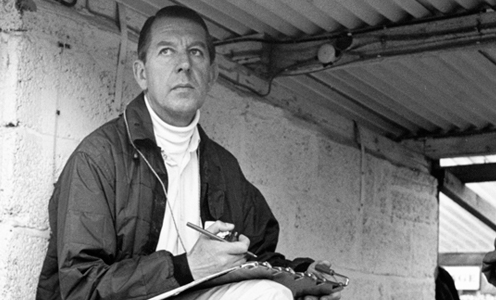
After his three year contract with Brooke Bond Oxo ended Walker left Team Surtees. Racing had been in Walker’s blood and with his wife Betty the two had participated in racing happily together for decades. Walker would continue as a Grand Prix correspondent Road & Track magazine, having starting in 1967. This enabled him to remain a part of the F1 circus and attend races so he could provide readers of the American magazine with his finely crafted analyses of how things had gone and why.
Rob Walker died at the age of 84 in 2002 on the 29th of April, of pneumonia. Tributes flowed in from all corners where men raced cars. Bob Judd, wrote that, “Rob was a prince, born in another time in a house of a hundred rooms to a fortune as big as Texas, and a gentle spirit rare among men. He had the grace and grandeur of an ocean liner. And nobody had more fun.” Journalist Nigel Roebuck recalled that: Rob Walker was the first ‘insider’ to befriend me when I began working as a journalist in F1 30-odd years ago, and coming to know him well was one of the joys of my life. I loved the fact that, as the world turned sour, he did not, that his qualities – civility, wit, compassion, style – survived quite intact to the end of his life.
“I remember his voice, his smile and mannerisms. The last gentleman of motor racing. In all the years I raced with him, I never even had a letter of agreement from him, let alone a contract. It was not the way you did things with Rob. You’d decide on something and that was it My relationship with Rob was not like that of a team manager and a driver; he was so passionate about it all, got so involved, he felt to me more like a co-driver.” – Stirling Moss
Alf Francis
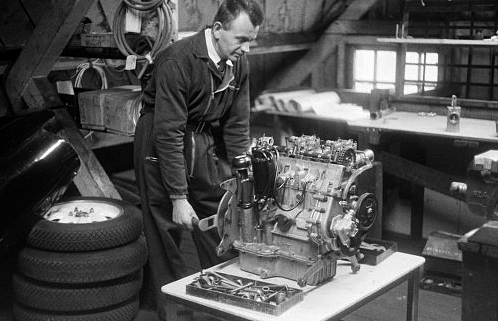 Born in Poland, Alphons Frantisek Kowalski, escaped from occupied Poland and crossed Europe to Portugal where he got a boat to what he thought was America only to make land in Liverpool! Francis took out British nationality as soon as he could and became very pro-British such that it was hard to believe he came from Poland, until he spoke, never having lost his accent.
Francis appeared on the racing scene immediately after the war as mechanic to the rising star Stirling Moss and he looked after the HWM team in the days when John Heath and George Abecassis were forging a lonely path into European motor racing with their British team. During his racing career he worked variously as a mechanic, engineer, team manager and transporter driver. Francis rejoined Moss for his Maserati days in the mid-fifties and then helped run Rob Walker’s successful privateer team from the Dorking premises. After a spell in Italy with Valerio Colotti where the two ran a business in gearbox design and manufacture. Francis tried to resurrect the Italian ATS marque, but unsuccessful he eventually went to America where he worked with various classic car restorers and collectors.
He died in Oklahoma, it was said at the age of 65, but probably nearer 70. Alf Francis could be outspoken and often stubborn but the relationship he had with Moss and Rob Walker were based on a deep mutual respect that comes from the fact that all three were racers to the core.