
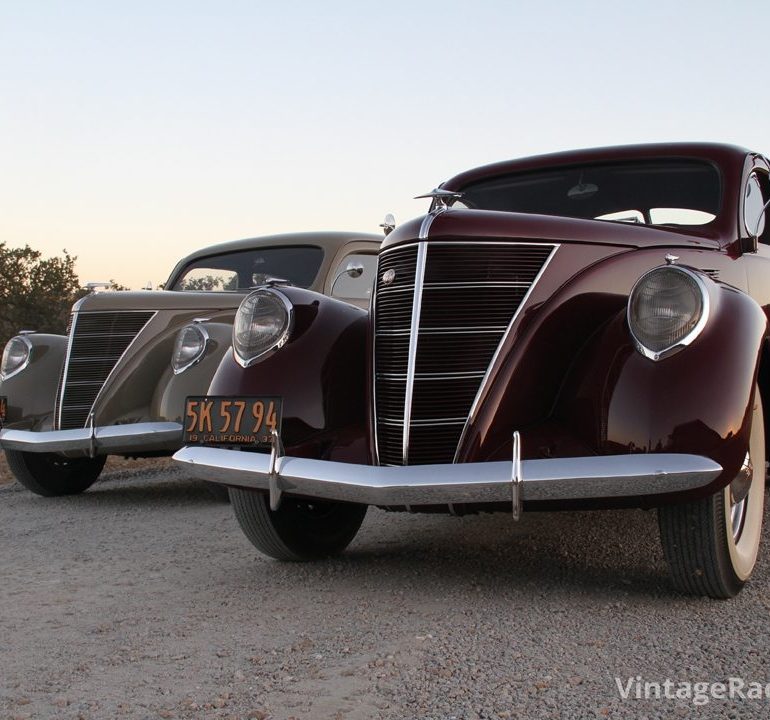

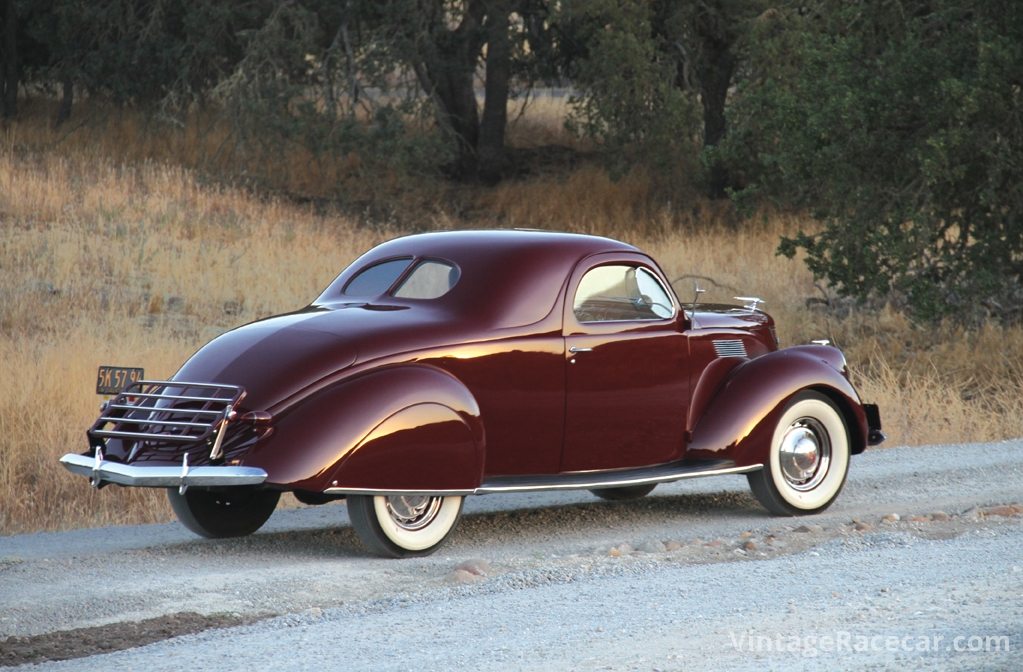
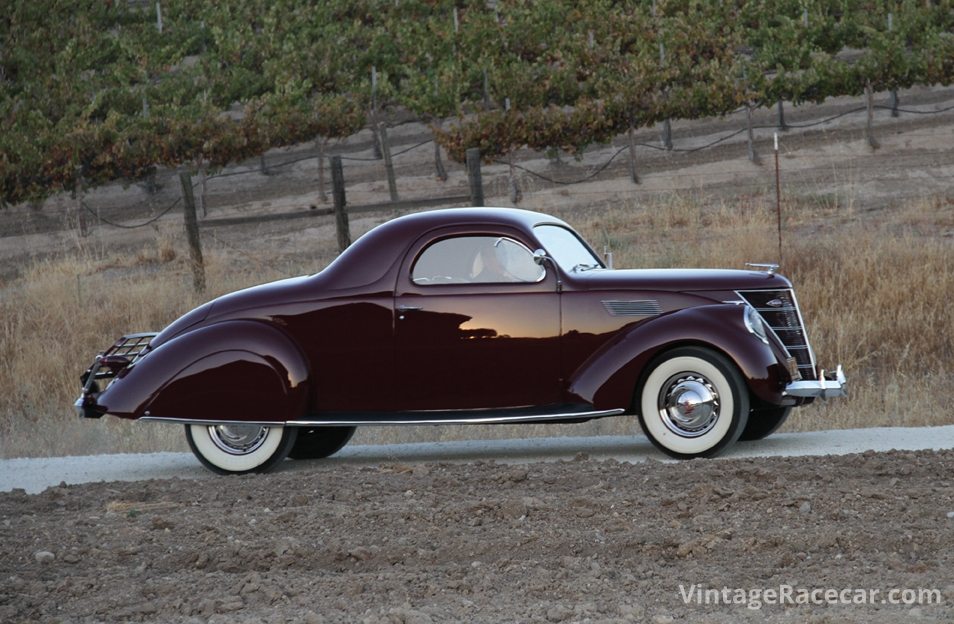
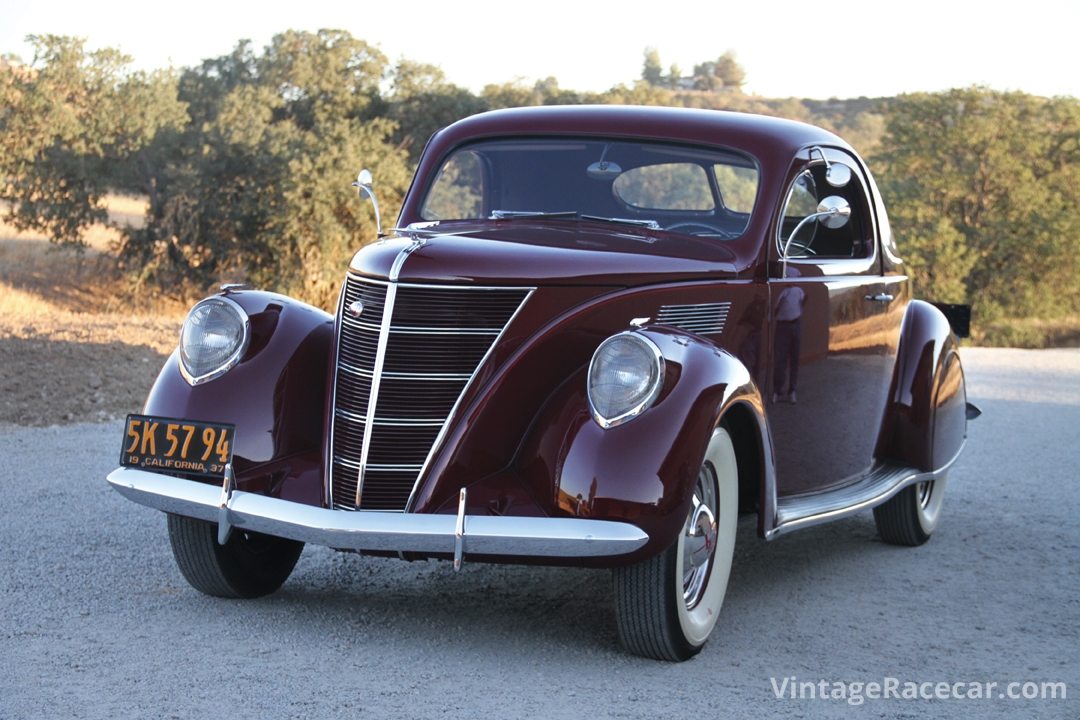
A few miles north of Paso Robles we come up over a rise on a rolling two-lane road through Central California’s golden, hilly wine country and spot a 1937 Lincoln Zephyr coupe on a hill in the distance. It looks like a Brancusi sculpture. Its gleaming, dark merlot paintwork and its swooping lines contrast sharply with the square, functional corrugated buildings around it. We know we have arrived.
 And so has David Caparone who is the proud owner of two beautifully restored 1937 Zephyrs—the coupe and a rare Tudor sedan—as well as the exclusive Caparone family-owned winery where they are housed. His situation is as close to paradise as I can imagine. Beauty is everywhere we look, and he has enough premium, traditionally crafted wine to stay lightly toasted for the rest of his days if he so chooses.
After a little conversation, Dave gets into his ’37 coupe and starts it up. As it turns over I am reminded of the countless flathead Fords of my youth. The sound is so familiar that it is part of me. The 267.3-cu.in., 110-horsepower V12 catches, revs, and then settles into an idle that is much smoother than the Ford V8s of the time. As Caparone revs it, I detect that unique throaty Ford flathead burble in the exhaust note.
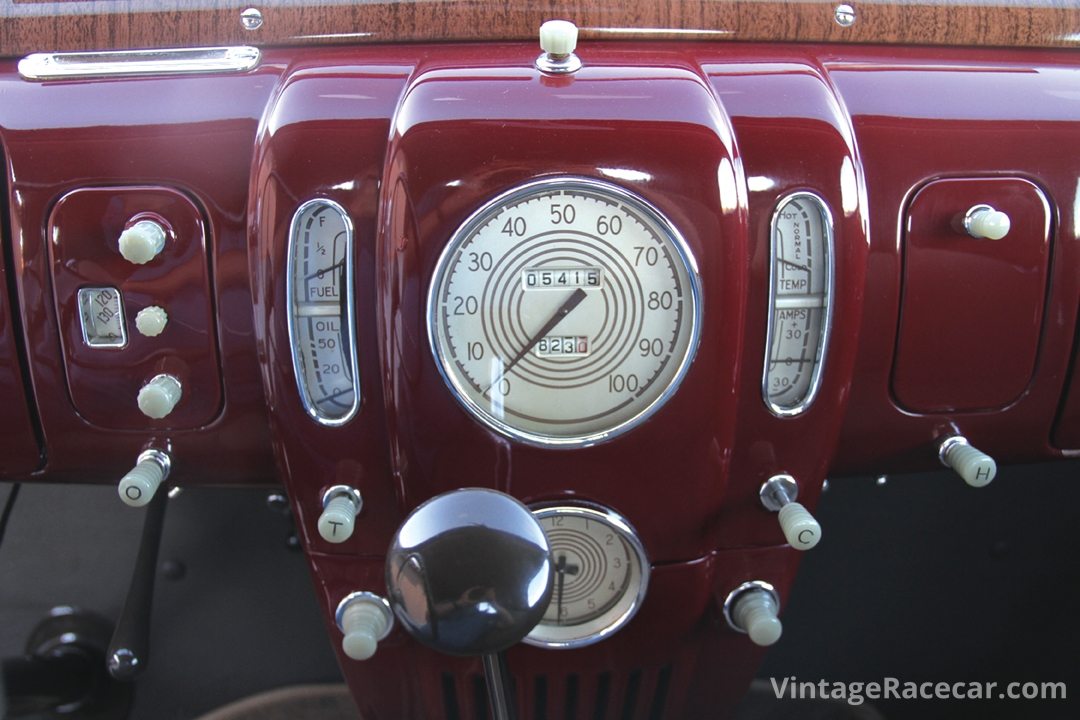
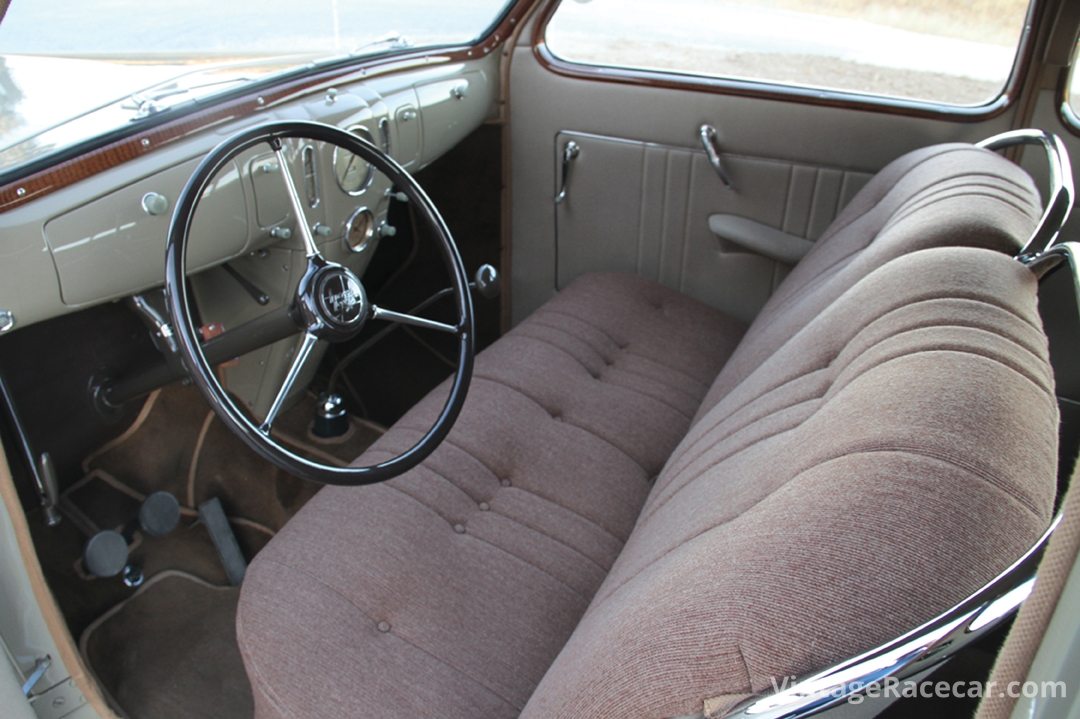
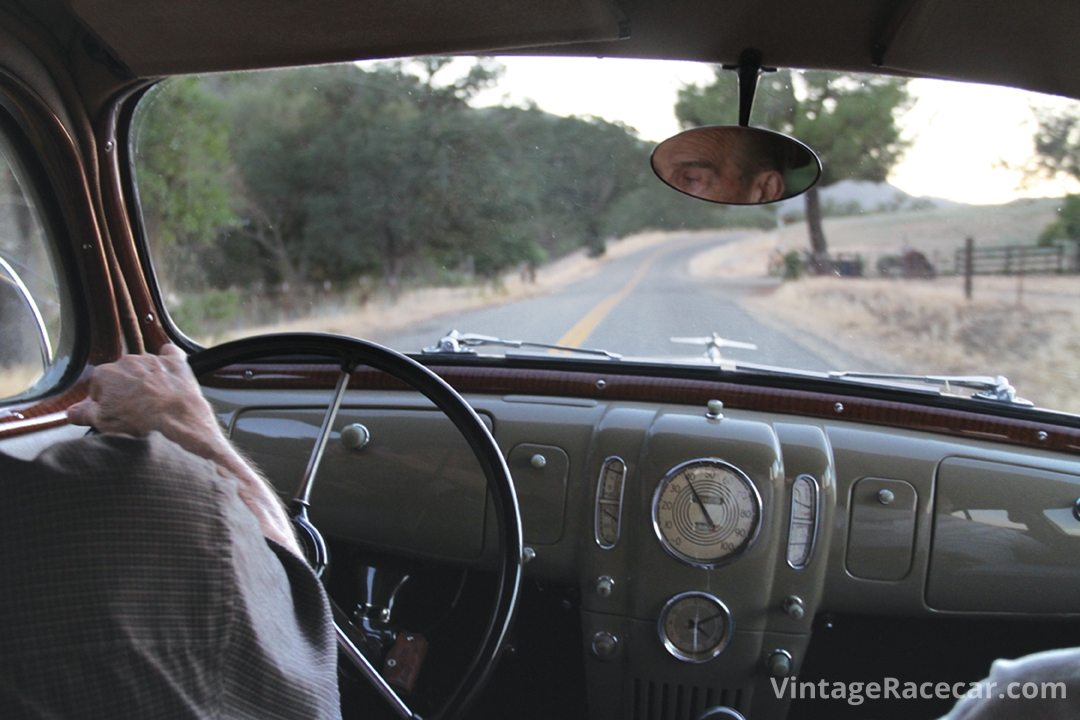
 Dave slides over and says, “Get in.” I oblige, and find myself in a divan-like seat covered in taupe English broadcloth, surrounded by a handsome frame made of chrome tubing. I shift the three-on-the-floor transmission into low, pull out onto the highway and give it a little throttle. The response is instant. The acceleration is outstanding for a mid-priced car of the late ’30s.
Having driven contemporary Junior series Packards, as well as LaSalles, Oldsmobiles and Buicks, I would say that this car accelerates faster than the Packard 120, the Olds and the Buick, but the LaSalle might beat it up to about 60 miles per hour. That is when Ford’s Columbia quick-change comes into its own and allows a 115 mph top speed. For a mid-priced car in 1937, that is brisk indeed. Without the Columbia rear end, the car is good for 90 mph, which is still exceptional for a mid-priced automobile.
 The Packard 120, inline-eight is smoother and quieter, with the Olds eight being about the same, but the LaSalle flathead V8 and Lincoln V12 have just the slightest lope to them. Which you prefer depends on whether you want a silky smooth cruise in silence, or prefer a bit of throatiness and quick acceleration.
As I wind the Zephyr through the gears, in the hills, I realize the handling and feel of the car is pure Ford. That’s because underneath this Streamline Moderne masterpiece of a body is exactly that…a Ford. The car is a heavy-duty version of the same lightweight flexible frame, single transverse front and rear springs, three-speed standard transmission and Columbia Quick Change differential, as well as the mechanical brakes of the Fords of the era. The engineering is anachronistic even in 1937 terms, but it works surprisingly well.
 The coupe exhibits a bit of oversteer in the corners at speed because of its long, light rear end and almost stubby front end where most of the car’s weight is located. A rear stabilizer bar limits body roll however, and moderates the situation enough so that it is not as abrupt as that of a 1937 Ford coupe. Nevertheless, the back end will step out if you try to drive it like a modern car.
There are none of the rattles typical of the cars of the era because the all-steel body is welded together as a unit and attached to the frame with special struts. The mechanical brakes on our test car work well, and the car stops fine with no pulling or fading, but then the car is in pristine condition. Ford’s mechanical brakes of the period can be notoriously bad when neglected and worn.
 Because the car is light (3,330 pounds) compared with its competition of the time, bumps are a bit more pronounced. The front suspension is also a little choppy, and there is the suggestion of wheel tramp due to the solid front axle, but the light, simple suspension and the car’s aerodynamically clean monocoque body results in a hot combination. Not only does the car look fast; it is fast, even at low and mid rpms.
Maybe that is why it has the same name as a record-breaking streamlined train of the era called the Burlington Zephyr. The train was later named the Silver Streak after a 1934 movie that was made about it. A remake of the movie was done in 1976 starring Richard Pryor and Gene Wilder.
 John Tjaarda, who emigrated from Holland in the 1920s, originally penned the sedan’s striking design. He was well acquainted with the work of Austro-Hungarian Paul Jaray who was the first to test cars in a wind tunnel in Europe. As a result of Jaray’s efforts, the streamlined Czechoslovakian Tatras were designed using his data, and Ferdinand Porsche was inspired to come up with a series of cars culminating in the Volkswagen Type 1 Beetle as well. Chrysler got in on the act too, with its Airflow for 1934.
 As with the other aerodynamic cars mentioned above, the original Tjaarda design that later became the Zephyr was to have its engine in the rear. That explains the rather long rear end and stubby front end. Tjaarda worked for the Briggs Company at the time, and they designed and built most of Ford’s bodies. Edsel Ford commissioned an adaptation of Tjaarda’s prototype for the 1933-’34 Chicago Century of Progress exhibition as a design study known as the Briggs Dream Car. The public loved it, and Edsel decided it would make a great mid-priced offering between the low-priced Fords and the Lincoln Model K custom V12s.
 Henry Ford had turned management of the company over to his son Edsel back in 1925, but kept him on a short leash. In fact, some would say he used a spiked choke collar too. Henry, who was getting along in years by that time, at first resisted any change to his beloved Model T, but plummeting sales softened him up. By the 1930s, he didn’t bother Edsel excessively when it came to re-styling the company’s offerings, but he still insisted that his basic Model T chassis design was ideal and not to be changed. As a result, it continued to be used until the redesign of the entire Ford line came out in 1949.
That’s why the stunning, cutting-edge Zephyr sedan debuted in 1936 with essentially a beefed up Model A chassis under it, and a flathead V12 that was a Ford V8 with four more cylinders. The engine was all Ford, with the exhaust coming out low on the sides of the block, two water pumps, and a crab-style distributor mounted on the end of the camshaft at the front of the engine.
 The Zephyr V12 bore no relation to the contemporary Lincoln K model 385-cu.in. V12 engines. In fact, the Zephyr twelve was actually quite small for an engine with that many cylinders. As noted, its displacement was only 267.3-cu.in., with a bore of 2.75-inches and a stroke of 3.75- inches. When you consider that Packard’s V12 was 445-cu.in., and Cadillac’s was 368-cu.in., that makes the Lincoln easily the smallest American twelve. In fact, it was even smaller than Packard’s junior series straight eight, which was 289-cu.in. It shared some of the shortcomings of the Ford V8s too, plus a couple of its own, such as inadequate crankcase ventilation and cooling problems, despite its aluminum heads. Because it was a long way from the water pumps to the rear cylinders, sediment and rust would build up in the rear of the engine and cause overheating. However, the new engine did result in Ford offering the only mid-priced car with a V12 in 1936, and the company did work out the bugs in time.
 Just as Ford trumped Chevrolet’s sixes in 1932, by coming out with a low-priced V8, they trumped the mid-priced inline-eights of the mid-’30s with a V12. That, coupled with the inimitable styling, made for a very tempting package when the Zephyr appeared on the scene in 1936. There was a Tudor (two-door) sedan called a Coupe Sedan and a Fordor (four-door) sedan, but the three-passenger coupe didn’t appear until 1937.
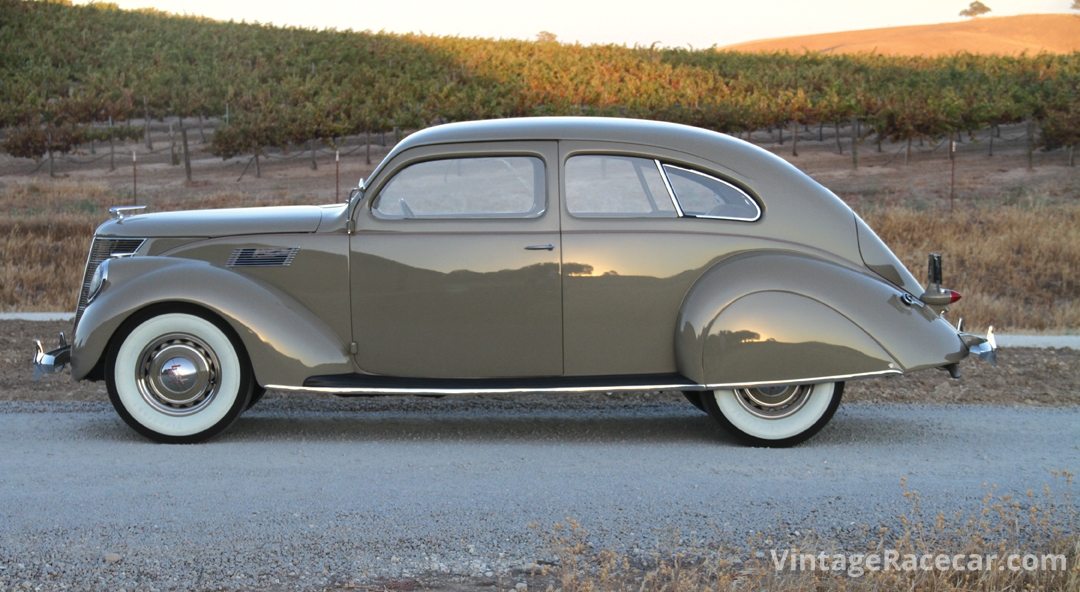
Many cars of the mid- to late-’30s had bodies that were still transitioning from the two-box concept (a small one in front with the engine in it, and a big one behind it for the passengers), but the Zephyr was a complete break. It was actually a big teardrop. E.T. Gregorie, head designer at Ford, and director of the new styling department as of 1935, and Edsel Ford updated Tjaarda’s original design to adapt it for production. That meant moving the engine to the front and using Ford’s unique running gear throughout, and it also meant the simplification and refinement of Tjaarda’s original design.
 Both E.T. Gregorie and Edsel Ford were avid yachtsmen, and Gregorie got his start as a boat designer. As a result, both men favored simple, rounded lines and a pointed prow. That’s why the car’s teardrop streamlining was provided a more pointed front end than Tjaarda’s VW Beetle-like treatment, and it looked stunning. The headlights, which echoed the car’s shape, were integrated into the fenders as well.
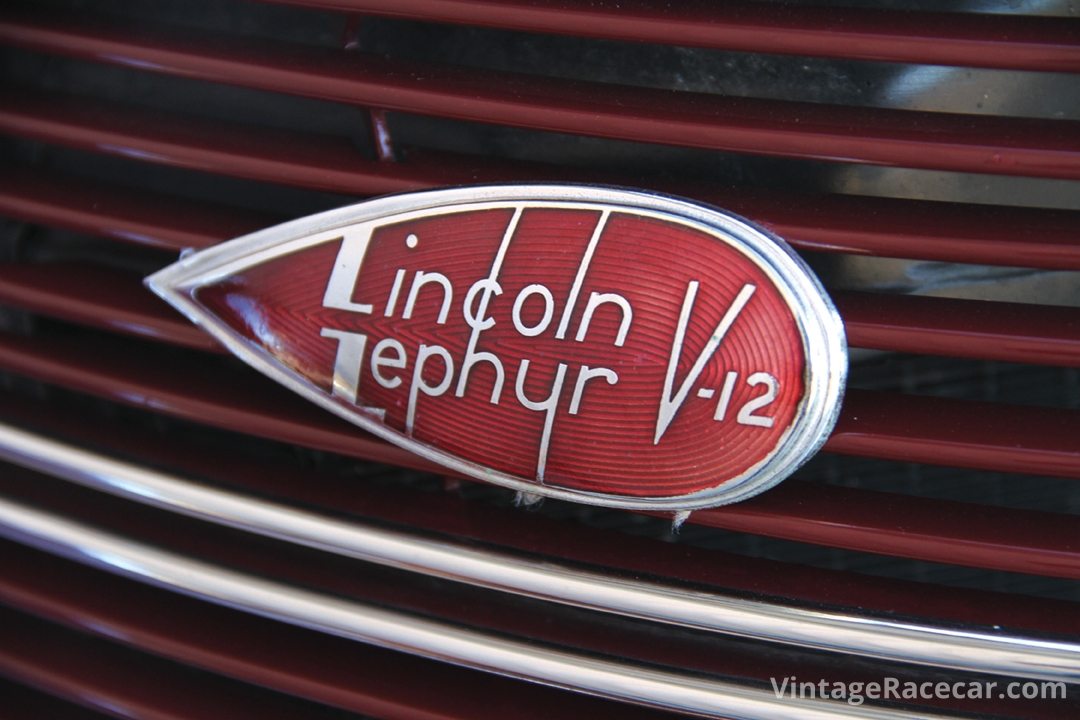
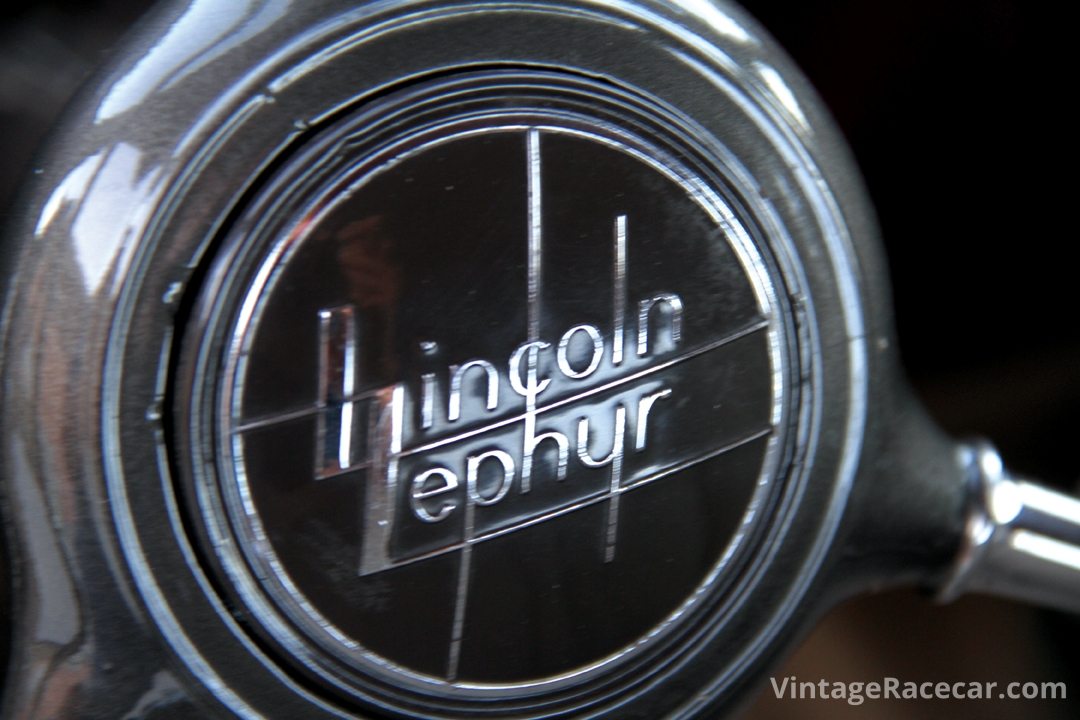
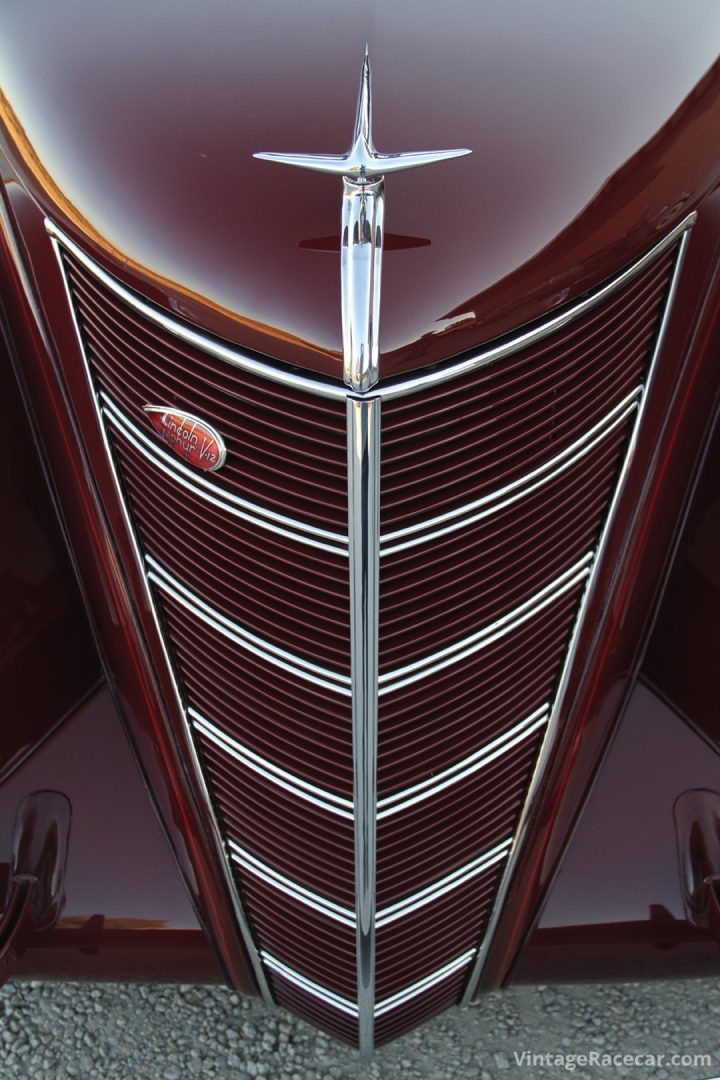
In fact, everything on the car echoes the teardrop motif, from the body shape down to the car’s Lincoln emblem. In the 1930s, the teardrop was considered the ultimate streamlined aerodynamic shape, and it almost is. Later, in the 1960s, they discovered that you didn’t need the long tail though. It was chopped off of racecars of the time, and actually improved performance and handling! That’s because when air hits the front of the teardrop it goes around it in a wide circle and then tucks back in. The tail just gets in the way and causes more turbulence.
 Another famous teardrop from the era was the Hindenburg, a giant 800-foot-long German zeppelin that was a floating luxury hotel and could cross the Atlantic from Germany to New Jersey in three days. Sadly, 1937 was the final year for the Hindenburg—and zeppelins in general—because the thing was filled with explosive hydrogen and caught fire while landing. A Lincoln Zephyr would have looked right at home at the aerodrome in Lakehurst, New Jersey, though. That’s because the car’s styling was not so much futuristic as it was the essence of the design thinking of its time.
Lincoln’s Zephyr actually wound up with a Coke-bottle shape when looking down on it, a configuration later proven to be optimal on Mach II aircraft. The American automotive press, at the time the Zephyr came out, called it the first successfully streamlined American car. That’s partly because Chrysler’s Airflow, though an excellent automobile, had a blunt bulldog front end and the public didn’t go for it.
The Zephyr is aerodynamically cleaner than the Airflow, as well. It was so dramatic-looking that a Coupe was chosen to portray the “Black Beauty” for the hero to drive in the movie series The Green Hornet of the 1940s. It was actually a customized 1937 Zephyr with skirts on all four fenders. And it was reputed to do 200-mph in the matinee serials. It actually fell 85-mph short of that, but there still weren’t many cars of its day that could stay with a Zephyr.
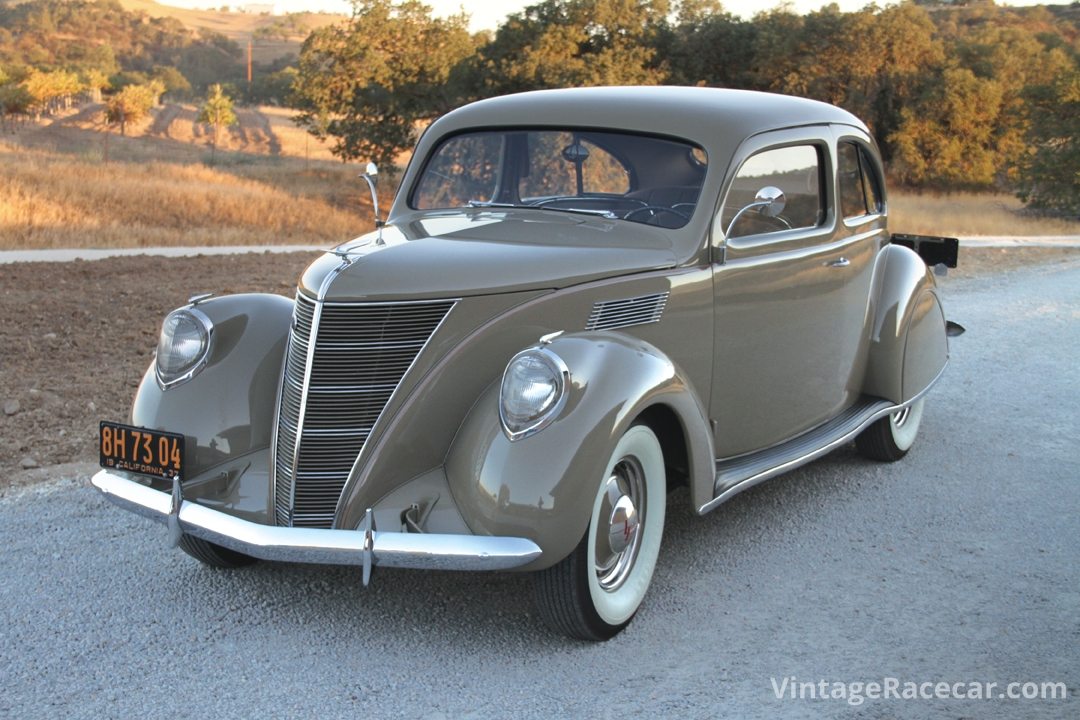
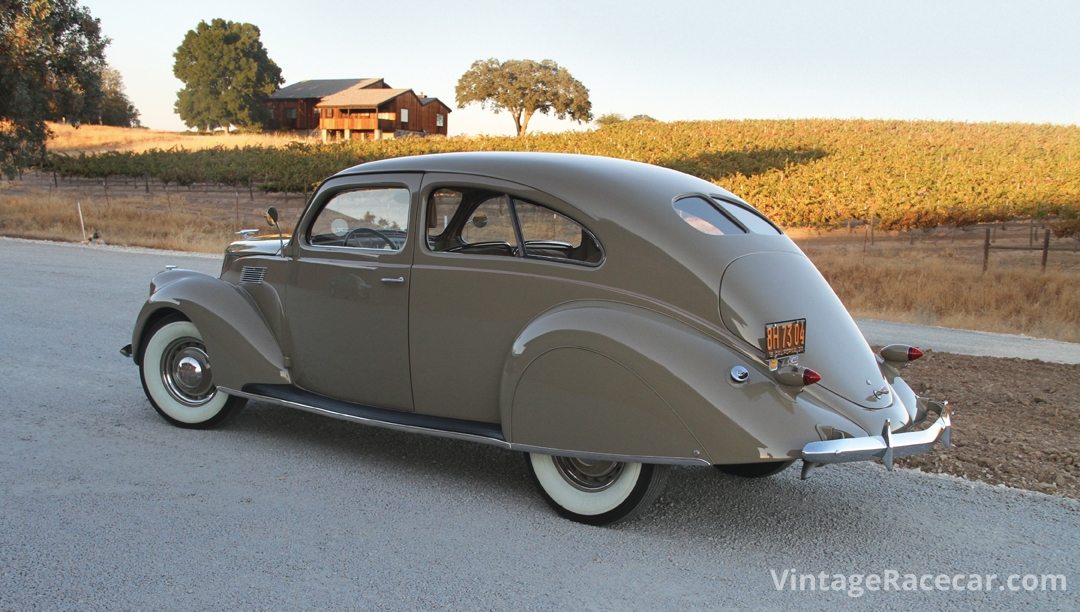
 As we were extolling the beauty and harmony of Caparone’s coupe, he quietly backed his coffee-with-cream-colored Coupe Sedan out of the shed. If anything it was even more beautiful than the coupe, and that is saying something. Somehow the uninterrupted line of the top sweeping back, echoed by the line below the windows and a single pinstripe to emphasize the line is exquisite. The light subtle color scheme also allows you to enjoy the sensuous lines of the car more easily. Also, the sedan is truer to Tjaarda’s original aerodynamic creation.
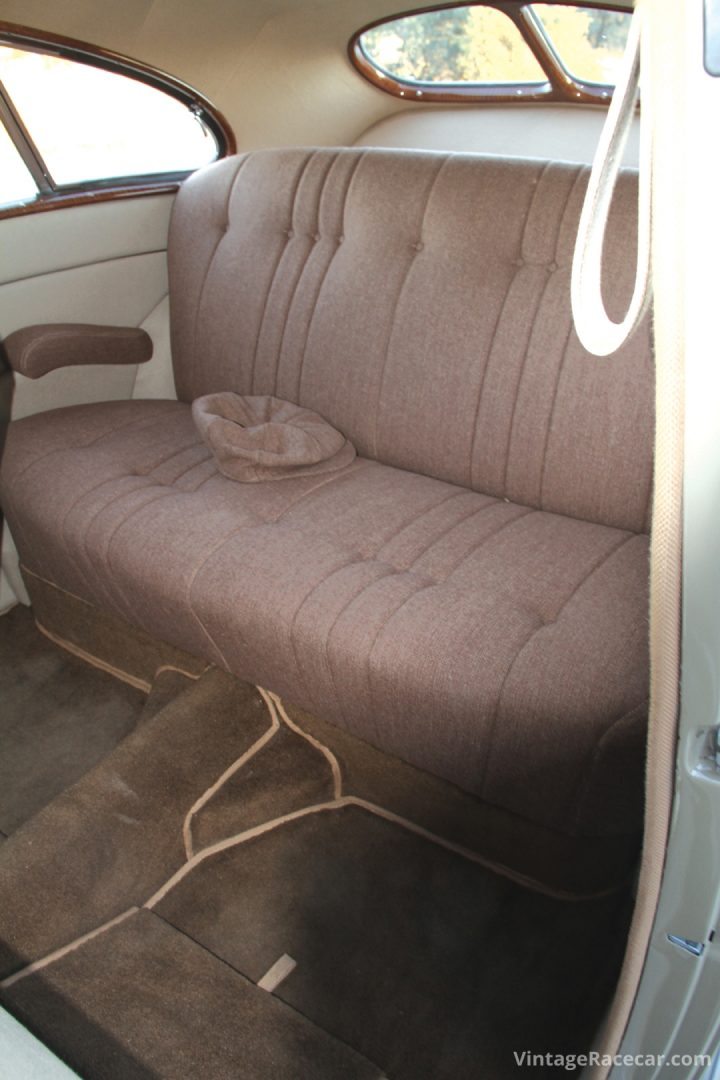
The back seat of the Coupe Sedan is pure luxury. There is plenty of leg and headroom, and the nicely sprung seats are very comfortable. The interior is all subdued tans and beiges, and has a restrained, elegant feel. With four people in the car, it handles beautifully. The spare tire in the Zephyr is also unique and convenient. It is mounted on a rack that folds down flat in the trunk, but when needed it can be pulled up vertically and removed very easily. This was a welcome innovation on a car that is equipped with a full-size 700 x 16 spare tire.
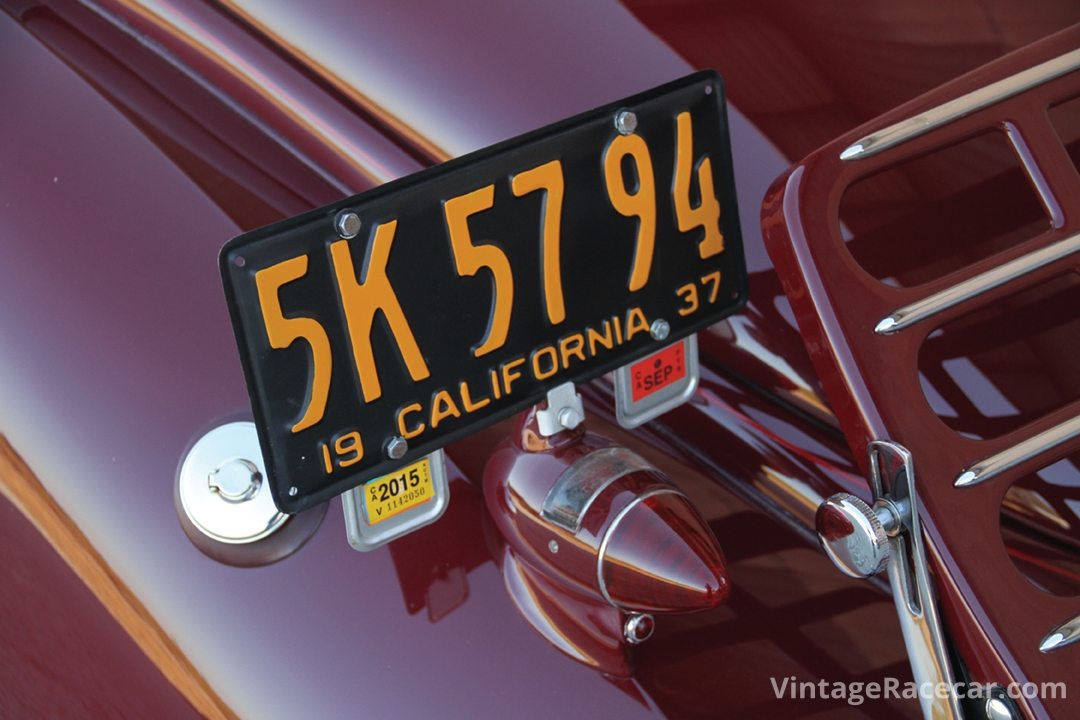
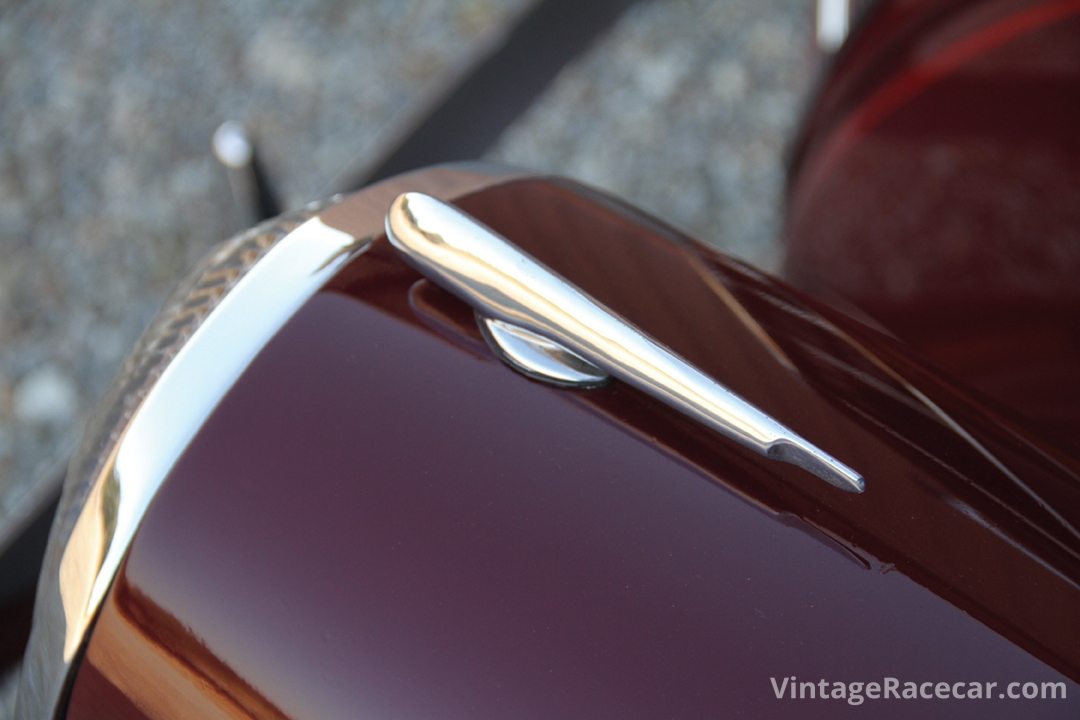
 Everything on the Zephyr was thought out beautifully. For example, there is no radio antenna protruding from the body of the car. Instead, the trunk lid is isolated and does the job of reception nicely with no interruptions to the car’s lines. Also, the hood mascot acts as the handle for opening it. There is no fumbling around below the grille for a latch. The grille and headlights sweep back and are totally integrated as well. The taillights also echo the teardrop streamlining, and work beautifully with the overall look of the car.
As beautiful as it was, the Tudor sedan didn’t sell particularly well, with only 1,500 made in 1937, so the model was dropped after 1939. The Fordor model was lovely in its own right, sold very well, and was more convenient, but a bit busier looking. The three- passenger coupe came out in 1937, and sold very well, with 5,199 built, and it is the coupe that most people lust after even today.
 The Tudor is the epitome of the Streamline style, however, and it has the added bonus of being able to carry friends and family. In fact, I would have to say it is probably the most beautiful sedan of the era, with the 1937 Cord 812 Beverly as its only rival. Surprisingly, the Cord’s drivetrain was as ahead of its time as the Zephyr’s was behind the times, but the Ford layout, though obsolete, was well worked out, simple, tried and true. The Cord running gear was cutting edge, and as a result, baffling for mechanics of the era.
Sadly, the Lincoln Zephyr was only built from 1936 until 1942. That is partly because Ford came out with their Mercury in 1939, and it was an instant hit. It, too, was intended to fill the mid-priced niche between the low-priced Fords and the high-priced, custom-built Lincoln K models, which were discontinued in 1940. After the war, an updated version of the Zephyr continued to be built, but it simply became the Lincoln. Then in 1949 Ford came out with an all-new Lincoln that sported a 337-cu.in., flathead V8 rather than the smaller, smoother twelve.
We swing into the drive at the Caparone Winery, pull up to the sheds in back, and shut off the engine. The sun is setting, splaying warm golden light on the magnificent machines in which we have been touring. It is the end of a perfect day, and an adventure that has taken us back to the best the pre-war streamline era had to offer. Later we will celebrate this perfect day with a glass of vintage wine from Dave’s winery.