
1976 Porsche 935/76
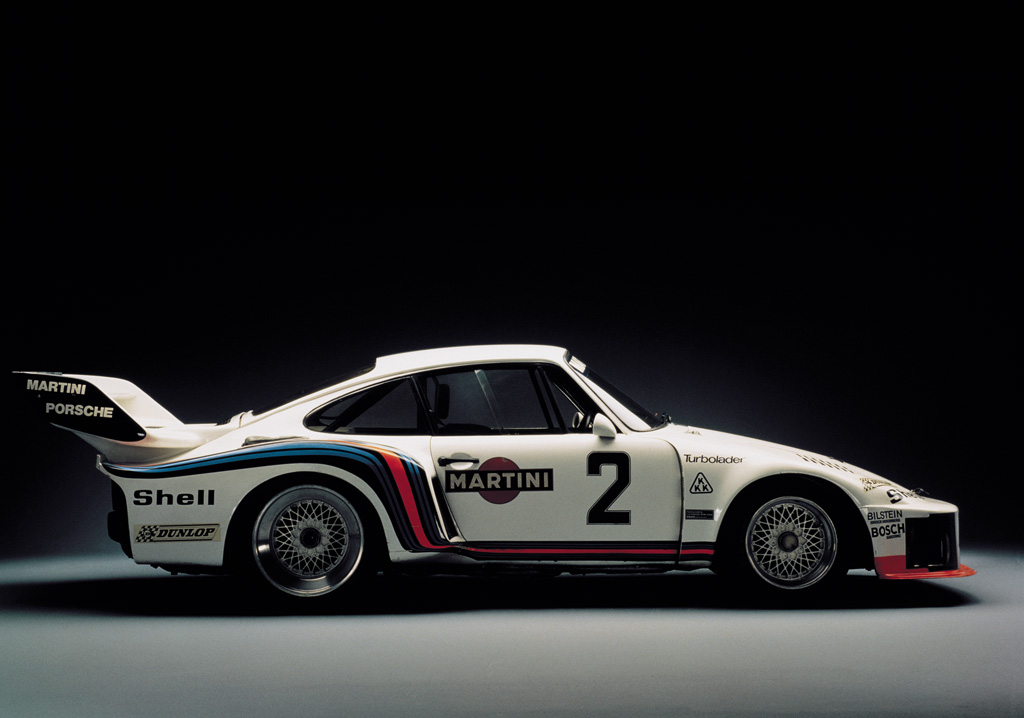
Porsche’s 935 was made to contest various Group 5 ‘Silhouette’ races such as the World Championship of Makes, IMSA GT and Deutsche Rennsport Meisterschaft (DRM). By 1977, the 935 was sold as a customer car for these series to race against cars like the BMW CSL. Thus, the 935 had a long period of developmental upgrades and race wins along the way.
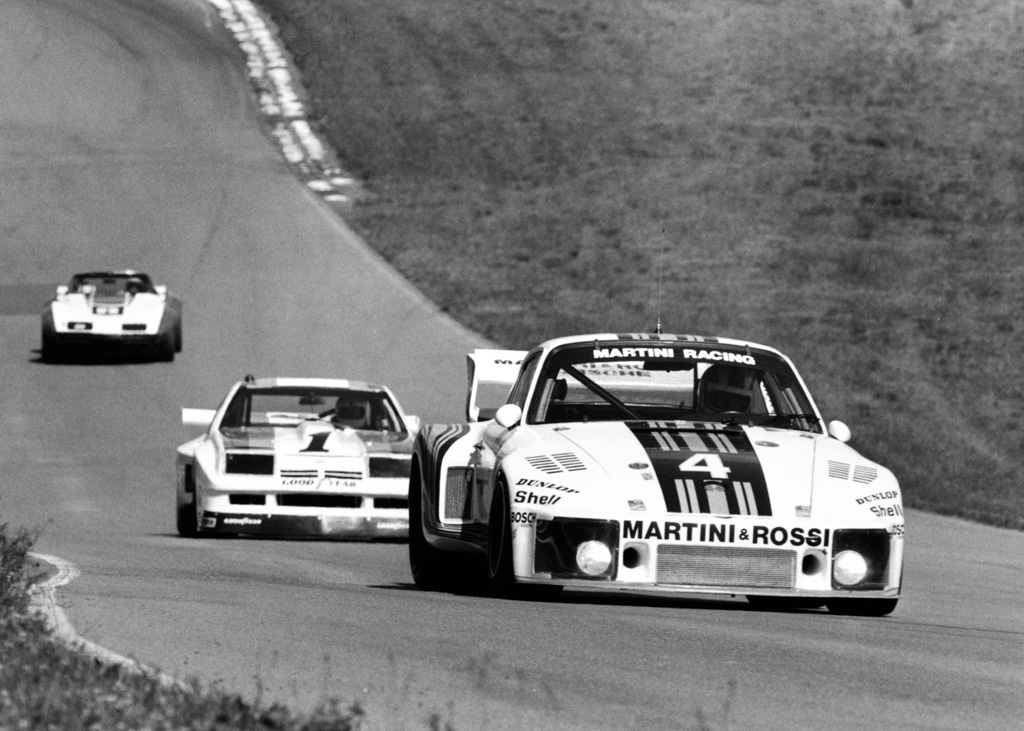
Providing a basis for the 935 was the Porsche Carrera RSR 2.1 Turbo which contested the 24 Hours of Le Mans in 1974. Due to the more relaxed Group 5 regulations, engineer Norbert Singer could drastically alter the outer-bodywork of the standard 930 unitary steel monocoque. This allowed for much larger fender flares and a huge rear wing. Half way through the 1976 season, Porsche relocated the front headlights to the Flachbau or flatnose design.
The design retained the 930 Turbo bodyshell which was stiffened by an aluminum roll cage. The attached front and rear sections were made from fiber-glass and 5-inch wheel arches were fitted covering 15-inch tires in the rear. Plexiglass windows and other lightweight construction meant that the car was produced 90 kg underweight which was offset by ballast.
Using the 1.4 equivalency factor given to turbocharged engines, Porsche could assemble a 2.9-liter engine that fit well within the 4-litre restriction. To offset the smaller displacement, a huge KKK turbocharger was fitted which helped the 2808cc flat-6 produce close to 600 bhp. This number varied depending on the boost which ranged from 1.35 and 1.55 bar.
The engine used dual-ignition, a 908-style fuel pump, plunger-type fuel injection and spraybar lubrication. Consumption was rated at 4.38 mpg.1 A knob on the dashboard controlled the boost which could vary the power from a reliable 550 bhp to 650 bhp in sprint mode.
The suspension and wheels were also drastically upgraded including coil springs, adjustable anti-roll bars, and larger ventilated discs. Naturally, the car was completely stripped and Porsche managed to reduce weight to 900 kg. With ballast the car could then meet the required 970 kg formula.
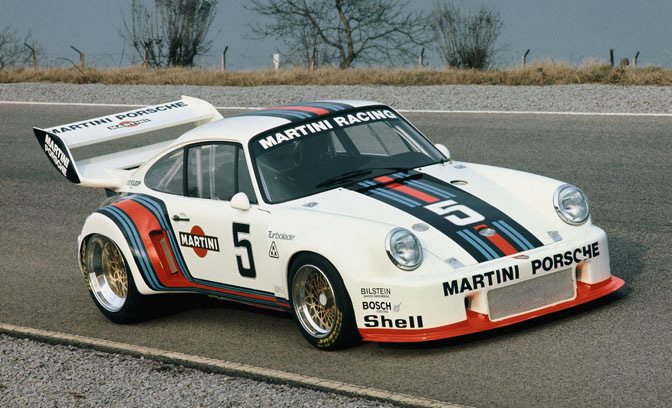
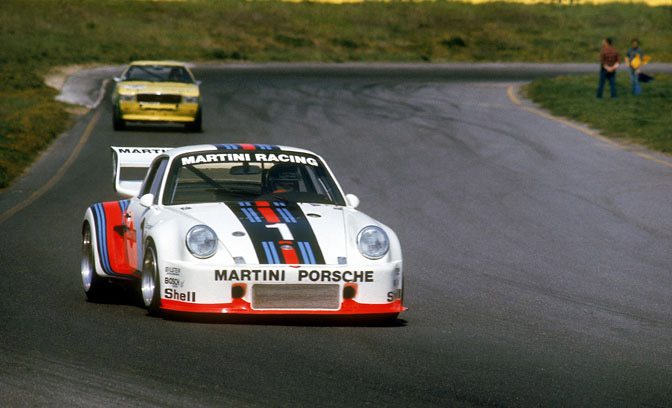
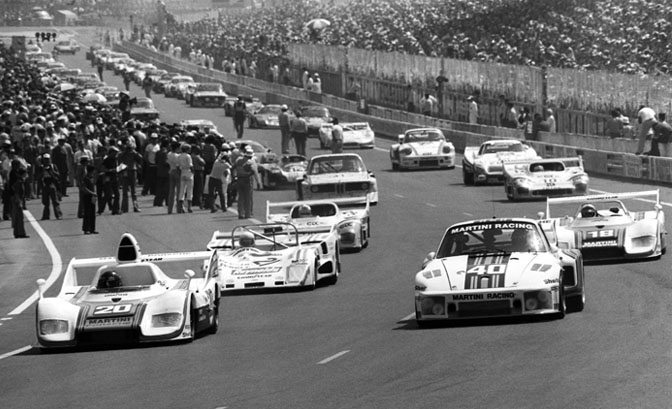
The first season was largely developmental for Porsche but under the Martini Racing banner they were quite successful, winning the championship outright by a very narrow margin. Typically driven by Jacky Ickx and Jochen Mass, the 935 won the 6-hour races at Mugello, Vallelunga and Dijon. Later in the season, the works cars were joined by privateers in the 935/77 and a couple bespoke cars built by Kremer.
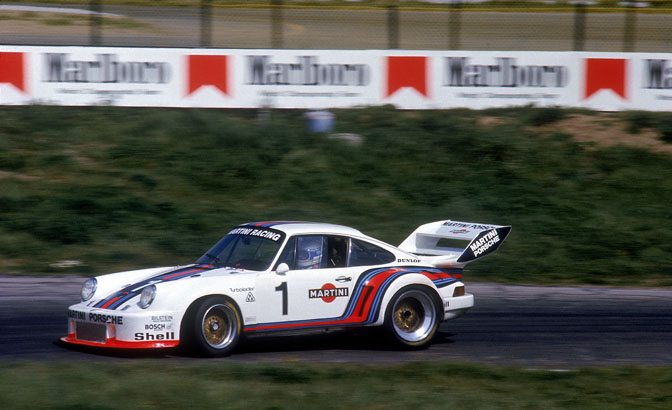
For the last two legs, Porsche needed to secure vital points and they used both 935.001 and 935.002 to contest the final two races. Drivers Rolf Stommelen and Manfred Schurti won the Watkins Glen 6-Hours outright in 935.001 which nearly secured the Championship. The final round at Dijon, Jacky Ickx and Jochen Mass won again for Porsche and the Championship was secured.
Sources & Further Reading.
1. Starkey, John. 930 to 935 The Turbo Porsches. Gryfon Publishers: 1998.
In Detail
| type | Racing Car |
| built at | Germany |
| engineers | Norbert Singer |
| production | 2 |
| engine | Type 930/72 Boxer-6 |
| position | Rear, Longitudinal |
| aspiration | KKK Turbocharger |
| block material | Aluminum |
| valvetrain | SOHC, 2 Valves perCyl |
| fuel feed | Bosch Mechanical Fuel Injection |
| displacement | 2856 cc / 174.28 in³ |
| bore | 92.8 mm / 3.7 in |
| stroke | 70.4 mm / 2.8 in |
| compression | 6.5:1 |
| power | 417.6 kw / 560 bhp @ 8000 rpm |
| specific output | 196.08 bhp per litre |
| bhp/weight | 622.22 bhp per tonne |
| torque | 587.1 nm / 433 ft lbs @ 5400 rpm |
| body / frame | Unitary Steel Monocoque w/Fiberglas Panels |
| driven wheels | RWD |
| front brakes | Ventilated Discs w/4-Piston Calipers |
| rear brakes | Ventilated Discs w/4-Piston Calipers |
| front wheels | F 40.6 x 26.7 cm / 16 x 10.5 in |
| rear wheels | R 48.3 x 38.1 cm / 19 x 15 in |
| steering | Rack & Pinion |
| f suspension | MacPherson Struts w/Bilstein Dampers, Adjustable Anti-Roll Bar |
| r suspension | Double Wishbones w/Bilstein Dampers, Adjustable Anti-Roll Bar |
| curb weight | 900 kg / 1985 lbs |
| weight distro | 40 % / 60 % |
| wheelbase | 2271 mm / 89.4 in |
| front track | 1501 mm / 59.1 in |
| rear track | 1557 mm / 61.3 in |
| length | 4681 mm / 184.3 in |
| width | 1971 mm / 77.6 in |
| transmission | 4-Speed Manual |
| top speed | ~339.50 kph / 211 mph |
| 0 – 60 mph | ~3.3 seconds |
| 0 – 100 mph | ~6.1 seconds |
| 0 – 1/4 mile | ~8.9 seconds |
| fuel econ epa | 52 L/100 km or 4.52 mpg-us |
| city fuel econ epa | 58.80 L/100 km or 4 mpg-us |
| key drivers | Jacky Ickx, Jochen Mass, Rolf Stommelen, Manfred Schurti |
| race victories | 1976 Watkins Glen 6 Hours, 1976 Dijon 6 Hours |
Auction Sales History
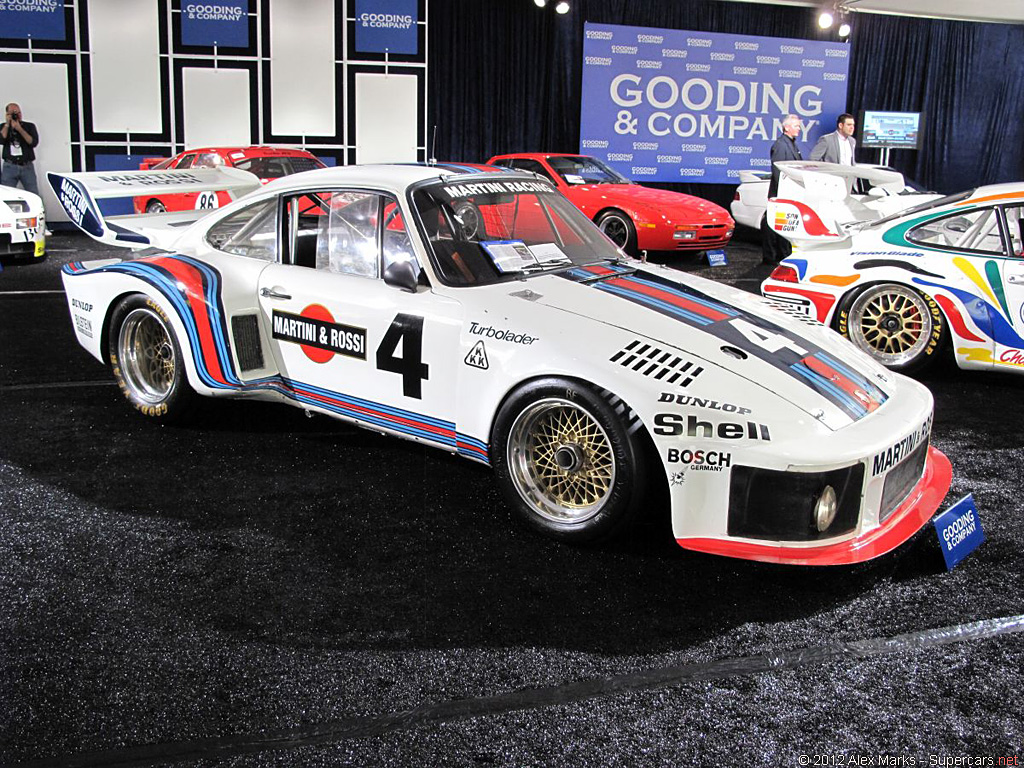
1976 Porsche 935/76 9305700001 (R14) – sold for $2,530,000 The First 935 Built and the First 930 Chassis. Factory Prototype Used for Testing and Development Work. First Overall at Watkins Glen and Third at Dijon. Driven by Rolf Stommelen and Manfred Schurti. An Integral Component of Porsche’s 1976 Group 5 Championship. Only Four Private Owners Since Leaving Porsche. Well-Preserved, Largely Unrestored Condition. The Only Works 935/76 in Private Ownership. A Significant Piece of Motor Racing History. Auction Source: The Amelia Island Auction 2012 by Gooding & Company