

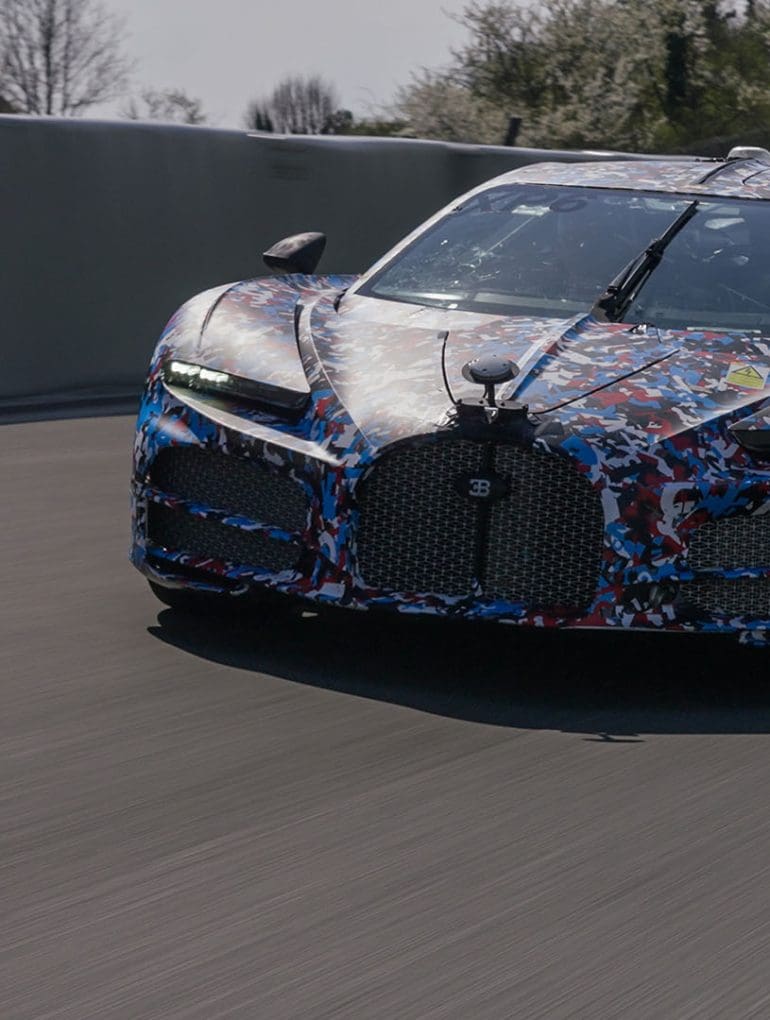

When you’re building a hypercar with 1,800 PS on tap, every component matters. But according to Bugatti’s development team, none is more important than the four small patches of rubber connecting the car to the road.
In the latest episode of Bugatti’s A New Era documentary series, the Tourbillon development program arrives at Michelin’s renowned Ladoux proving grounds in France, where engineers and test drivers faced one of the most critical challenges in the hypercar’s journey to production: selecting the perfect tire.

The Tourbillon has already endured extreme testing conditions, from the icy landscapes of Sweden to the high-speed banking of Italy’s Nardò test track. Now, with production drawing closer, attention has turned to the component that ultimately translates the car’s astonishing performance into real-world grip.
At the center of the program is Chief Test and Development Driver Miroslav Zrnčević, whose role extends far beyond simply driving prototypes.
“If it was a kitchen, I would be the taster,” explains Zrnčević. “I’m working with different engineering teams to develop the character of the car – controls, vehicle dynamics, everything else.”
A tire built exclusively for the Tourbillon
Unlike many high-performance vehicles that adapt existing tire technology, Bugatti and Michelin opted to create an entirely bespoke solution for the Tourbillon. The challenge was immense. Compared with the Chiron, the new Tourbillon delivers higher power, stronger acceleration and even greater performance potential. Existing tire technology simply wasn’t enough.

Months of virtual development and simulation work allowed Bugatti and Michelin engineers to evaluate numerous front and rear tire concepts before narrowing the field to just three final candidates. These were then subjected to extensive real-world testing at Ladoux, where specialized tracks enabled detailed analysis of high-speed stability, cornering behavior and overall handling balance.
The evaluation process combined objective telemetry with subjective driver feedback, ensuring the selected tire would not only deliver exceptional performance but also contribute to the unique driving character Bugatti wanted for the Tourbillon.
The most important part of the car?
For Zrnčević, the answer is simple. “The tire is the most important part,” he says. “You only have four small contact patches connecting the car to the ground. What happens there defines everything else.”

It’s a statement that carries significant weight when discussing a hybrid hypercar producing 1,800 PS. No matter how advanced the powertrain, suspension or electronic systems become, everything ultimately depends on the tires’ ability to transmit power, steering inputs and braking forces to the road.
Developing the car and tire at the same time
One of the biggest engineering challenges was timing. Tire development had to progress simultaneously with the evolution of the vehicle itself, forcing engineers to make critical decisions before every system on the Tourbillon had reached full maturity.

“You always develop things in parallel, and this is the most challenging part,” explains Zrnčević. “The car and its systems are at a certain maturity level—not necessarily at the optimal one to choose the tire—but you need to do it because it takes time to produce and validate the tire.”
The process required close collaboration between Michelin’s tire specialists and Bugatti’s vehicle dynamics team, translating driver impressions into measurable engineering targets that could be refined throughout development.
Technology meets human instinct
While simulation technology played a major role in the Tourbillon’s development, engineers spent more than three years working in virtual environments before final validation began, Bugatti insists that computers alone cannot create a great driver’s car. Head of Vehicle Dynamics Tomislav Šimunić believes human feedback remains irreplaceable.

“In the end, we are developing cars for people,” he says. “We cannot develop everything just with computer technology. We need the drivers and this emotional, subjective factor in the whole story.”
A major milestone reached
By the conclusion of the Ladoux test program, Bugatti had successfully identified its preferred tire specification. With the tire package finalized, engineers can now focus on fine-tuning steering calibration, suspension settings, damping characteristics and electronic control systems around the chosen setup.

It marks another significant milestone in the Tourbillon’s path toward production. More importantly, it highlights a truth often overlooked in the pursuit of horsepower and top-speed headlines: even in an 1,800-PS hypercar, ultimate performance begins and ends with four carefully engineered contact patches.