
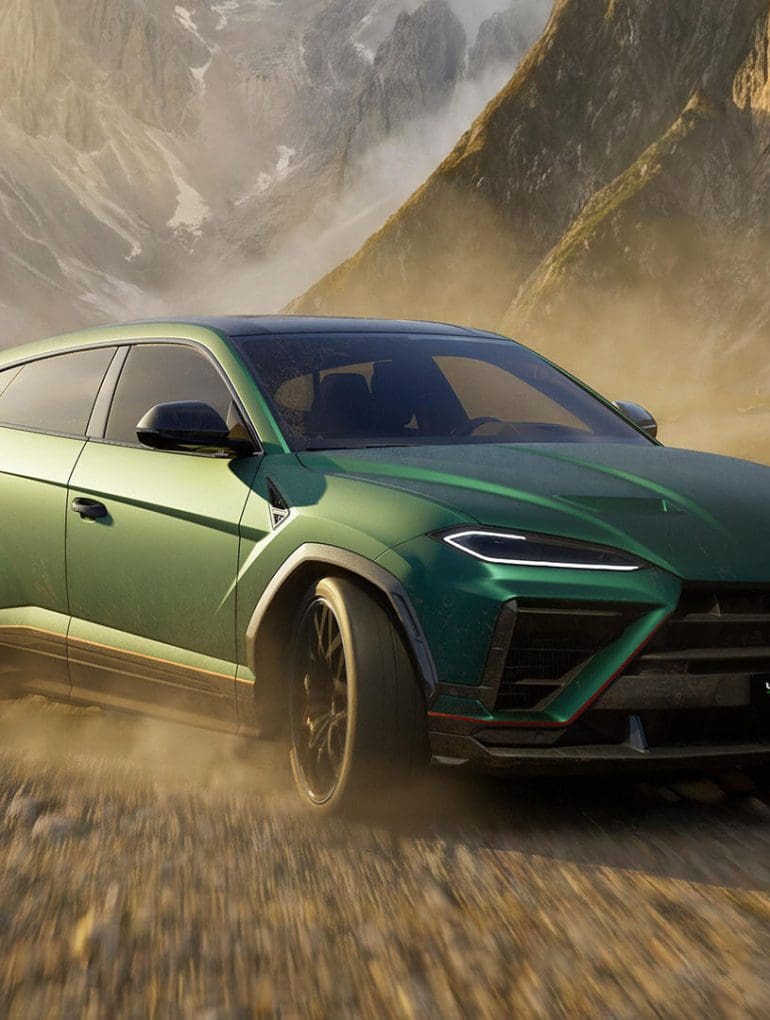
When Lamborghini launched the original Urus, critics questioned whether an SUV deserved to wear the raging bull badge. Nearly a decade later, that debate has largely disappeared. The Urus has become the brand’s best-selling model, introduced thousands of new customers to Sant’Agata Bolognese and helped fund the development of Lamborghini’s next generation of electrified supercars.
Now comes what could be the most ambitious version yet.

The new Urus SE Performante doesn’t merely add more power or a fresh body kit. It represents a comprehensive rethink of what a high-performance SUV can be, combining plug-in hybrid technology with lighter construction, smarter aerodynamics, advanced suspension and a host of predictive electronic systems designed to make one of the world’s quickest SUVs even sharper to drive.

The headline figures are suitably outrageous. A combined output of 812 hp (596 kW), 1,000 Nm of torque, a 0-100 km/h sprint in just 3.3 seconds and a top speed of 312 km/h firmly place the Urus SE Performante among the fastest SUVs ever built. But Lamborghini insists the real story lies beyond the acceleration numbers.
More Than Just Another Performance Upgrade
The temptation with any flagship performance model is to assume it’s simply the previous version with a little more boost pressure and some extra carbon fibre. Lamborghini claims that’s far from the case here.

Instead, engineers approached the project from every angle. Power, weight, aerodynamics, suspension, braking and software have all been revised with a single objective: making the Urus feel less like a very fast SUV and more like a genuine Lamborghini supercar that happens to seat five people.

That philosophy becomes obvious before you even step inside.
The Urus SE Performante wears an aggressive new front end featuring a carbon-fibre bonnet with functional S-Duct air channels, larger cooling intakes and a more sculpted profile than the standard SE. Carbon fibre is used extensively throughout the exterior, from the bonnet and roof to the wheel arches, side skirts and rear diffuser.

These aren’t cosmetic additions designed to impress outside a luxury hotel. Every panel contributes to reducing weight or improving airflow.
A redesigned front splitter increases downforce over the front axle, while a taller rear spoiler works alongside a larger diffuser to improve high-speed stability. Lamborghini says the new package delivers significantly more aerodynamic efficiency while simultaneously reducing drag, a combination that’s notoriously difficult to achieve.

The result is an SUV that looks more purposeful without abandoning the clean, unmistakable silhouette that has defined the Urus since its debut.
Hybrid Power With Supercar Intentions
Electrification continues to divide opinion among enthusiasts, but Lamborghini has embraced it as a performance tool rather than simply a way of reducing emissions.
The Urus SE Performante pairs the familiar 4.0-litre twin-turbocharged V8 with a permanent-magnet electric motor positioned ahead of the eight-speed automatic transmission. Together they produce 812 hp and 1,000 Nm, making this the most powerful Urus ever created.

Unlike some plug-in hybrids that rely heavily on electric assistance to mask turbo lag or improve fuel economy, Lamborghini has calibrated the system to enhance throttle response and maintain relentless acceleration throughout the rev range.
Torque arrives from just 2,000 rpm and remains available across a remarkably broad operating window, ensuring the SUV feels explosive whether leaving a standstill or overtaking at motorway speeds.

Despite its extreme performance credentials, the hybrid system also adds genuine versatility. A 25.9 kWh lithium-ion battery enables more than 60 kilometres of electric-only driving, allowing owners to commute through city centres in near silence before unleashing the V8 once the road begins to open up. That dual personality has become one of the defining characteristics of modern Lamborghini engineering.
Lighter, Faster, Smarter
Perhaps the biggest engineering achievement isn’t the increase in horsepower but the reduction in weight. Large carbon-fibre body panels, a titanium exhaust system, lighter braking hardware and careful optimisation throughout the vehicle trim approximately 32 kilograms compared with the Urus SE.

That gives the Performante an impressive power-to-weight ratio of just 3 kg per horsepower—an extraordinary figure for an SUV weighing nearly two-and-a-half tonnes. While 32 kilograms might sound modest on paper, Lamborghini argues that reducing mass in strategic locations transforms the vehicle’s responses far more than adding another 30 or 40 horsepower ever could.

The extensive use of lightweight materials also lowers the centre of gravity, helping the Urus resist body roll while improving steering precision during aggressive driving.
Suspension Designed To Do Both Jobs
Performance SUVs have always struggled with compromise. Make the suspension firm enough for enthusiastic driving and passengers complain on ordinary roads. Soften everything for comfort and the handling becomes vague once speeds increase. Lamborghini believes it has found a solution through its new dual-chamber AURA air suspension.

Unlike conventional air springs, the system uses two independently managed chambers that can alter spring characteristics according to the selected driving mode. During spirited driving the suspension prioritises body control, reducing roll by more than half compared with previous systems. Switch into more relaxed settings and the second chamber allows significantly greater compliance over uneven surfaces, reducing vibrations while maintaining tyre contact.

Combined with electronically controlled dampers capable of adjusting compression and rebound independently, the result is a chassis with an unusually broad operating range. It’s designed to feel comfortable enough for long-distance touring while remaining composed on demanding mountain roads or racing circuits.
Electronics That Think Ahead
Modern performance cars increasingly rely on predictive software rather than simply reacting to driver inputs, and the Urus SE Performante takes that philosophy even further. A new six-degree-of-freedom sensor positioned close to the vehicle’s centre of gravity continuously monitors acceleration, pitch, roll and yaw. Working alongside multiple accelerometers placed around the chassis, the system builds a detailed picture of how the SUV is moving at any given moment.

That information feeds Lamborghini’s latest Integrated Power Brake and vehicle dynamics systems, allowing the electronics to anticipate changes in grip rather than waiting for wheel slip or instability to occur. The braking system itself has also evolved. Instead of the familiar pulsing sensation associated with conventional ABS, brake pressure is adjusted more progressively, improving pedal feel while shortening stopping distances and increasing driver confidence during repeated heavy braking.
For drivers, the effect should be largely invisible. The objective isn’t to overwhelm occupants with technology but to create the impression that the vehicle simply behaves exactly as expected, regardless of road conditions.
Rally Mode Brings A Different Personality
One of the most intriguing additions is a dedicated Rally mode. Performance SUVs have become increasingly capable away from smooth tarmac, yet few encourage drivers to actively enjoy loose surfaces. Lamborghini has specifically calibrated the new mode for gravel and dirt roads, allowing greater freedom of movement while maintaining enough electronic oversight to keep everything under control.

It’s a reminder that the Urus traces part of its lineage back to the legendary LM002, Lamborghini’s unconventional off-road machine from the 1980s. Although few owners are likely to subject a six-figure luxury SUV to serious off-road punishment, knowing it’s capable of tackling rough terrain only adds to its appeal.
A Cabin That Feels More Like A Cockpit
Inside, Lamborghini has focused on making the driver feel central to the experience without sacrificing the comfort expected in a premium SUV.

The latest version of the “Feel Like a Pilot” philosophy introduces new sports seats, extensive carbon-fibre trim and upholstery combining leather with performance-oriented Dinamica materials. A redesigned steering wheel, aviation-inspired switchgear and updated graphics for the 12.3-inch infotainment system help modernise the cabin while maintaining the distinctive Lamborghini atmosphere.

The digital instrument display and infotainment system also integrate telemetry functions, enabling drivers to monitor vehicle performance during track sessions. Unlike many technology-heavy interiors, however, the design still prioritises theatre.

Every button, switch and paddle feels deliberately mechanical, reinforcing the emotional connection between driver and machine.
A Soundtrack Worthy Of The Badge
Hybridisation often raises concerns about engine sound, but Lamborghini appears determined to preserve the emotional drama expected from its V8. The standard titanium Akrapovič exhaust is lighter than before and engineered to produce a more distinctive soundtrack across different driving modes. Internal resonators reduce unwanted booming while enhancing the deep, metallic tone associated with Lamborghini’s performance models.

Software calibration also plays an important role. Sport mode extends the characteristic overrun crackles, while Corsa produces sharper, more aggressive pops under braking and throttle lift. Even the start-up sequence has been tuned to create maximum theatre, with the engine briefly flaring before settling into idle. It’s a reminder that emotion remains just as important as objective performance.
The Bigger Picture
The Urus SE Performante arrives during a period of enormous change for Lamborghini. Every model in the company’s range now incorporates some form of electrification, marking one of the most significant technological transitions in its history. Yet the company’s approach differs noticeably from many rivals.

Rather than presenting hybrid systems primarily as environmental necessities, Lamborghini continues to frame them as performance enhancers capable of delivering sharper responses, stronger acceleration and greater versatility. The Urus SE Performante embodies that philosophy perfectly. Its electric motor isn’t there to dilute the experience; it’s there to make every input feel more immediate.
Final verdict
The world’s fastest SUVs are no longer simply about horsepower.
Almost every manufacturer can produce astonishing straight-line performance given sufficient power and all-wheel drive. The real challenge lies in making two-and-a-half tonnes feel agile, engaging and unmistakably special. On paper, Lamborghini has thrown every available technology at that challenge.

More power, less weight, smarter aerodynamics, predictive chassis electronics, dual-chamber suspension, a titanium exhaust and genuine electric capability combine to create a machine that aims to redefine expectations of what a luxury performance SUV can achieve.
Whether it ultimately becomes the new benchmark will depend on how all those innovations work together on the road. But one thing is already clear. The Urus is no longer simply the SUV that transformed Lamborghini’s fortunes. With the arrival of the SE Performante, it’s becoming the technological showcase for everything the company has learned about building fast, electrified performance cars.

If this is the future of the Super SUV, it’s arriving with 812 horsepower, a titanium soundtrack and enough engineering ambition to ensure the raging bull remains firmly at the front of the pack.