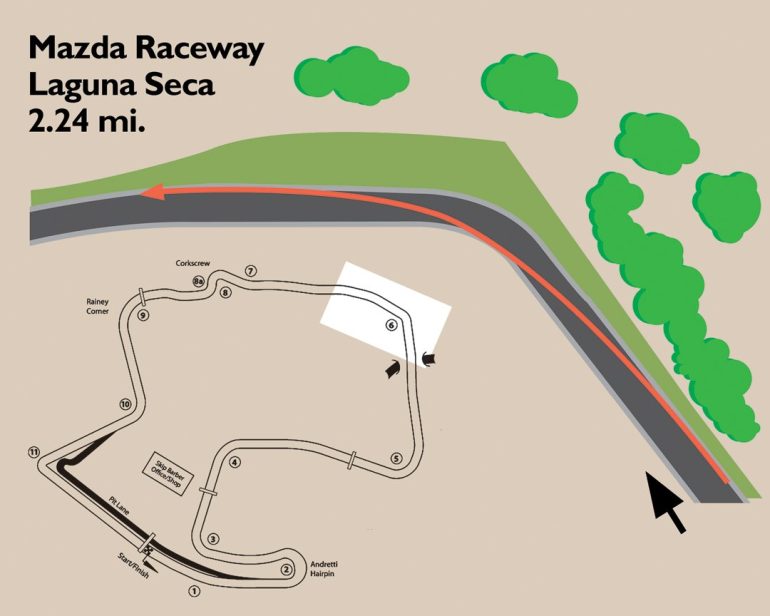
Justly famous for corners such as the Corkscrew and Andretti (a.k.a. Turn 2), plain-named Turn Six is actually one of the more important corners at this world-famous track. As you’ll remember from “Racecar Driving 101,” good lap times are based on straightaway speeds. Straightaway speeds are based on corner exit speeds. And leaving T6 puts you on a long straightaway. Six also has a reputation as a “difficult” corner (i.e., people crash here). This is not due to the corner being technically more difficult as far as the proper line, but rather because of its unique contours and elevation changes. The good news relating to the potential crashes at the exit of T6 is that, in recent years, the wall on driver’s left was moved farther away from the track. This has greatly reduced the number of wall hits resulting from TTO (trailing throttle oversteer) spins, which means we can say goodbye to the “rainbow wall.” (This wall was a panoply of colors, a mural painted by the multitude of different colored cars that ended their races here.)
Turn Six is a fairly high-speed corner, as are many at Mazda Raceway, and thus requires a normal “back to power at turn-in” technique. But here’s the complication: While the second half of the corner heads uphill toward the Corkscrew and therefore provides increased grip, the beginning of Six actually goes downhill toward the apex. More difficulty: It’s a corner where a traditional late turn-in can be too abrupt, adding its own problems to the contour difficulties. Just as you turn in, you crest a small rise, but then the track falls away slightly all the way to the apex. What this means is that, initially, as you start turning into the corner, the back end of the car becomes momentarily unweighted and has a tendency to lose traction. So, concentrate on slowing early in a straight line and then using the throttle to shift weight to the rear during the initial corner entry—the normal technique for any higher speed corner. This is even more important in Six, due to the unweighting caused by the “dip” on the way to the apex. Slowing too late and coasting into T6 can cause oversteer faster and more aggressively than almost any other corner I can think of.