
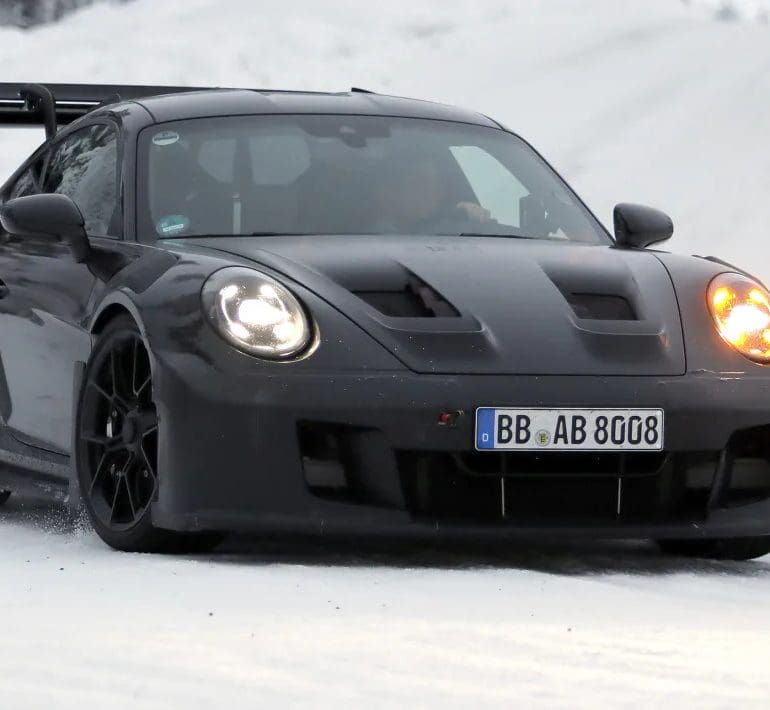

Recently spotted testing on the frigid Scandinavian tundra, the latest test mule for the upcoming 992.2 GT3 RS, even at just a glance, reveals some very telling details. But for as much as it does answer, it also presents many more new questions. Or challenges.
Let’s start with the nitty-gritty of what’s verifiable through either our eyes or by spoken truths. We’ve become accustomed to Porsche’s mid-cycle “facelifts”—as they’ve broadly come to be known—featuring slight cosmetic refreshes, and a few relatively small tweaks or refinements to the suspension geometry or other driver-centric features.
That’s still very much the case for the upcoming 2027 Porsche 911 GT3 RS. Based on the spy photos, the new GT3 RS is the beneficiary of a new headlight design and a reimagined front fascia design. It also now features what looks to be a 3-element DRS (an upgrade from the 992.1’s 2-element), suggesting that another tier of active aero performance will now be unlocked. Everything checks out, so far.
But Wait, There’s More!
Most revealing of the “minor” changes, perhaps, are the larger front intake ducts and a revision of the exhaust system which appears to have added 2 additional exhaust pipes—one on either side-of the center-exit dual tailpipes. Eagle-eyed observers also pointed out additional air outlets on the rear bumper. All of this, ultimately, is hinting at much, much more.
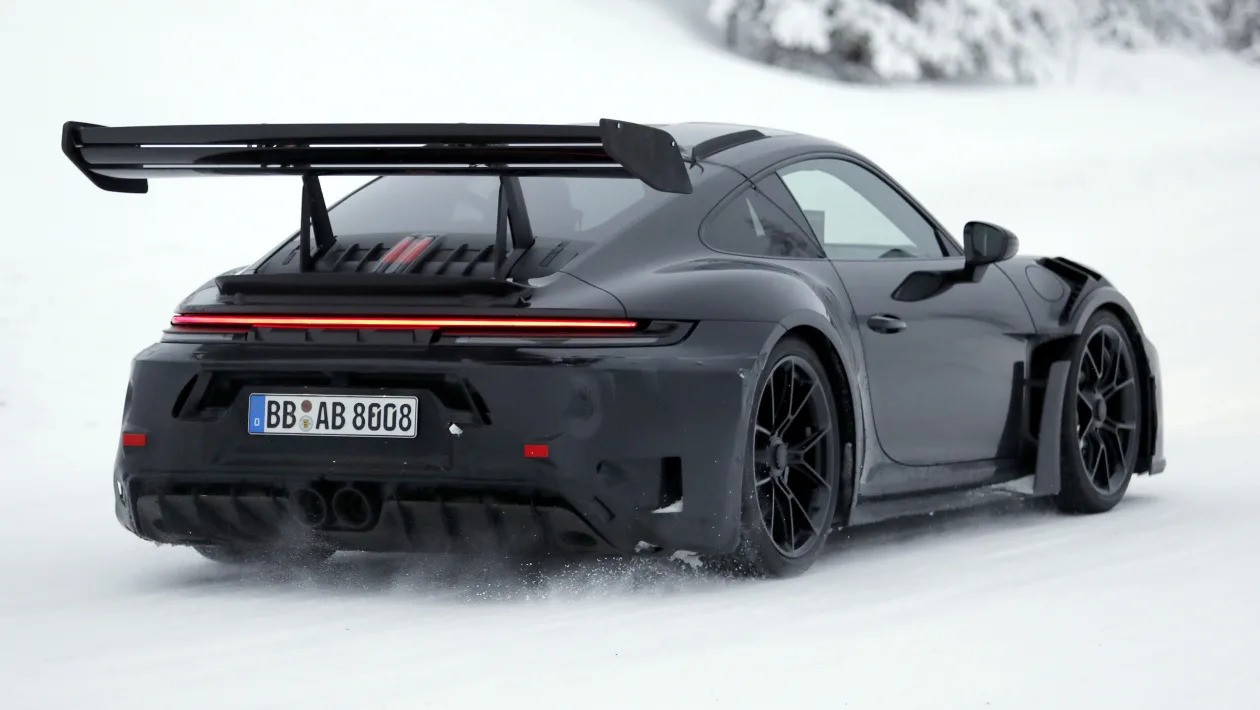
Now, had the engine remained relatively or even completely untouched, it looks like all of the boxes have been ticked for this to be adequately deemed a “facelift”. Even with just the surface-level details, we can also confidently assume that Porsche will make some small adjustments to the suspension and other metrics such as steering/gear ratios and electronic nannies, all in an effort to deliver a more involved driving experience. I expect to see the new carbon buckets, as debuted on the 992.2 GT3, featured here also.
The 992.2 GT3 RS has smashed that convention to pieces now, introducing—as some might have already derived from some of the empirical evidence on hand—a new turbocharged powerplant to the once exclusively naturally-aspirated nameplate.
But Why?
At the offset, the reason for this monumental shift in philosophy looks to be two-pronged in its approach. The most obvious would have to be in relation to the same emissions regulations—namely, Euro 7—which propelled Porsche towards its first foray into the EV market, as well as the decision to begin turbocharging or hybridizing many of its existing models for the first time. Given that regulations are only getting stricter, all of that it seems, was a test-run leading up to this very moment. It was going to happen at some point, and here we are.
The next, might not be as apparent, depending on where your biases lie and how much real-estate the bubble you live in covers. In and of itself, the 992 GT3 RS is undoubtedly a marvel on the racetrack. The adoption of elaborate active aerodynamics technology and use of a full double-wishbone suspension design for the first time on the platform, are some of the things hugely responsible for the production car’s initially undisputed domination on the circuits.
That gap has certainly been diminished since the 992 GT3 RS’s debut, with other marques now offering legitimately competitive alternatives to Porsche’s quintessential track car and at much lower price points, particularly for North American customers. Cars like the latest Corvette ZR1 and Ford Mustang GTD immediately come to mind.
With the 525 hp 4.0L naturally-aspirated flat-6 very much tapped out for power—especially as it relates to remaining emissions-compliant—the only sure-fire way for Porsche to re-establish the GT3 RS at the top of the hierarchy is through a massive power bump. The nature of which only a turbocharged (or hybrid, or both) powerplant can afford. Afterall, you could say that the current GT3 RS is massively hamstrung compared to its latest rivals, which boast 1,064 hp and 815 hp, respectively, through the use of a 5.5L twin-turbocharged V8 and a 5.2L supercharged V8, respectively.
The Future
If not for inflation on its own, the 992.2 GT3 RS was always going to be more expensive than the outgoing version. One of the biggest questions the latest proposition raises is how much pricing will be affected by the addition of a turbocharged powerplant. If we were to use recent history as a reference point—via the 991 GT3 RS and 991 GT2 RS—then we might be in for quite a significant bump in MSRP.
To a certain limit, I don’t think most Porsche loyalists will care too much about pricing, as long as the new car is able to smoke its competition (and predecessor) out of the water. At a minimum, that has to be the main mission for the successor. As far as race-bred road cars go, this is the kind of aura that Porsche still commands, particularly in relation to brands like Chevrolet and Ford. People, in general, are willing to pay a premium for the Porsche badge….at least for now.
A New Path
Some argue that Porsche might even have made the current 992.1 GT3 RS too capable, too quickly. It’s a car that galvanized other manufacturers to fast-track their motorsport R&D in an effort to prevent Porsche from getting too far ahead. With how that has played out, Porsche have now basically been strong-armed into making the next GT3 RS—whether it was going to be a refresh or next-gen overhaul—a turbocharged car. Emissions regulations were always taking us on this path, but the current state-of-play has likely sped that process up faster than the Stuttgart suits would’ve liked.
It also muddies the waters a little bit when it comes to the upcoming 992 GT2 RS. The primary distinction between the GT3 RS and GT2 RS up to now, has always been that they were exclusively naturally-aspirated and turbocharged, respectively. Now, the upcoming GT3 RS has blurred the lines between the two cars, making us wonder how they are going to manage to be principally different cars going forward. That being said, early speculation has already suggested that the new GT2 RS will feature a mild-hybrid setup, so there’s that.
Somehow, all of this news is just a blip in the grand scheme of things—a precursor for a chain of events to follow. I believe that the GT3 RS becoming turbocharged, is emblematic of so much more. I think that in earnest, the new GT3 RS marks the end of naturally-aspirated Porsche 911s. The only naturally-aspirated model which will run concurrent to the 992.2 GT3 RS is the 992.2 GT3, and as such, more than likely presents the last realistic opportunity to purchase a 911 which isn’t turbocharged, hybrid, or perhaps worse….