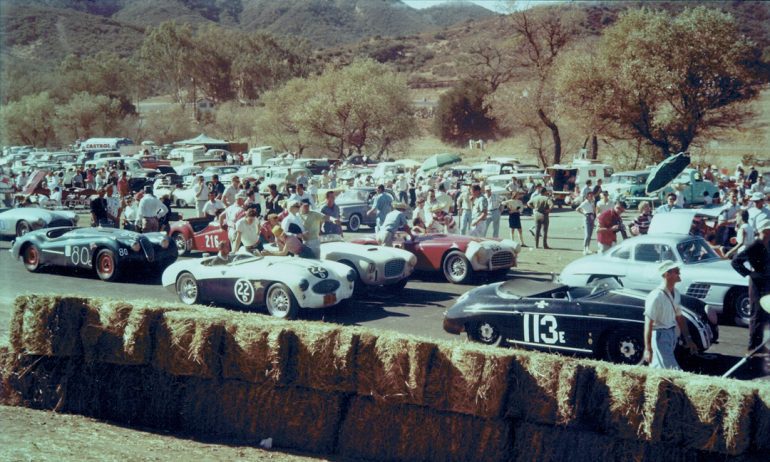
The Porsche Super Speedster of Lou Bracker (#113), the Austin Healey 100S of Gil Bloemendaal (#22) and the Jaguar XK-120 of Jim Mathews (#80) line up for the big production car race in November 1956.
Photo: Allen Kuhn
Eventual winner, Harrison Evans, in a Ferrari Monza, chases the Jaguar D-Type of Bill Krause on Paramount RanchÕs opening weekend August, 1956. Photo: Jim Sitz
In 1921, Paramount Pictures bought a 2,700 acre parcel of land near Agoura, California, that had been part of the Rancho Las Virgenes Spanish land grant. Paramount used the ranch as a set for movies, building up a western town, a colonial New England street, a fortress and support buildings including barns, stables, a craft shop and a commissary. As Paramount’s needs changed through the years, parts of the property were sold off for development. By 1952, William Hertz purchased the remaining 326 acres, which he and his son, Robert, continued to operate as a movie set, leasing it to the studios. TV productions, The Cisco Kid and The Zane Grey Theatre, were added to the long list of feature films that had been shot on the property, including The Virginian, Sante Fe Trail and Pony Express. Hertz added more buildings, purchased when RKO shut down its Encino ranch in 1954. The next year, his health began to fail and he sold the property to an investor group.
Starter Cy Yedor congratulates Richie Ginther after GintherÕs win in the inaugural under-1500 cc feature. Photo: Jim Sitz
At this time, sports car racing was entering a new era. After accidents and political hassles closed most of the original street circuits, where the road racing revival had begun after World War II, the sport had survived on airport circuits. Now, bolstered by 1950s prosperity, purpose-built road circuits were about to be built. The Paramount Sportsman’s Ranch, an investor group led by a man named Drummond, bought the property after officers of the California Sports Car Club had failed in an attempt to put together a stock underwriting to raise money. The Drummond investors were early participants in a mid-fifties road circuit building boom that was similar to the proliferation of oval tracks in America in recent years. 1957 saw years of planning come to fruition with new courses opening at Riverside, Lime Rock and Bridgehampton. The last of these had all approvals and permits two years earlier, but it took that long to arrange the financing. Many other proposed tracks with overly optimistic timetables and inflated promotional releases never reached completion.
Members only$29 / year
Keep going. This is where it gets good.
Supercars.net Membership is for people who'd rather know the spec sheet by heart than skim ten headlines. The rest of this story — and every other one like it — is a few seconds away.
Thousands of members-only stories
Deep dives, driven reviews and the full archive back to 2005.
No ads. None.
The whole site reads like a magazine, on every device.
Every car, every spec
Twenty years of models, numbers and history in one place.
30% off the shop
Every Supercars.net shirt and piece of merch, all year.
$29 a year. Cancel anytime, no hoops. Already a member? Sign in
BY CAR PEOPLE, NOT A NAMELESS MEDIA COMPANY. Your membership keeps a small independent team that celebrates the brands and cars that defined this industry doing this.