
In an era where most concept cars are little more than design exercises, Rolls-Royce does things differently. Its Experimental, or EX, cars aren’t built to tease the future. They’re built to define it. And in 2026, the British marque is celebrating a rare milestone: three of its most modern prototypes, 101EX, 102EX and 103EX, are marking their 20th, 15th and 10th anniversaries respectively.

Not Concepts. Not Prototypes. Something More.
While the industry often uses concept cars to “test the waters,” Rolls-Royce flips that idea entirely. EX cars are fully functional, road-ready machines, engineered with a clear vision of what elite clients will want next. This philosophy traces back to founders Henry Royce and Charles Rolls, whose experimental machines shaped icons long before the modern era.

Today, that same DNA runs through every Rolls-Royce, from the coachbuilt Rolls-Royce Sweptail to the all-electric Rolls-Royce Spectre.
101EX (2006): The Coupe That Changed Everything
Debuting in Geneva, 101EX was a statement: Rolls-Royce could be driver-focused, sleek, and dynamic without losing its signature opulence. Shorter, lighter, and more aggressive than the Phantom, it introduced what would become one of the brand’s most iconic features, the Starlight Headliner.

Two years later, it evolved into the legendary Rolls-Royce Phantom Coupé, a car that helped reposition Rolls-Royce as a modern luxury powerhouse.
102EX (2011): The Electric Pioneer
Long before EVs became mainstream, Rolls-Royce was already experimenting. 102EX, also known as the Phantom Experimental Electric, was the brand’s first fully electric car. With one of the largest batteries of its time and even early wireless charging tech, it was a bold leap into the unknown.

Instead of hiding it in a lab, Rolls-Royce took it global, letting clients experience the future firsthand. The result? Critical insights that would eventually lead to the creation of the Rolls-Royce Spectre.
103EX (2016): A Glimpse Into 2030 and Beyond
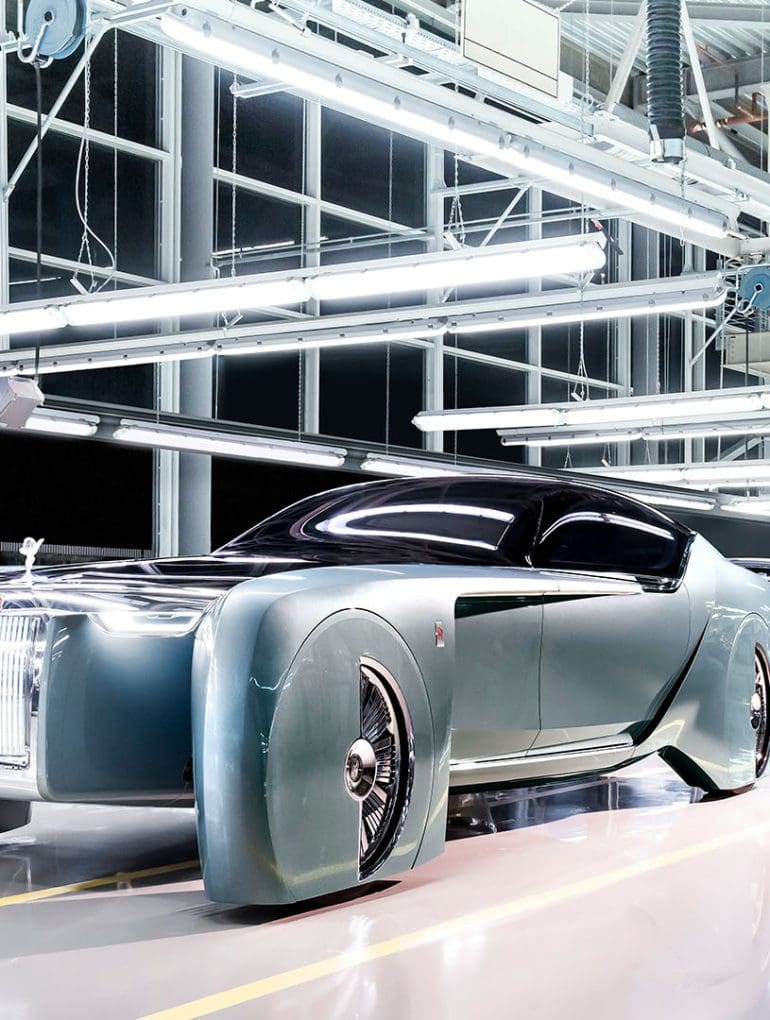
If 102EX was about electrification, 103EX was about total transformation. This dramatic “Vision Vehicle” imagined a world of fully autonomous, chauffeur-less luxury. Inside, traditional seats were replaced by a floating sofa, turning the cabin into a rolling lounge.

At its heart was “Eleanor,” a digital assistant inspired by Eleanor Thornton, designed to seamlessly connect owner and machine. It wasn’t just a car. It was a prediction of how ultra-luxury mobility could evolve.
The Red Badge Connection
All three EX cars share a rare distinction: the red Rolls-Royce badge, a symbol reserved for exceptional moments in the brand’s history.

It’s a subtle detail, but one that underscores their importance: these aren’t just experiments. They’re milestones.
Why It Matters
Together, these three cars map out Rolls-Royce’s modern evolution:

101EX redefined design and driver appeal
102EX pioneered electrification
103EX reimagined the entire luxury experience

They didn’t just predict the future, they built it. And if history is anything to go by, whatever Rolls-Royce is quietly developing next… is already far closer to reality than anyone expects.