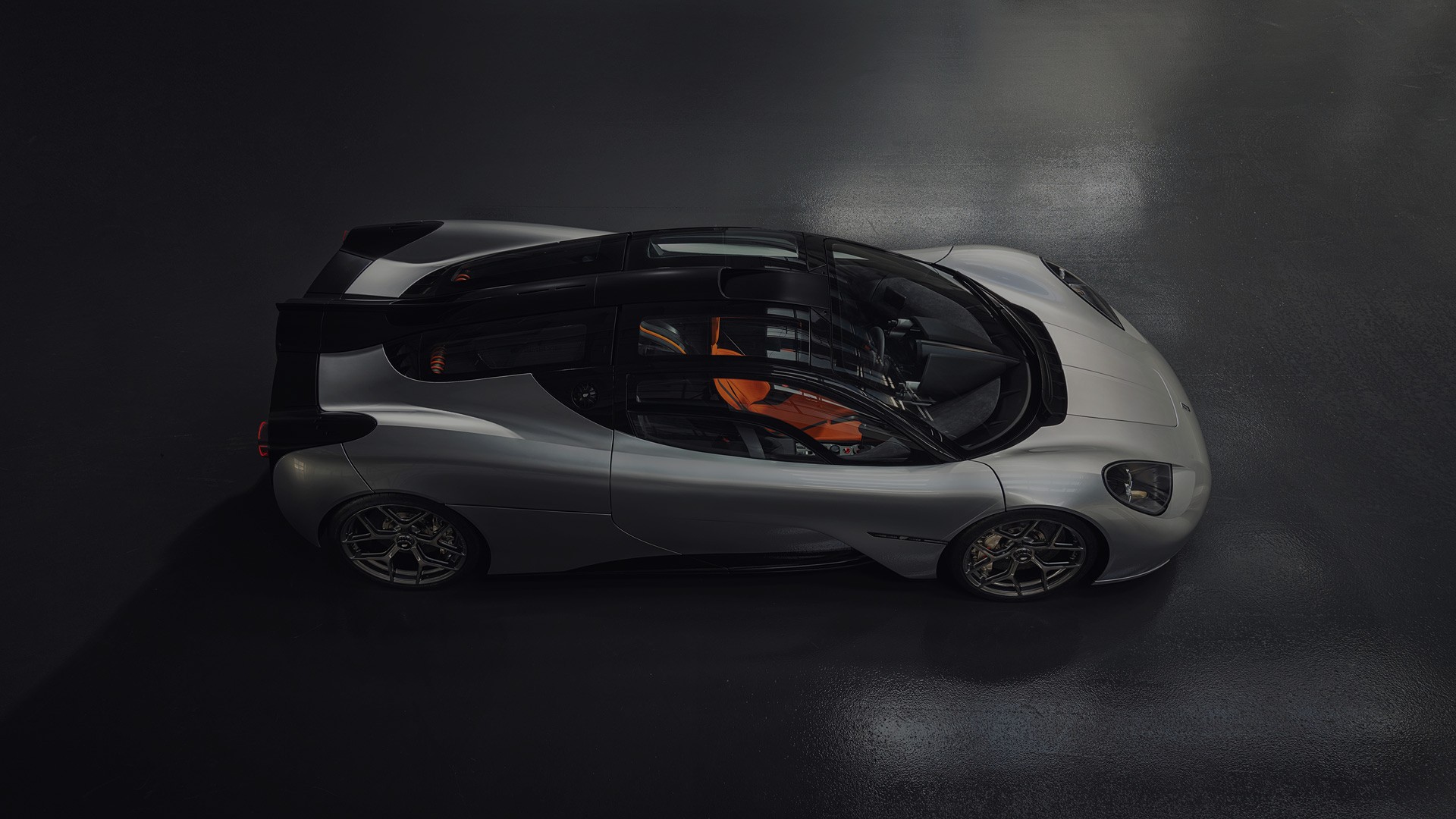

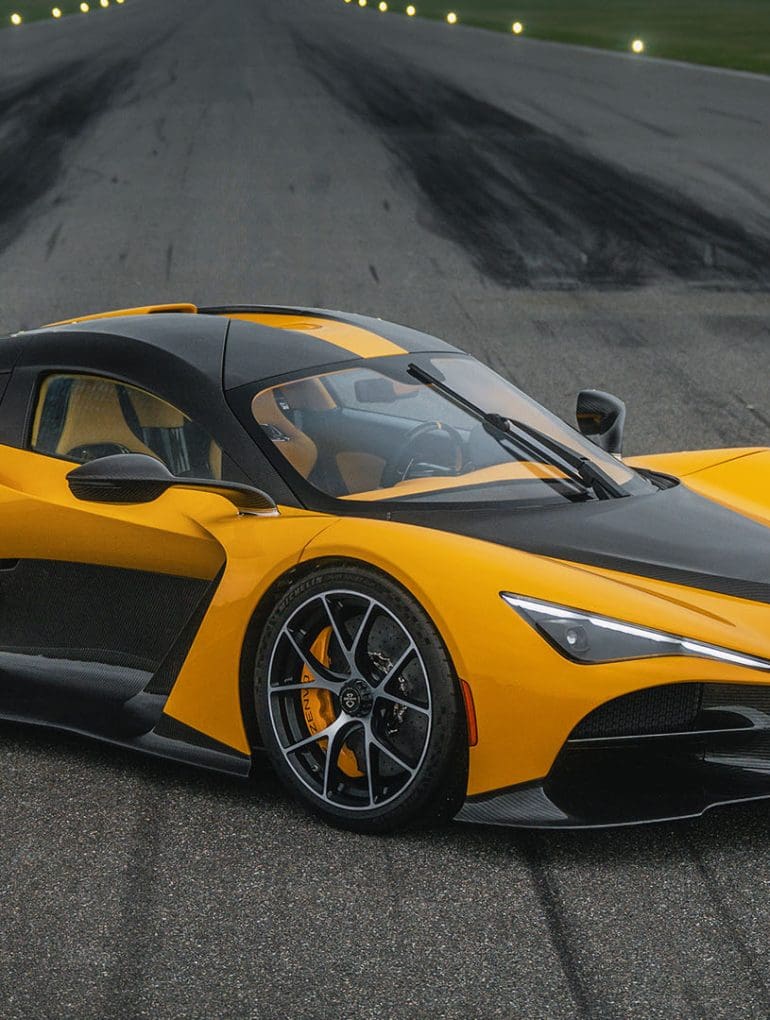
Zenvo took two validation prototypes of its 1,850-hp Aurora Tur to the 2026 Goodwood Festival of Speed, offering the public its closest look yet at the Danish hypercar headed for production.

Zenvo is taking another major step toward production of its wild Aurora hypercar, with two Aurora Tur validation prototypes making their global debut at the 2026 Goodwood Festival of Speed.
The Danish automaker displayed the latest customer-specification cars at Goodwood from July 9–12, alongside an Aurora Agil show car. The appearance came one year after an early Aurora prototype made its dynamic debut at the festival, but this time the cars represent a much more advanced stage of the development program.

Customer deliveries are targeted for the second half of 2027.
The Aurora Tur is the more traditional grand-touring interpretation of Zenvo’s new hypercar, sharing its carbon-fiber architecture and hybridized powertrain with the more aggressively focused Aurora Agil. Despite its GT-oriented character, the Tur is anything but restrained.

At its core is a completely bespoke 6.6-liter 90-degree V12, developed with MAHLE Powertrain. The quad-turbocharged engine produces a targeted 1,250 horsepower and 1,200 Nm of torque, while revving to an extraordinary 9,800 rpm.
That’s enough to make it the most powerful V12 ever fitted to a road car, according to Zenvo.

The combustion engine is supplemented by three electric motors. A 200-hp motor is integrated into the transmission, while two additional 200-hp motors power the front axle. Combined system output reaches a staggering 1,850 hp, with all-wheel drive and front-axle torque vectoring helping put that power to the road.
Zenvo estimates a 0–60 mph-equivalent 0–100 km/h time of 2.3 seconds, while 0–300 km/h is expected to take just nine seconds. The company also estimates a 0–400 km/h time of 17 seconds and a top speed of approximately 260 mph.

Those numbers are made possible in part by the Aurora’s lightweight construction. The hypercar uses a carbon-composite monocoque with carbon-composite front and rear structures, while the body panels are also made from carbon composite.
The Aurora Tur has a dry weight of just 3,413 pounds, giving it an estimated power-to-weight ratio of 1.19 hp/kg.

Despite its extreme performance, Zenvo has designed the Aurora around the idea of driver involvement rather than simply chasing headline numbers.
“Aurora is the car that sets the direction for Zenvo’s future,” said Jens Sverdrup, executive chairman of Zenvo Automotive. “It is a beautifully engineered and designed hypercar, created with real driving pleasure at its core.”

The engineering package includes double-wishbone suspension with pushrods at both ends, integrated underbody aerodynamics, carbon-ceramic brakes and a hybridized eight-speed paddle-shift transmission.
The Tur rides on bespoke center-lock aluminum wheels measuring 20 inches at the front and 21 inches at the rear, wrapped in Michelin Pilot Sport Cup 2 tires.

Two Auroras, two personalities
Zenvo will offer the Aurora in two distinct configurations.
The Aurora Agil is the more lightweight, track-focused version while remaining road legal. The Aurora Tur, meanwhile, takes a more classic grand-touring approach while retaining the same extraordinary underlying hardware.

Both versions are part of an extremely limited production run, with Zenvo planning to build just 50 Aurora examples.
The Aurora represents a significant evolution for the small Danish manufacturer, which was founded in 2007 and has built its reputation around limited-production hypercars combining extreme performance with an emphasis on driver engagement.

With the validation prototypes appearing at Goodwood, the Aurora program is moving beyond the concept and early-prototype stage and closer to the cars customers will eventually receive.
And with a 9,800-rpm V12, 1,850 horsepower and an estimated 260-mph top speed, the final production Aurora promises to be one of the most extreme road-going hypercars to emerge from Denmark.