
1948→1950 Ferrari 166 MM Barchetta
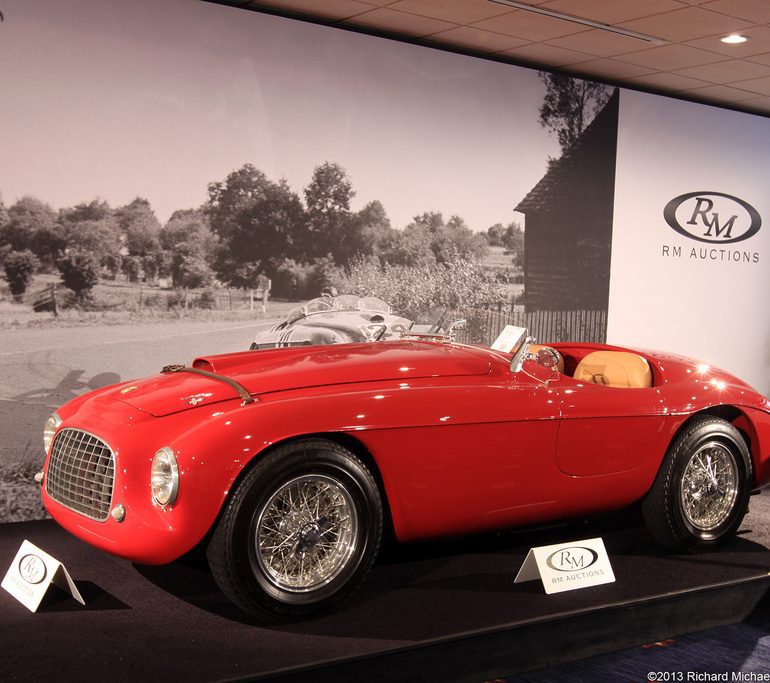
To commemorate their first major success at the prestigious 1948 Mille Miglia, Ferrari upgraded their successful 166 Sport and made a series of cars called the 166 MM. These contributed more than any other previous type, scoring many of Ferrari’s first international victories and established the company as a serious manufacturer of sports cars.
For their new series, Ferrari outsourced production of the bodies to Touring of Milan who made 25 roadsters using their patented Superleggera technique. It fixed aluminum-alloy panels directly to a tubular space frame which was both light and rigid.
The Barchetta
In March 1948, Ferrari asked Carrozzeria Touring to body his newest series of sports cars. After Felice Bianchi Anderloni died, his son, Carlo Felice Bianchi Anderloni was left to finish the project. Together with Federico Formenti, they presented a 1:10 scale model which was approved by Enzo Ferrari.
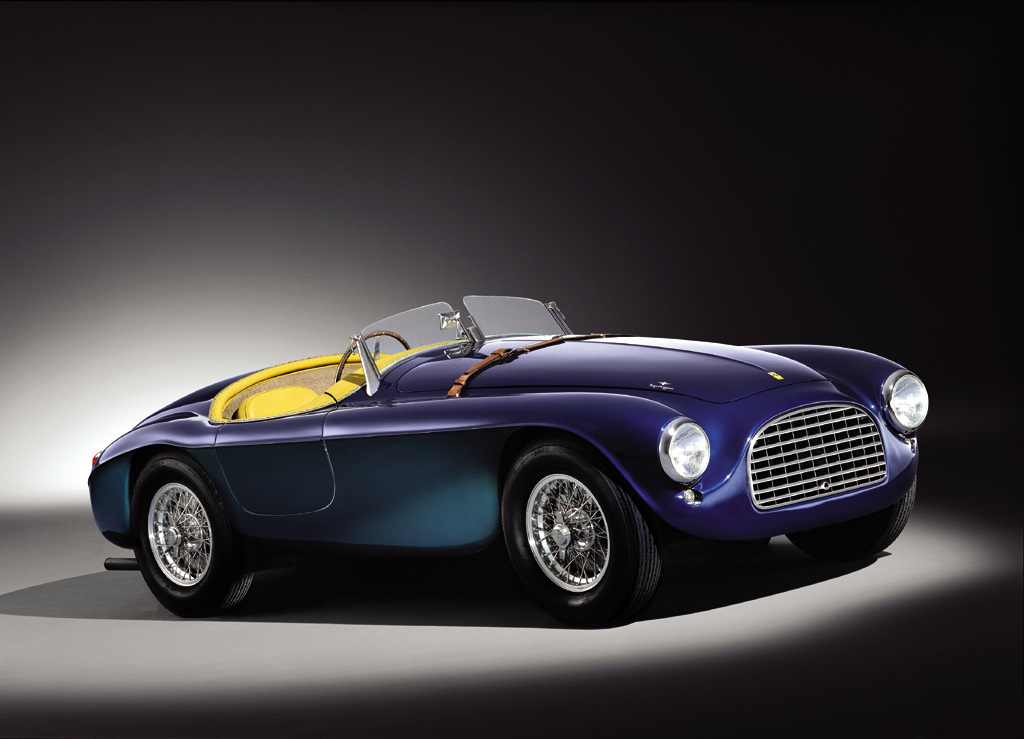
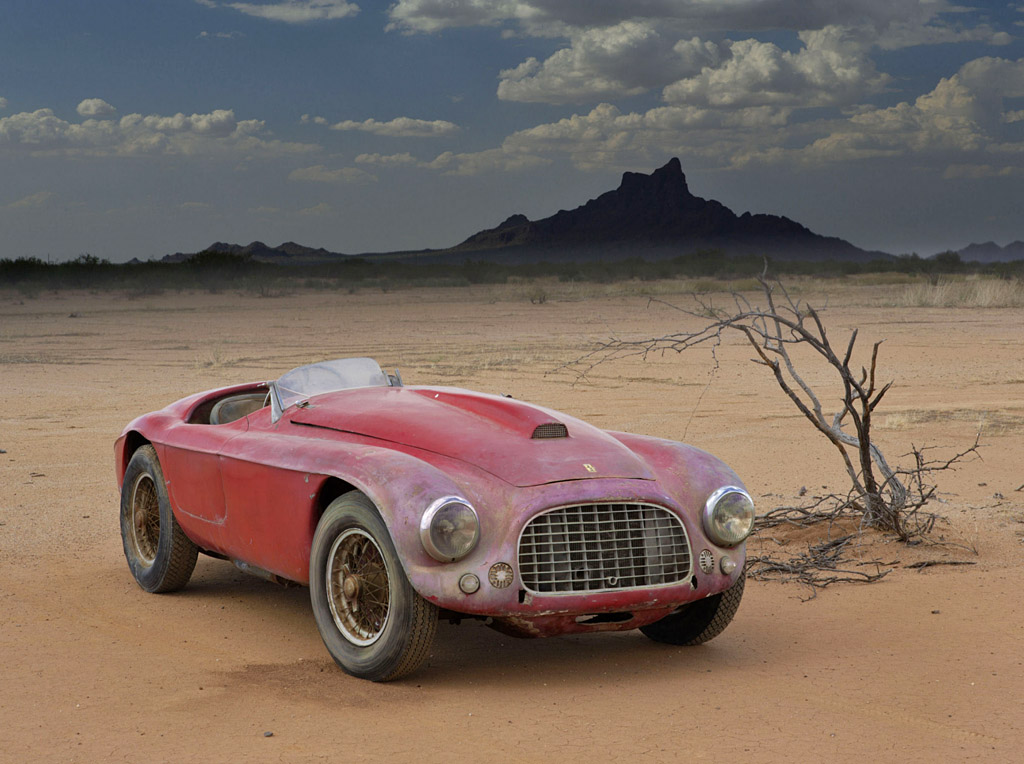
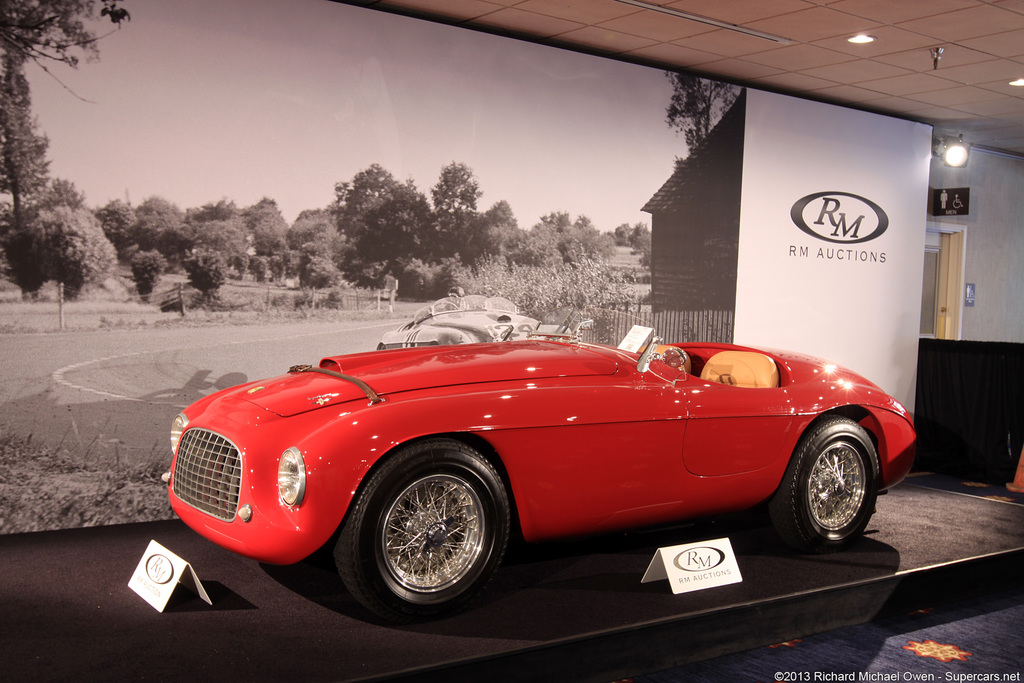
The new design used all-enveloping fenders, an egg-crate grill, moustache lines below the lights and a belt line that ran along the side of the car. Journalist Giovanni Canestrini nicknamed the car barchetta which translated to small boat. The design was copied by AC for their Ace which evolved into the Shelby Cobra.
The prototipo Barchetta was chassis 0002M and other cars of similar shape adopted this name. While each car shared roughly the same shape, they were different in detail. For instance, some cars were fitted with a full interior called ‘Lusso’.
Ferrari’s first coupe was built as on the 166MM chassis. The very first of these was a very unique Zagato Panoramica Speciale built on chassis 0018M. It was closely followed by three Touring Berlinettas made for the 1950 LeMans.
Racing
With its lightweight body, the 166 MM became Ferraris most potent sports car. It was based on the same chassis that Ferrari debuted years earlier, but featured an upgraded V12 engine, capable of 140 bhp. Combined with a durable chassis that had an independent front suspension, both factory and independent drivers raced these cars to many victories.
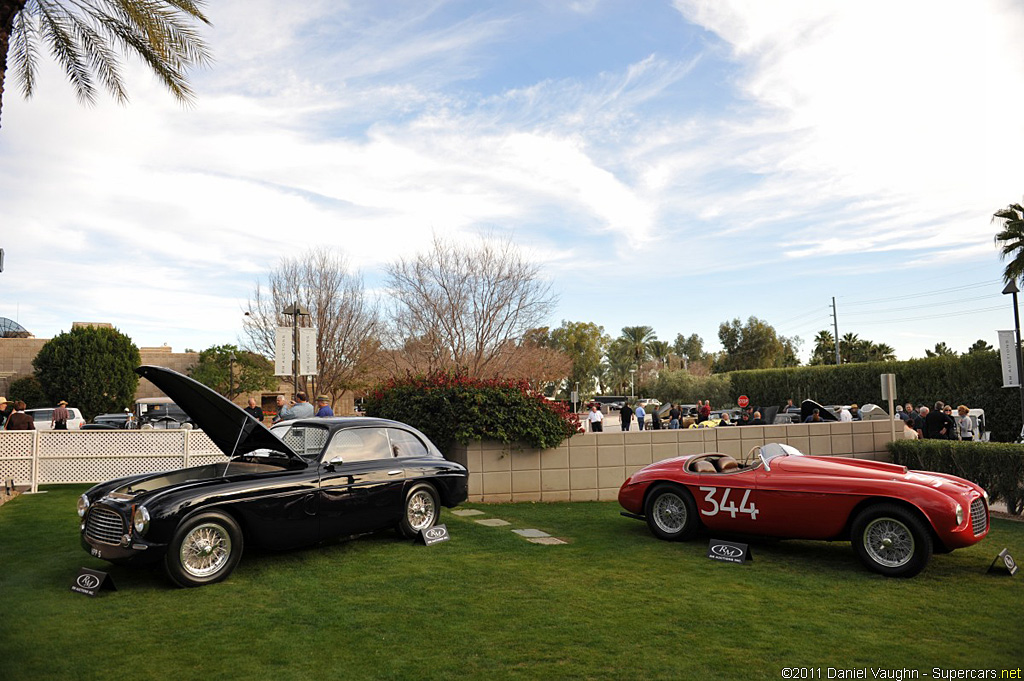
Luigi Chinetti scored the most famous of these victories when he raced 23 out of the 24 hours at Le Mans to score Ferrari’s first overall win. To comply with the regulations, Lord Selsdon only raced for an hour. The very same car, chassis 0008M, also won the 1949 Mille Miglia with Clemente Biondetti and Ettore Salani, making it one of the most significant, and may be the single most important single car in Ferrari history.
After his victory at LeMans, Chinetti went into business with Ferrari and became his North American Importer. In the US, he setup the North American Racing Team (NART) which supported many important Ferrari race efforts in the US and abroad. 0008M went on to win a number of less significant victories and, in more recent times, has been restored to its 1949 LeMans-winning guise with number 22 plastered over its burgundy body.
The 166 series was built quite successfully up until 1953. Afterwards, it was outclassed by Ferraris that used Lampredi’s long block engine, including two prototype 275 S cars that led to the 340 America series. However, for privateers, Ferrari enlarged the 166 engine and the 166MM evolved into the 195 S and then the 212 Export.
Sales & Chassis
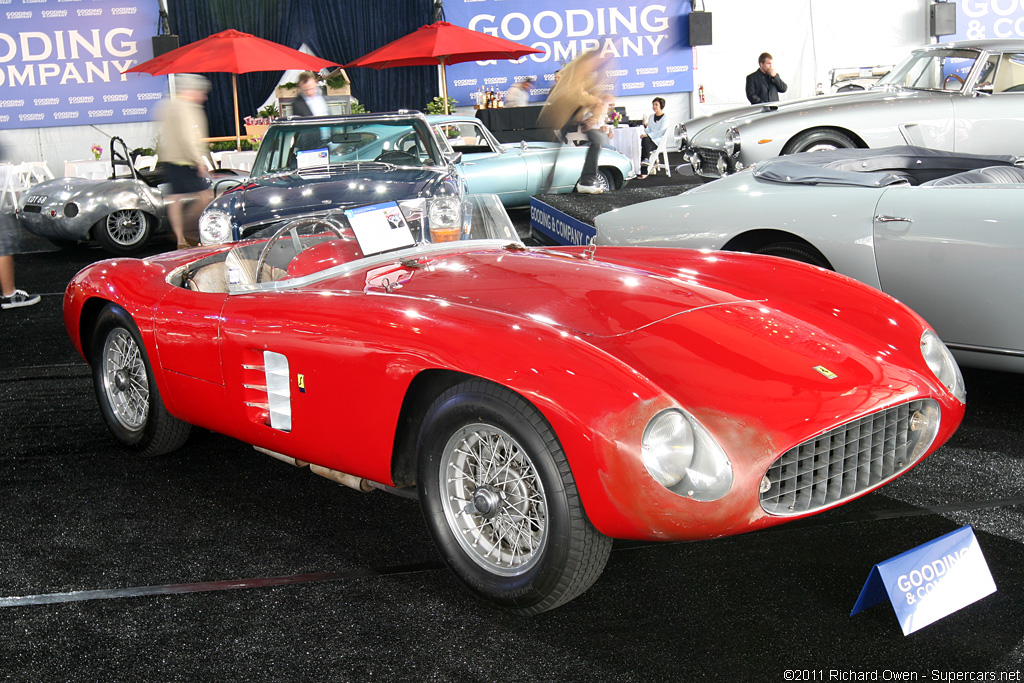
014I – This special Ferrari, chassis 014 I, started it’s life as a Tipo 166 Spyder Corsica with coachwork by Anasaloni. It experienced an extensive race season in which the car never suffered any major damage. In 1952 the car was privately sold with the new owner having the bodywork redone. Carrozzeria Scaglietti was hired and fitted chassis 014i with a unique 500 TR-style body in 1955, but it retained the Spyder Corsica wheelbase and finned aluminum drums. In remarkably original conidition, with vintage snake-skin seats, 014I was offered at the the 2001 Monterey Sports car Auction by RM Auctions but did not sell with a bid of $830 000 USD.
Story by Richard Owen
In Detail
| tags | 166mm |
| submitted by | Richard Owen |
| type | Racing Car |
| production years | 1948 – 1950 |
| released at | 1948 Turin Motor Show |
| built at | Turin, Italy |
| body stylist | Carlo Felice Bianchi Anderloni & Federico Formenti |
| coachbuilder | Carrozzeria Touring |
| engineers | Aurelio Lampredi |
| production | 33 |
| predeccesor | 1948 Ferrari 166 Sport |
| succeccesor | 1950 Ferrari 166/195 S Le Mans Berlinetta |
| engine | 60° V12 |
| position | Front Longitudinal |
| aspiration | Natural |
| block material | Aluminum Alloy |
| valvetrain | SOHC, 2 Valves per Cyl |
| fuel feed | 3 Weber 32 DCF Carburetors |
| displacement | 1995 cc / 121.7 in³ |
| bore | 60 mm / 2.36 in |
| stroke | 58.8 mm / 2.31 in |
| compression | 8.5:1 |
| power | 104.4 kw / 140.0 bhp @ 6600 rpm |
| specific output | 70.18 bhp per litre |
| bhp/weight | 215.38 bhp per tonne |
| torque | 158.63 nm / 117 ft lbs @ 5000 rpm |
| body / frame | Aluminum Body over Steel Ladder-Type Chassis |
| driven wheels | RWD |
| front brakes | Hydrualic Drums |
| rear brakes | Hydrualic Drums |
| steering | Worm & Sector |
| f suspension | Wishbones w/Transverse Leaf Spring, Hydraulic Dampers |
| r suspension | Live Axle w/Semi-Elliptic Longitudinal Leaf Springs, Hydrualic Dampers, Anti-Roll Bar |
| curb weight | 650 kg / 1433 lbs |
| wheelbase | 2200 mm / 86.6 in |
| front track | 1250 mm / 49.2 in |
| rear track | 1200 mm / 47.2 in |
| length | 3607 mm / 142.0 in |
| width | 1524 mm / 60.0 in |
| height | 1067 mm / 42.0 in |
| transmission | 5-Speed Manual |
| tran clutch | Dry, Single-Plate |
| top speed | ~170 kph / 105.57 mph |
| fuel capacity | 90 litres or 23.76 gal. |
| race victories | 1949 Mille Miglia |
Auction Sales History
Auction Source: 2013 Monterey Auction by RM Auctions
Auction Source: 2011 Pebble Beach Auctions by Gooding & Company
Auction Source: 2011 Automobiles of Arizona by RM Auctions