
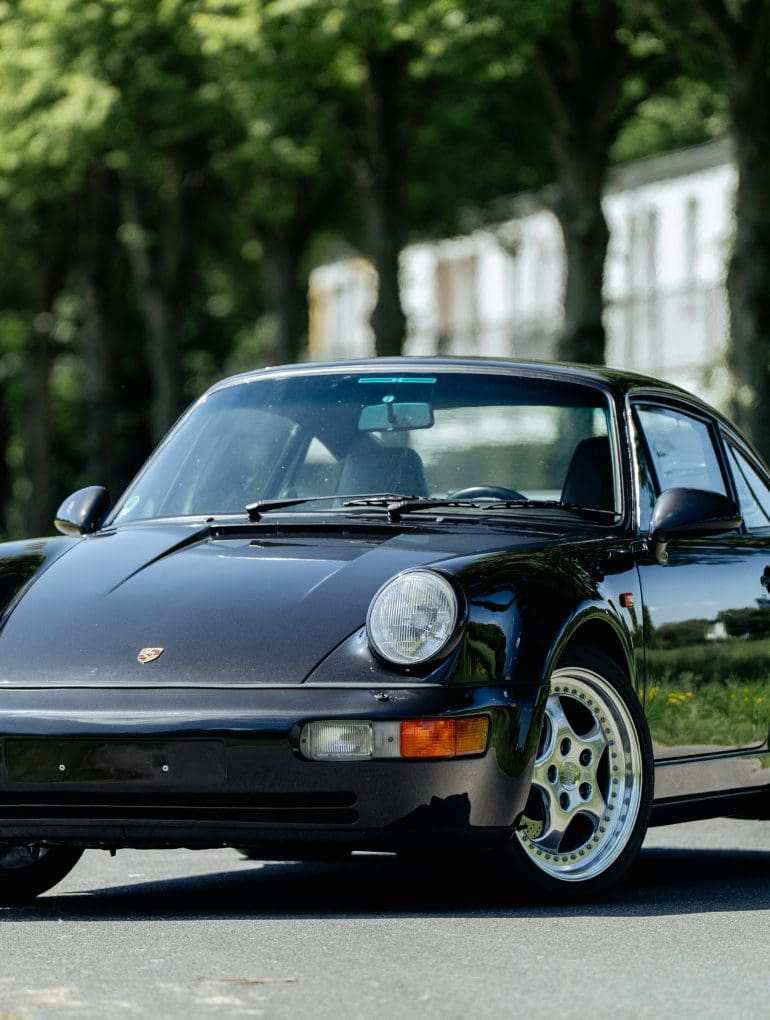

Geneva, March 1990. Porsche unveiled the new 911 Turbo at the Geneva Motor Show, bringing turbocharging to the 964 generation of the 911. It replaced the 930, whose sudden power delivery had earned it the nickname “Widowmaker,” and used that car’s 3.3-liter engine as its starting point. Porsche reworked the engine extensively and placed it in the modern 964 chassis. The air-cooled, single-turbo flat-six produced 320 PS (316 hp) at 5,750 rpm and 450 Nm (332 lb-ft) of torque at 4,500 rpm, and Porsche quoted a top speed of 270 km/h (168 mph). The 964 Turbo was faster, more refined and easier to drive than the 930, but it remained a demanding rear-wheel-drive supercar. Porsche built 3,660 examples during the 1990-1992 production run before replacing it with the more powerful Turbo 3.6.
Background and Origins
The 964 generation arrived in 1989, with the all-wheel-drive Carrera 4 as its first production model. It was the most extensive update to the 911 since the original car’s launch, with more than 85 percent of its parts new. Coil springs replaced torsion bars, ABS and power steering became standard, and the body was modernized with integrated bumpers. The 930 Turbo continued through the 1989 model year while Porsche prepared a Turbo version of the new car.
There was not enough time to develop a turbocharged version of the 964’s new 3.6-liter engine, so Porsche reworked the 930’s proven 3.3-liter flat-six for the new Turbo. This let the car reach the market quickly and preserved the classic single-turbo character that had defined the 911 Turbo since 1975. After its Geneva debut in March 1990, the Turbo went on sale for the 1991 model year. Unlike the Carrera 4, it used rear-wheel drive.
Design and Engineering
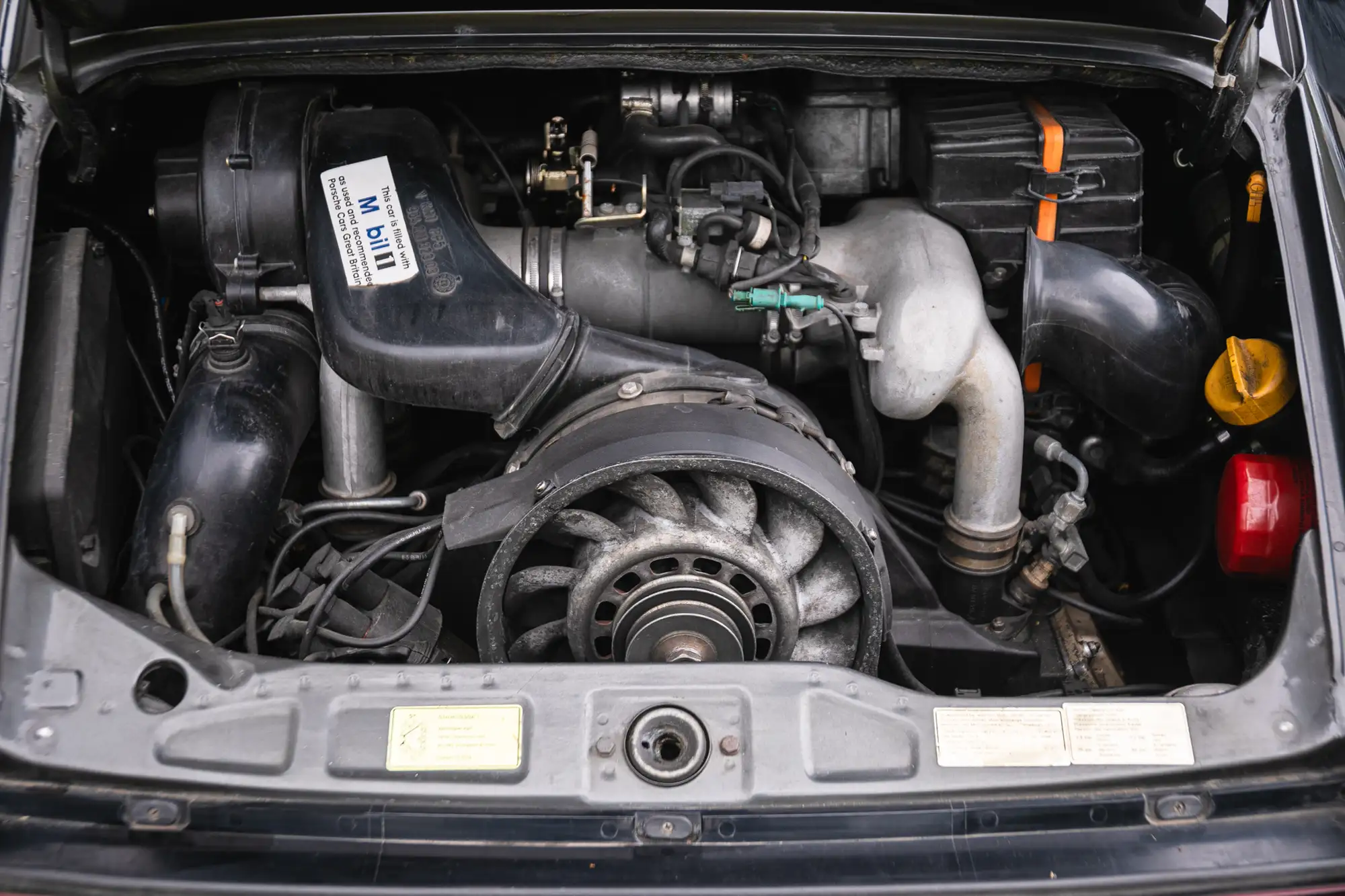
The engine, designated M30/69, retained the 930’s 3,299-cubic-centimeter displacement, single overhead camshaft per bank, two valves per cylinder and 7.0:1 compression ratio. It also received a revised KKK turbocharger, a larger air-to-air intercooler and updated engine management, using Bosch K-Jetronic mechanical fuel injection. Output rose by 20 PS over the final 930, to 320 PS at 5,750 rpm, while torque reached 450 Nm at 4,500 rpm. Thanks to these changes, the engine delivered its power more progressively than the 930’s, although it still produced a strong surge when the turbo came on boost. Power went to the rear wheels through a five-speed manual gearbox.
The chassis used the 964’s coil-spring suspension, which was more modern and better controlled than the 930’s torsion-bar layout. The Turbo had its own suspension tuning, along with 17-inch wheels measuring 7 inches wide at the front and 9 inches at the rear, with 205/50 front and 255/40 rear tires. The brakes used four-piston fixed calipers with ventilated, cross-drilled discs measuring 322 millimeters at the front and 299 millimeters at the rear. ABS and power steering were standard. Porsche quoted a top speed of 270 km/h (168 mph), and published 0-100 km/h times were around five seconds. The 964 Turbo still demanded respect at the limit because of its rear-engine layout and turbocharged power delivery, but contemporary reviews generally found it more stable and predictable than the 930.
Styling
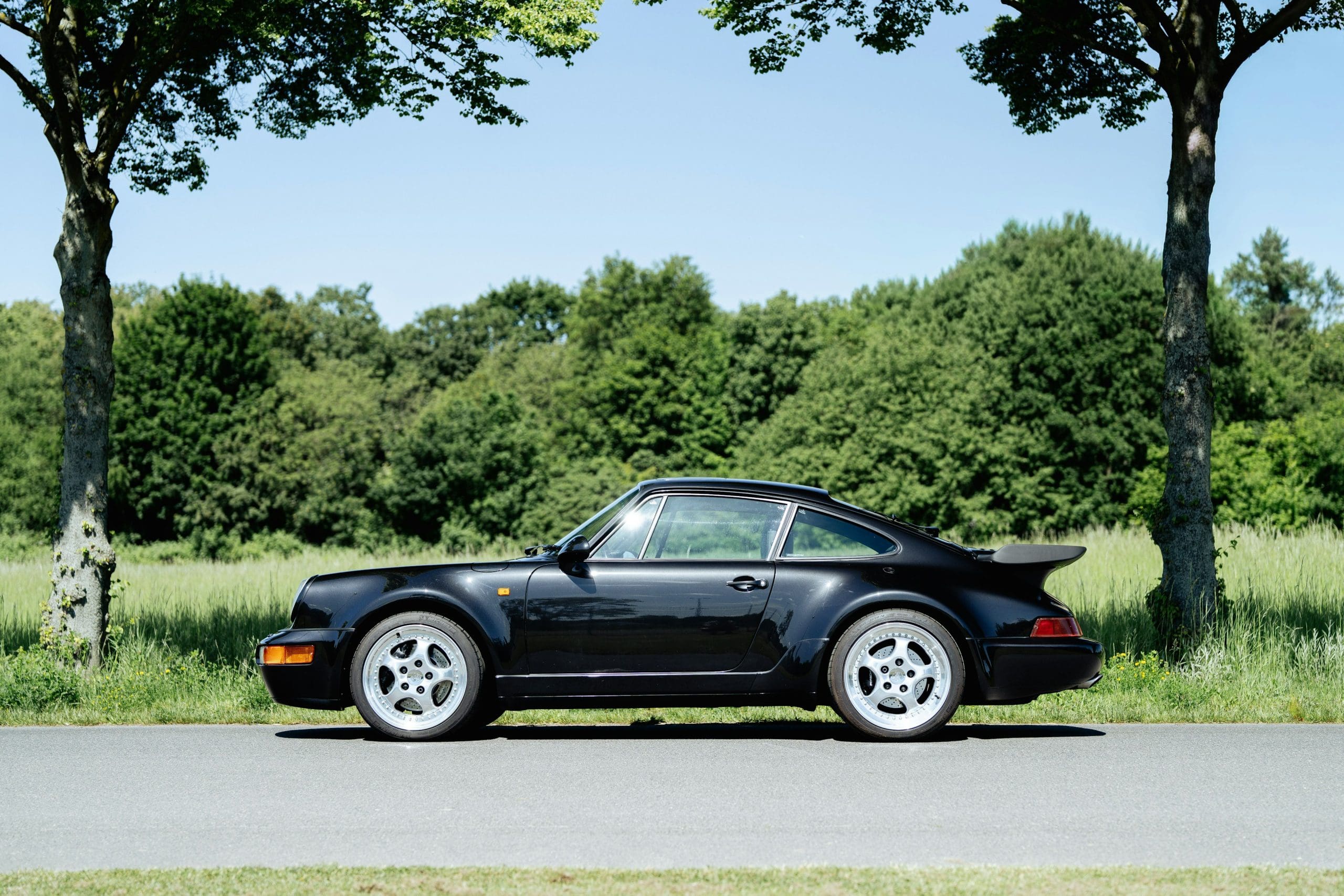
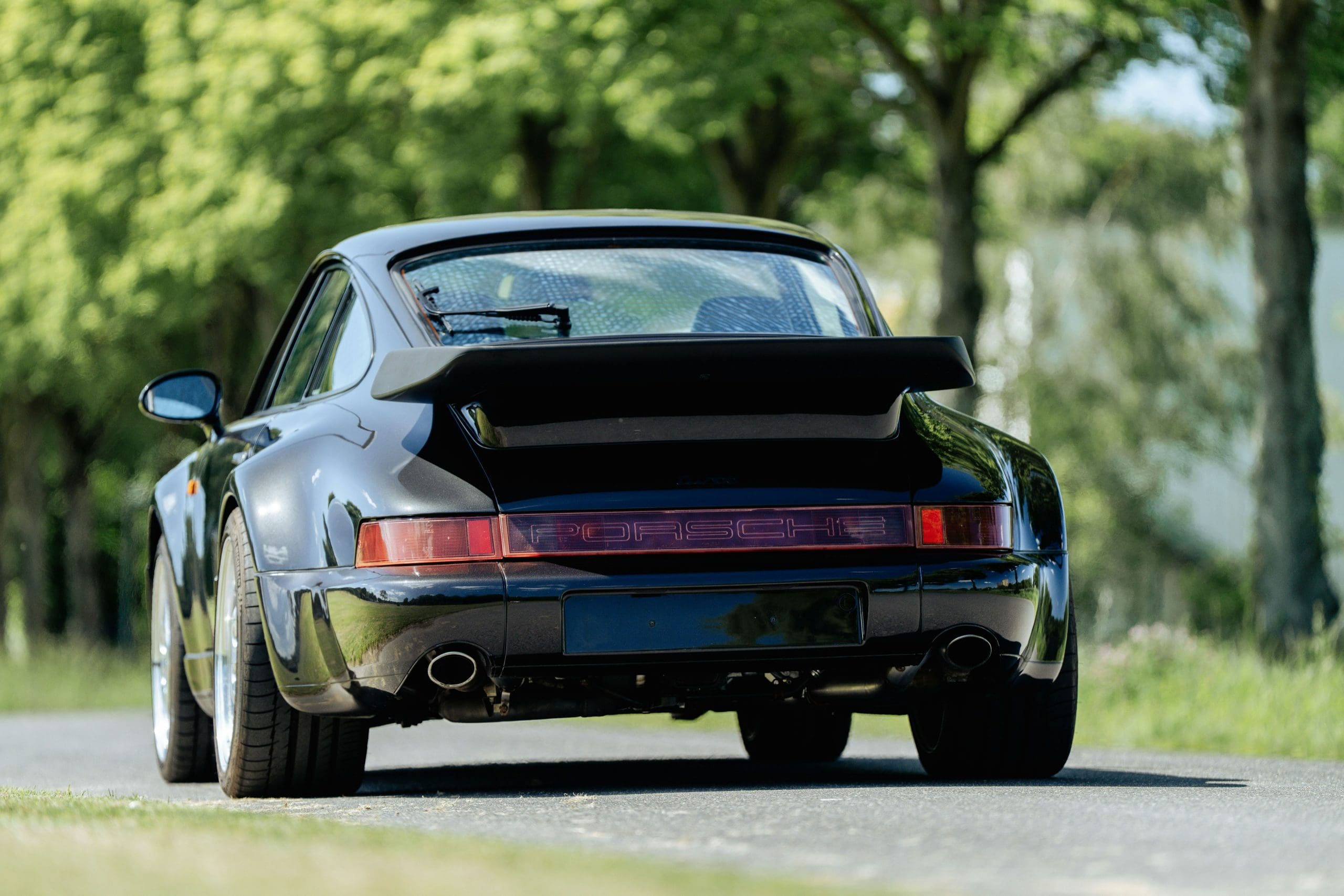
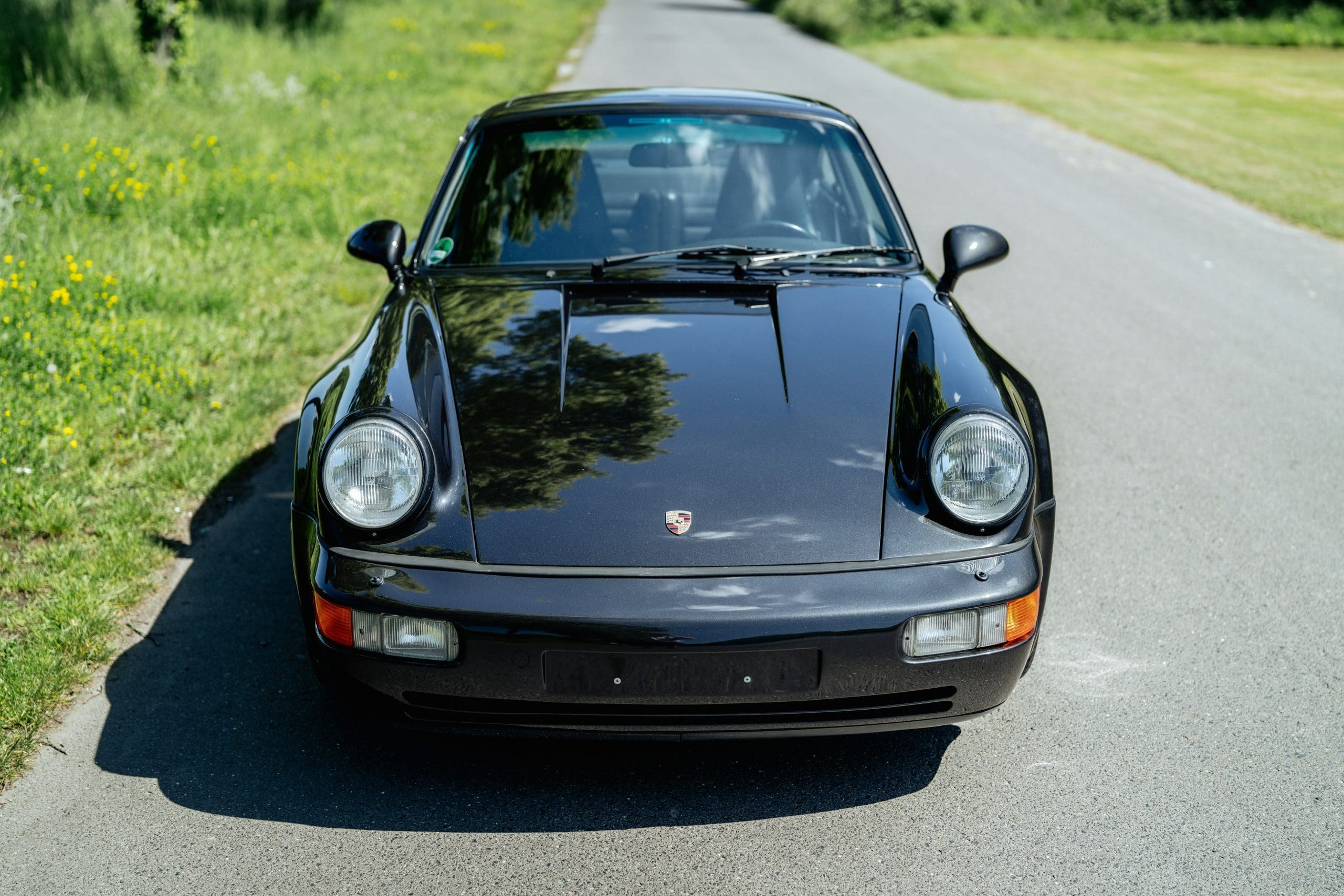
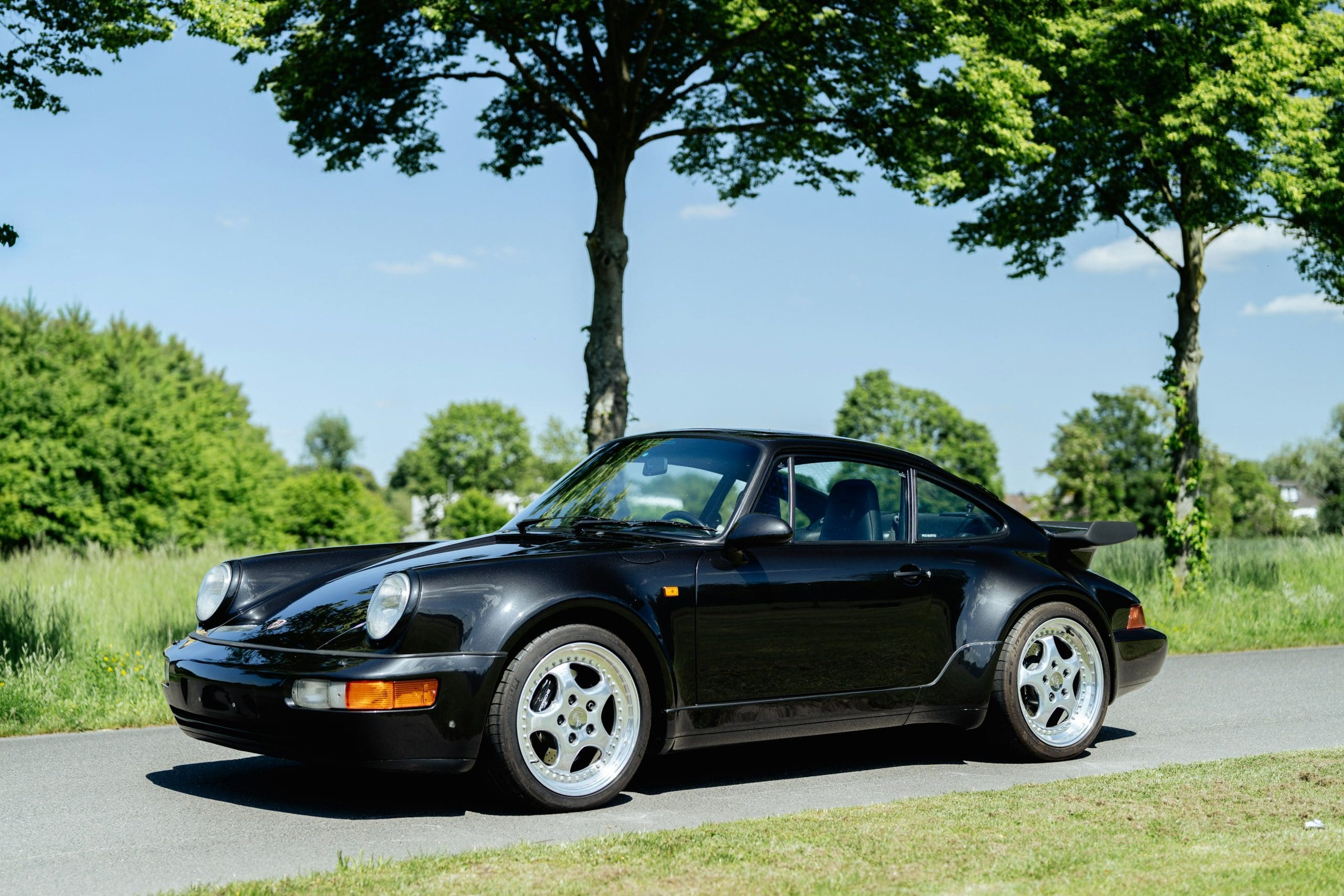
The 964 Turbo combined the cleaner shape of the 964 with the wide rear fenders that had become a 911 Turbo signature. It used the 964’s smooth, integrated front and rear bumpers, while the widened body covered the larger tires. A redesigned fixed rear wing housed the intercooler, and aerodynamic mirrors and Cup Design wheels completed the look. The drag coefficient was 0.36. The result looked more modern and refined than the 930, but it was still unmistakably a 911 Turbo, thanks to its wide stance and large rear wing.
Interior
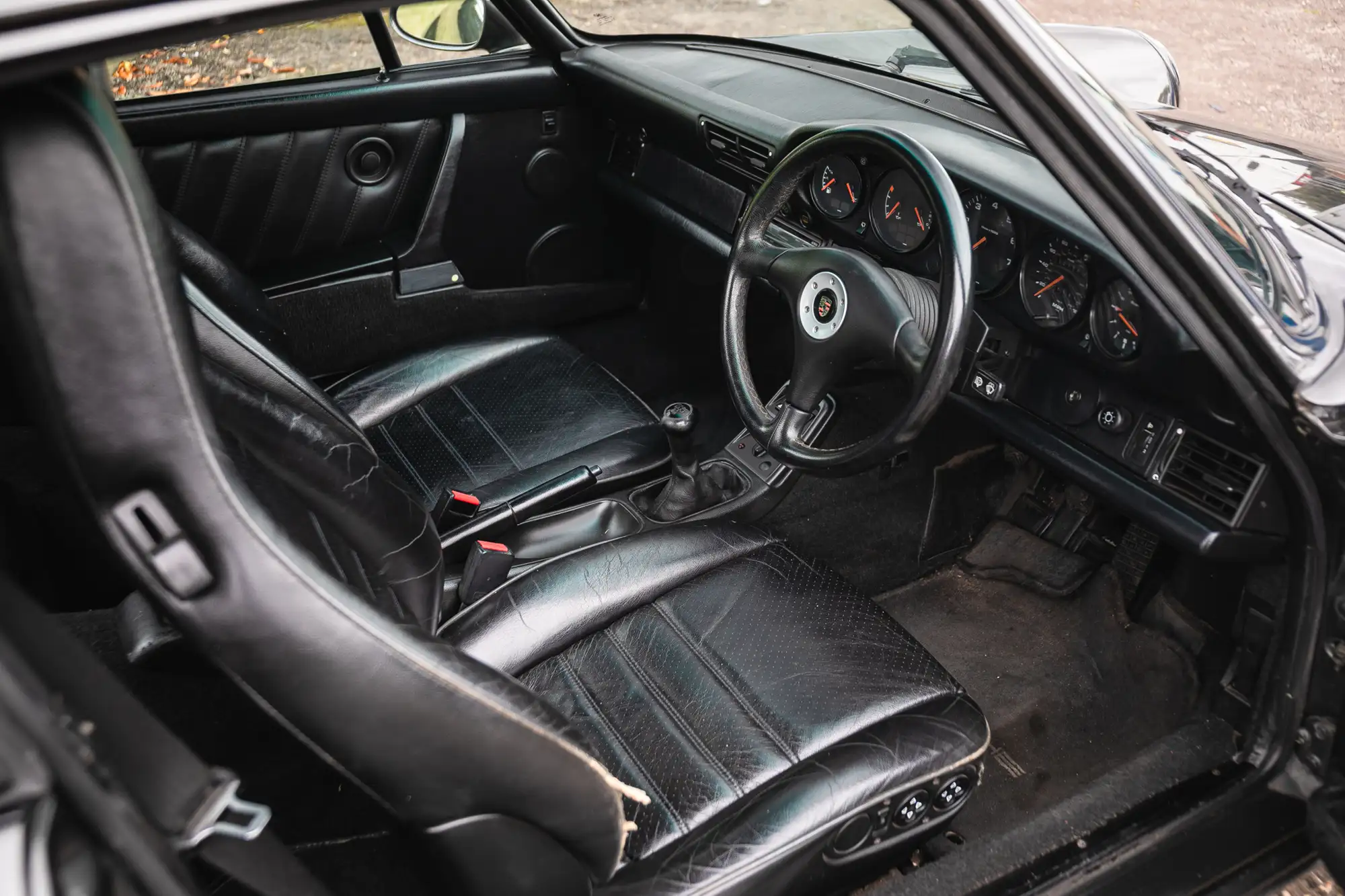
The cabin followed the 964 Carrera, with the traditional five-gauge instrument layout, an upright driving position and the 911’s familiar dashboard. As the top model in the range, the Turbo was generously equipped, although specifications varied by market. Leather upholstery and air conditioning were typical features. The 964’s improved heating and ventilation, along with standard power steering, made the Turbo much easier to live with day to day than the 930, although the cabin remained compact and focused on the driver.
Racing History
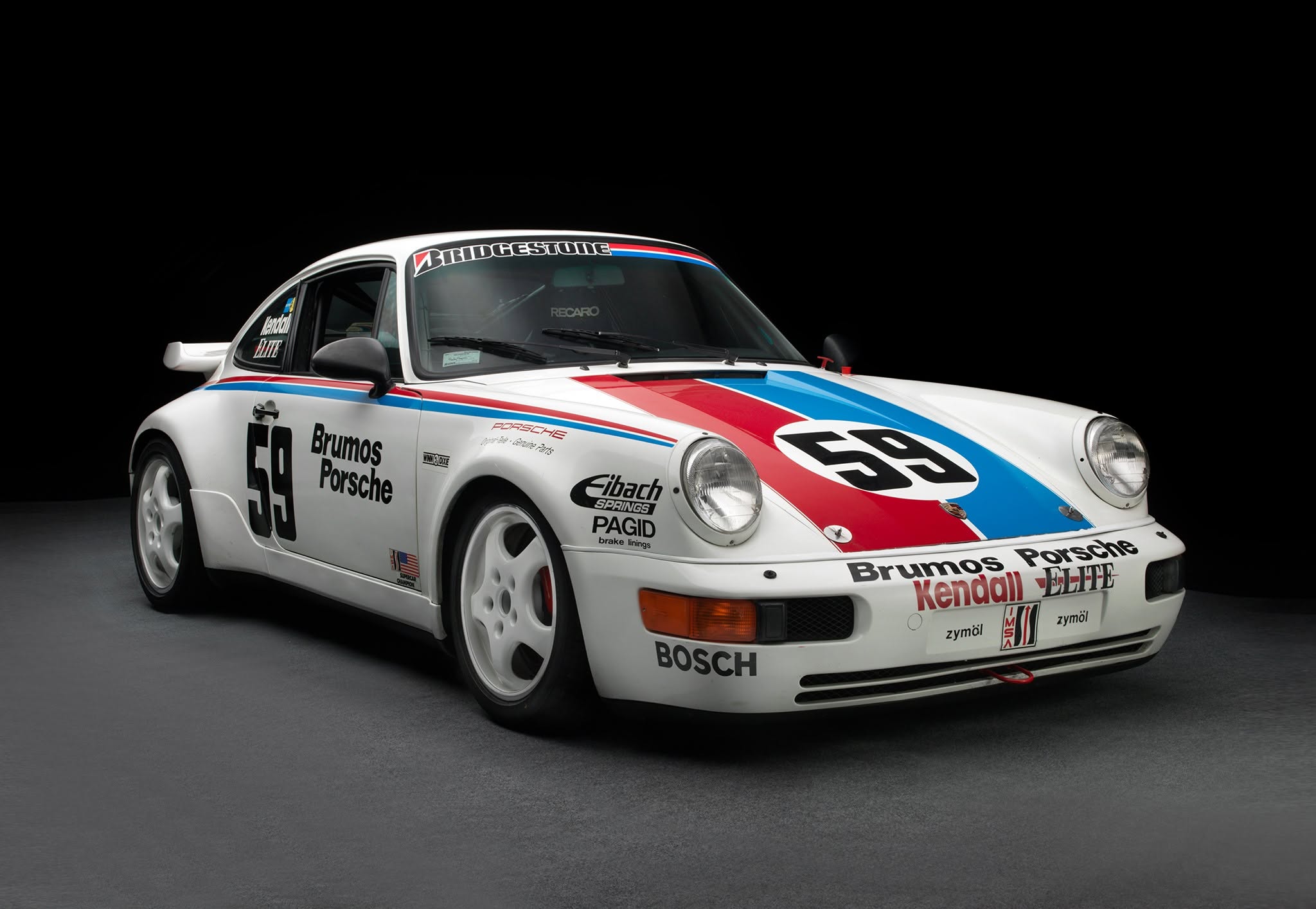
The 964 Turbo made its biggest competition impact in the United States. In 1991, IMSA introduced the Bridgestone Supercar Championship, a series for production-based sports cars, and Brumos Porsche entered two 964 Turbos. Hurley Haywood drove the No. 59 car, while Hans-Joachim Stuck drove the No. 58. Haywood won on the car’s debut at Watkins Glen and went on to claim the 1991 drivers’ championship with three victories. In 1992, Porsche won the manufacturers’ championship, but Doc Bundy took the drivers’ title in a Lotus Esprit X180R, finishing ahead of Haywood. Porsche returned in 1993 with the Turbo 3.6, and Stuck won the drivers’ championship.
To support its Supercar program, Porsche worked with Andial to build 20 road-going 911 Turbo S2s for the US market in 1992. These were specially modified versions of the Turbo 3.3 associated with the IMSA program, and they were a separate model from the European Turbo S Leichtbau. The 964 Turbo also competed in endurance racing. At the 1993 12 Hours of Sebring, the Brumos-entered Turbo S LM, a competition-prepared car driven by Walter Röhrl, Hans-Joachim Stuck and Hurley Haywood, finished seventh overall and won the Invitational GT class. The same trio raced the car at the 1993 24 Hours of Le Mans, where it retired after accident damage.
Specifications
- Engine: Porsche M30/69 air-cooled flat-six, 3,299cc, SOHC per bank, two valves per cylinder, 7.0:1 compression, single KKK turbocharger, air-to-air intercooler, Bosch K-Jetronic injection
- Power: 320 PS (316 hp) at 5,750 rpm
- Torque: 450 Nm (332 lb-ft) at 4,500 rpm
- Transmission: Five-speed manual, rear-wheel drive
- Chassis: Galvanized steel unibody
- Suspension: Independent with coil springs, front and rear
- Brakes: Four-piston calipers, ventilated and cross-drilled discs (322 mm front, 299 mm rear), ABS
- Wheels and tires: 17×7 front, 17×9 rear; 205/50 front, 255/40 rear
- Weight: Approximately 1,470 kg / 3,241 lbs
- Aerodynamics: Drag coefficient of 0.36
- Performance: 0-100 km/h in approximately 5 seconds, 270 km/h / 168 mph top speed
Production and Legacy
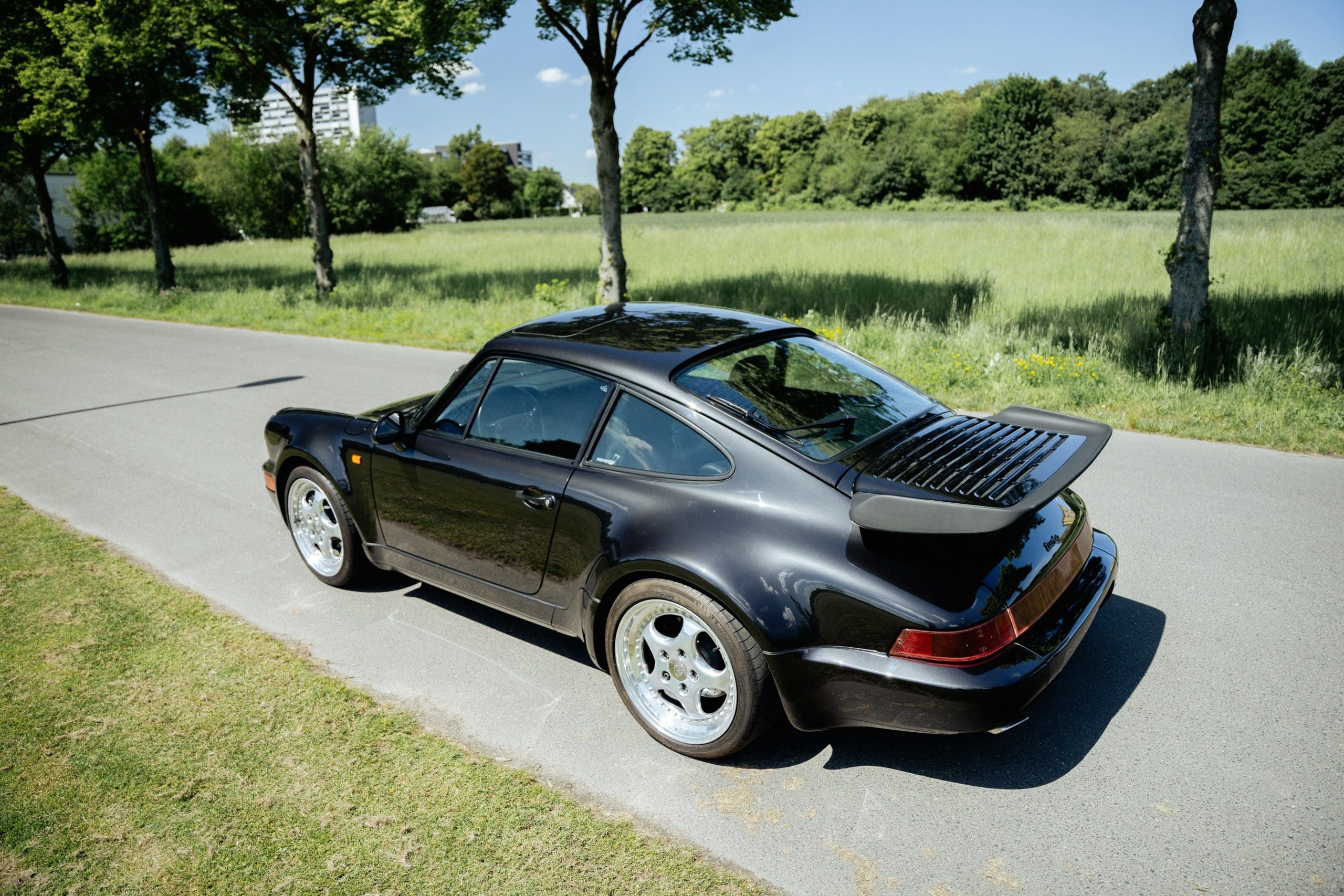
Porsche built 3,660 911 Turbo 3.3s during the 1990-1992 production run. In 1992, Porsche introduced the Turbo S Leichtbau, a lightweight model producing 381 PS. Production began in July 1992 for the 1993 model year, and 86 cars were built. The Turbo 3.6 arrived in late 1992 as a 1993 model, using a turbocharged version of the 964 Carrera’s 3.6-liter engine and producing 360 PS. When the 993 Turbo introduced twin turbochargers and all-wheel drive in 1995, the 964 became the last generation of the standard 911 Turbo with a single turbocharger and rear-wheel drive.
The 964 Turbo occupies an important place in 911 Turbo history. It bridged the raw character of the 930 and the more refined, more capable Turbos that followed, while retaining the air-cooled engine, rear-wheel drive and single turbocharger that many enthusiasts consider central to the classic Turbo formula. Its success in IMSA Supercar racing also gave it genuine competition credentials. Today, the 964 Turbo, particularly in its rarer forms, is highly regarded by collectors as one of the most desirable air-cooled 911s.