

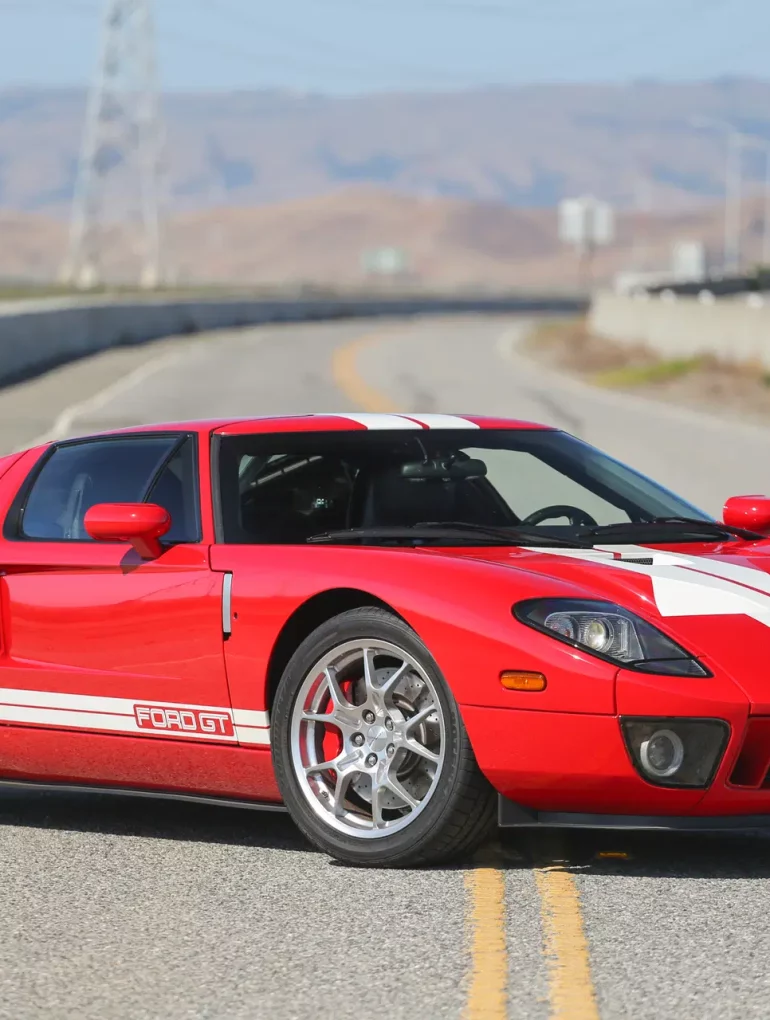

North American International Auto Show, January 2002. Ford unveiled the GT concept, a stunning two-seater mid-engine supercar celebrating the company’s centennial. The reaction was overwhelming, with automotive enthusiasts and media recognizing immediately that something extraordinary had been unveiled. Within forty-five days, Ford shocked the world again, officially announcing that production was proceeding. This wasn’t merely a show car destined for museum storage—Ford was committing to building the GT as a limited-production reality.
The GT was inspired by the legendary 1966 Ford GT40, which won the 24 Hours of Le Mans and established Ford’s racing dominance during the 1960s. The modern GT shared no components with its predecessor, instead representing a complete reinterpretation for the twenty-first century. The 5.4-liter supercharged V8 produced 550 horsepower, enabling 205 mph capability and 3.4-second acceleration to 60 mph. This was America’s response to Ferrari’s Enzo, Porsche’s Carrera GT, and Lamborghini’s flagship supercars, proving that Detroit could build world-class exotic machinery. Production began in 2004, with customer deliveries commencing in August. The 2005 model year represented the first full production year, with 2,027 examples built at Saleen Special Vehicles in Troy, Michigan, establishing the GT as one of the rarest American supercars ever produced.
Background and Origins
Ford’s centennial celebration in 2002-2003 prompted the company to revisit its most glorious automotive moments. The original GT40 had dominated international racing during the 1960s, winning Le Mans four consecutive years and cementing Ford’s performance credentials. The company recognized that building a modern supercar would celebrate that legendary heritage while demonstrating Ford’s contemporary engineering capabilities and global competitiveness.
Camilo Pardo, head of Ford’s “Living Legends” design studio under J. Mays’s leadership, led the GT’s development. Rather than simply replicating proportions from the 1960s car, Pardo’s team created an entirely new interpretation for modern sensibilities. The GT was eighteen inches longer and four inches taller than the original, yet maintained the iconic silhouette that made the GT40 instantly recognizable. The design process involved countless iterations, with engineers and designers working collaboratively to ensure every curve and line served both aesthetic and aerodynamic purposes.
The engineering challenge was extraordinary. The GT needed to exceed 200 mph safely on public roads, requiring engineering solutions typically reserved for race cars. Advanced aluminum construction, friction-stir welded center tunnel, super-plastic-formed body panels, and an all-new aluminum space frame provided the necessary strength while minimizing weight. Advanced computational fluid dynamics informed every aerodynamic decision, addressing challenges like preventing the lift inherent in the original 1960s design.
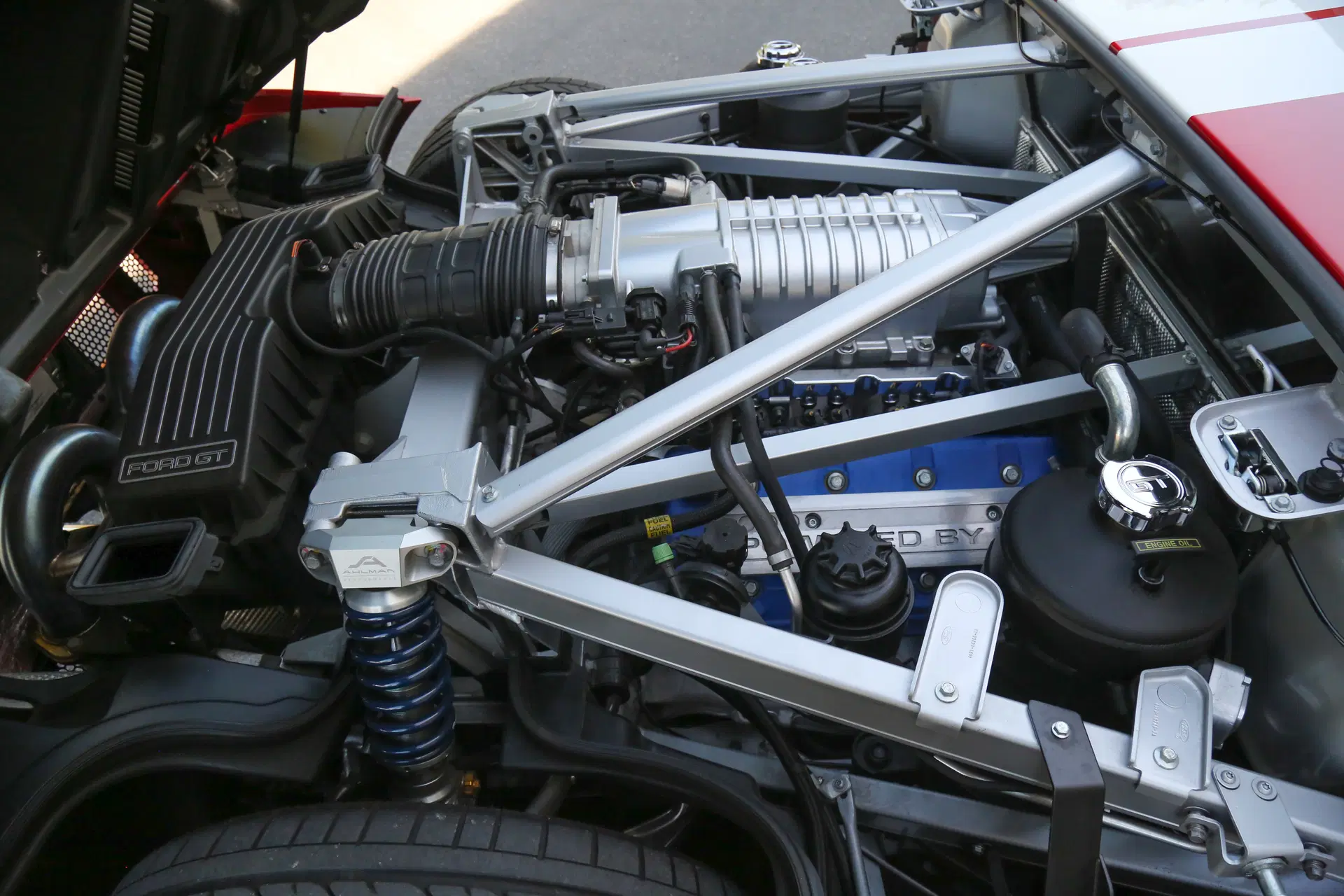
The supercharged V8 was derived from the 2000 Mustang SVT Cobra R engine but substantially revised and enhanced. Engineers enlarged displacement from 4.6 liters to 5.4 liters and optimized the Eaton supercharger for maximum power delivery across the entire rev range. The result was 550 horsepower and 550 lb-ft of torque, making the GT the most powerful production car Ford had ever built. The engine was constructed at Ford’s Romeo, Michigan facility, representing the fruits of extensive research and development.
The production-ready GT debuted at the 2004 Detroit Auto Show, with manufacturing beginning at Saleen Special Vehicles in Troy, Michigan. Ford initially planned 4,500 units but ended production at 4,038 after 2006, reflecting the limited market for $140,000+ supercars during that era.
Design and Engineering
The GT’s aluminum space frame provided an exceptionally rigid foundation at 3,485 kilograms, distributing weight optimally through the mid-engine layout. Super-plastic-formed aluminum body panels featured unstressed design, carrying no structural load while achieving dramatic shaping with minimal weight. One-piece door panels, roll-bonded floor panels, and friction-stir welded tunnels exemplified the advanced construction techniques employed throughout.
Suspension used independent coil-over springs and unequal-length double wishbones front and rear. The geometry was tuned for high-speed stability while maintaining responsive handling characteristics. The mid-mounted engine achieved near-perfect weight distribution, creating balanced dynamics that rewarded skilled driving.
Braking was handled by four-piston Brembo calipers with ventilated discs measuring 370mm front and rear, providing powerful stopping power adequate for the GT’s extraordinary performance. Anti-lock brakes and traction control were standard, though the system could be deactivated for driver engagement.
The 5.4-liter supercharged V8 featured all-aluminum Modular construction with a single overhead camshaft per bank controlling two valves per cylinder. The Eaton 2300 supercharger, belt-driven at engine speed, delivered 550 horsepower at 6,000 rpm and 550 lb-ft of torque at 3,750 rpm. A dry-sump oil system allowed the engine to sit lower in the chassis, improving weight distribution and lowering the center of gravity.
Transmission was a six-speed Ricardo manual with traditional gate shifter. Overdrive in fifth and sixth gear allowed relaxed highway cruising despite the engine’s performance credentials. A limited-slip differential transferred power with 3.55:1 ratio for excellent acceleration.
Styling
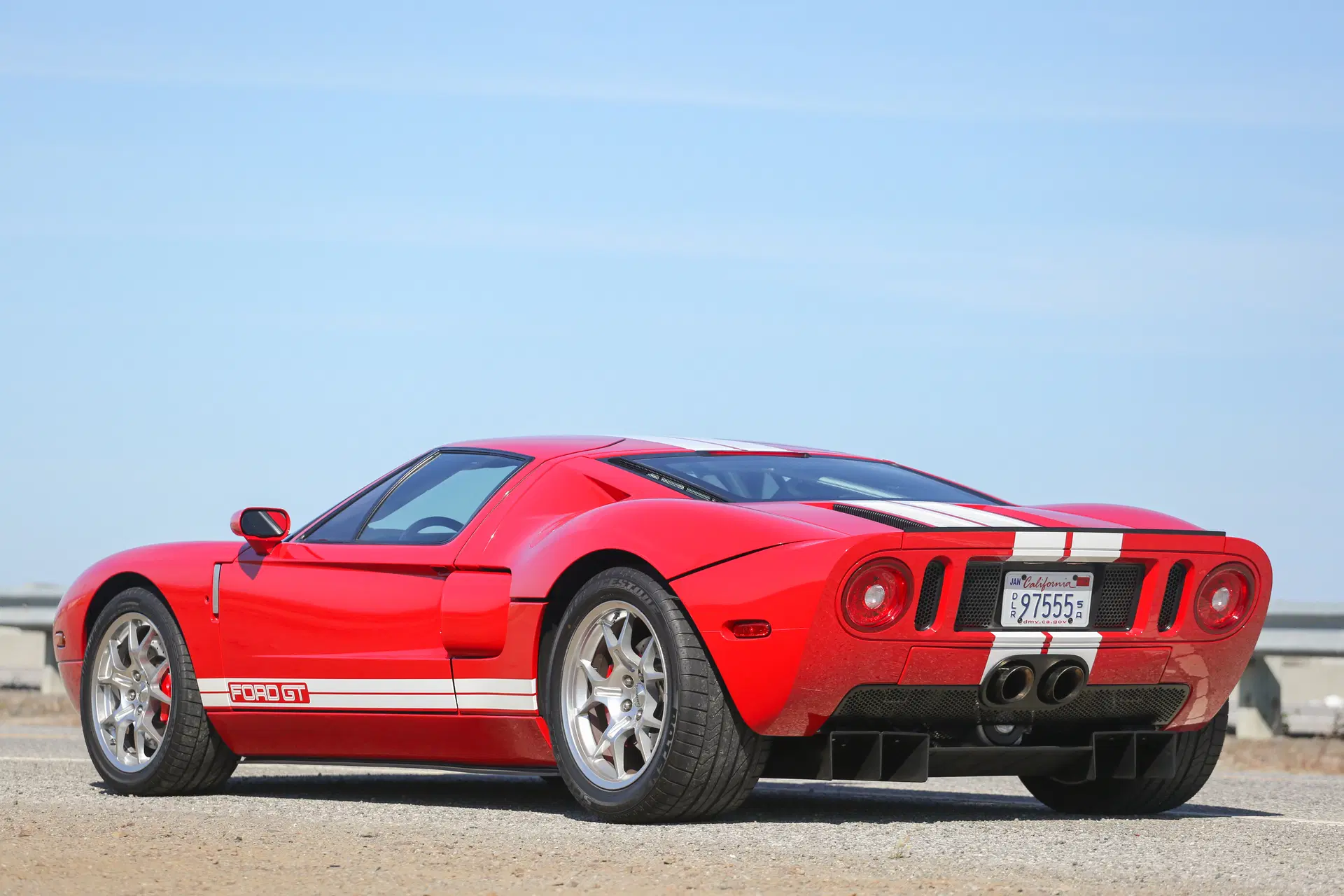
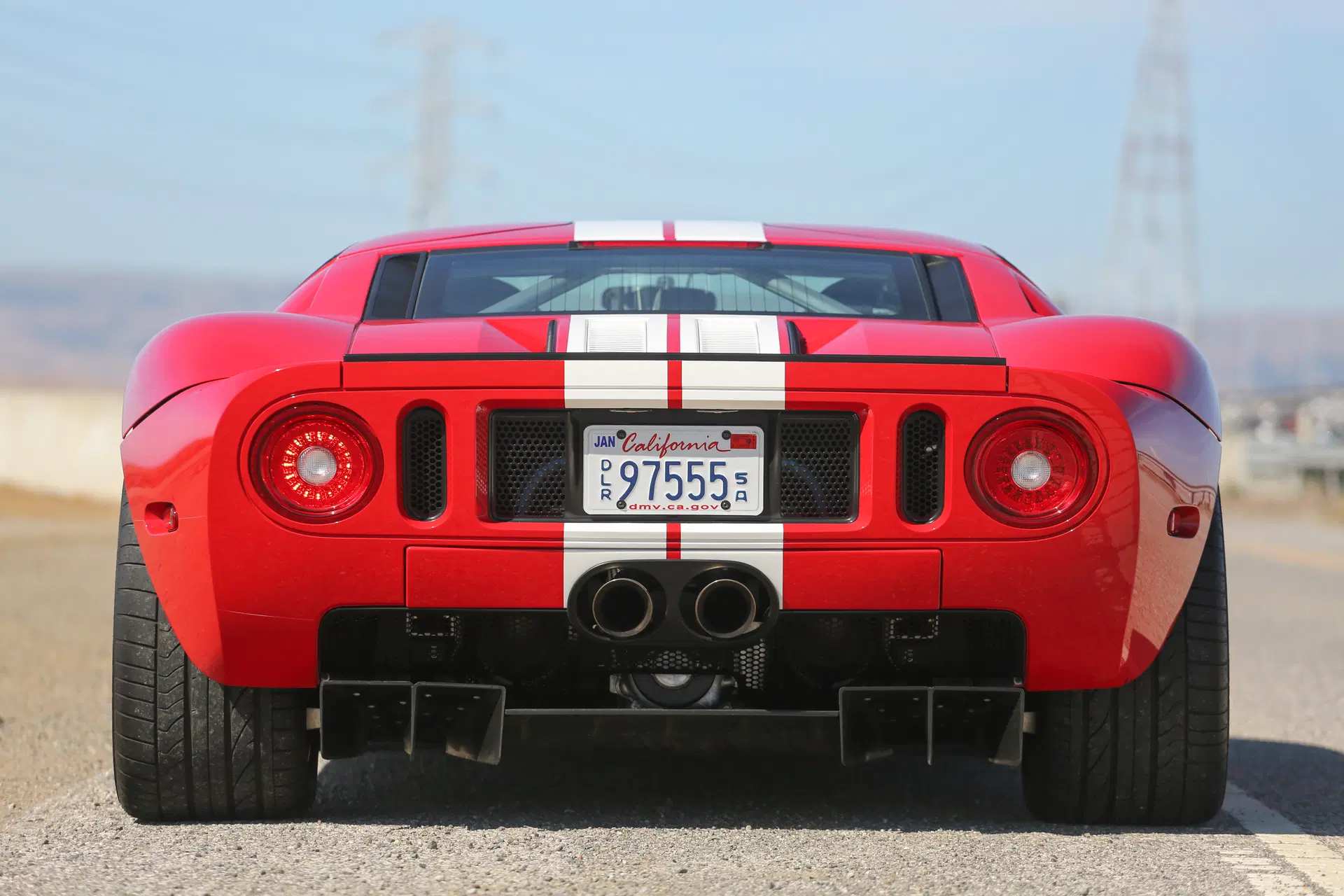
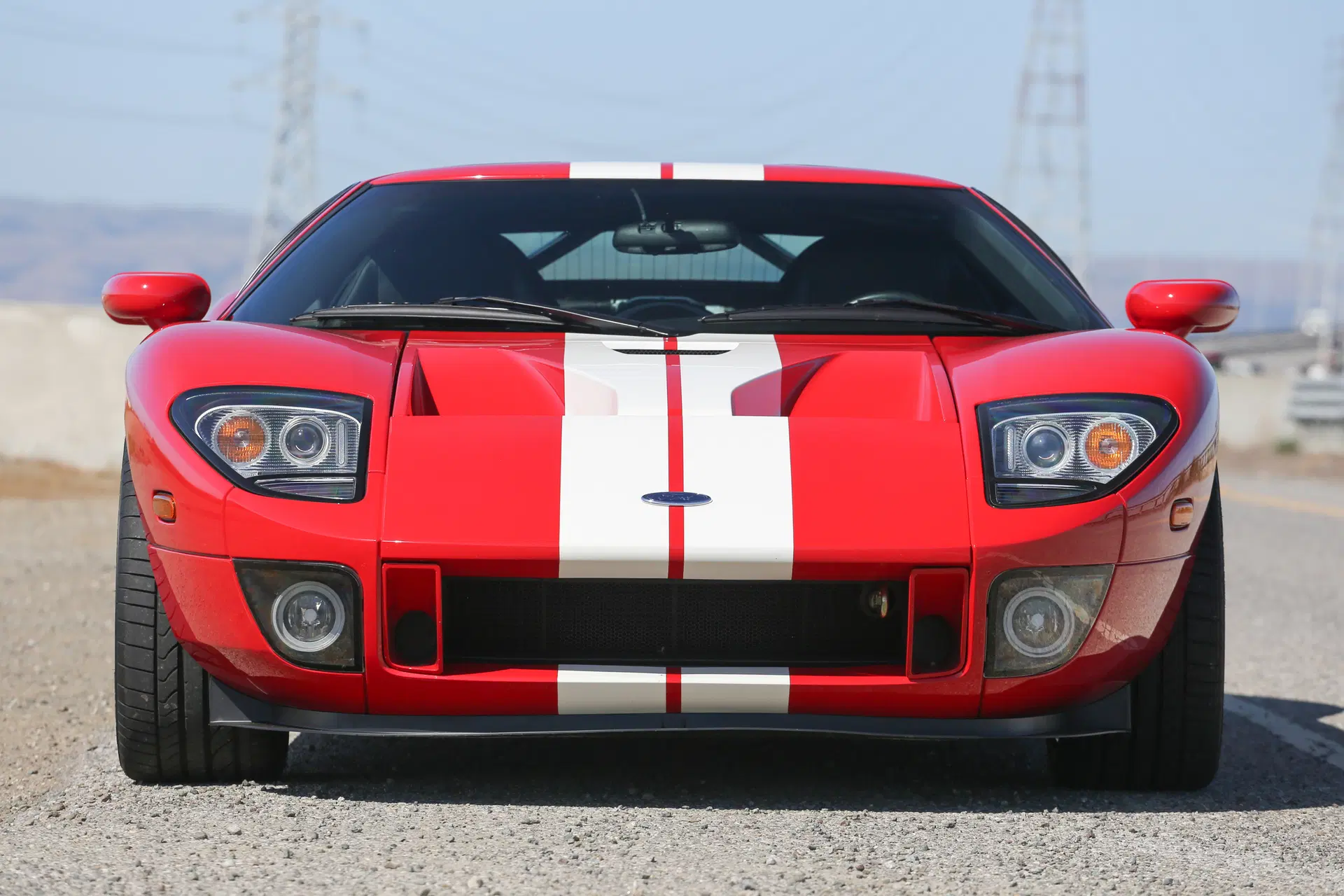
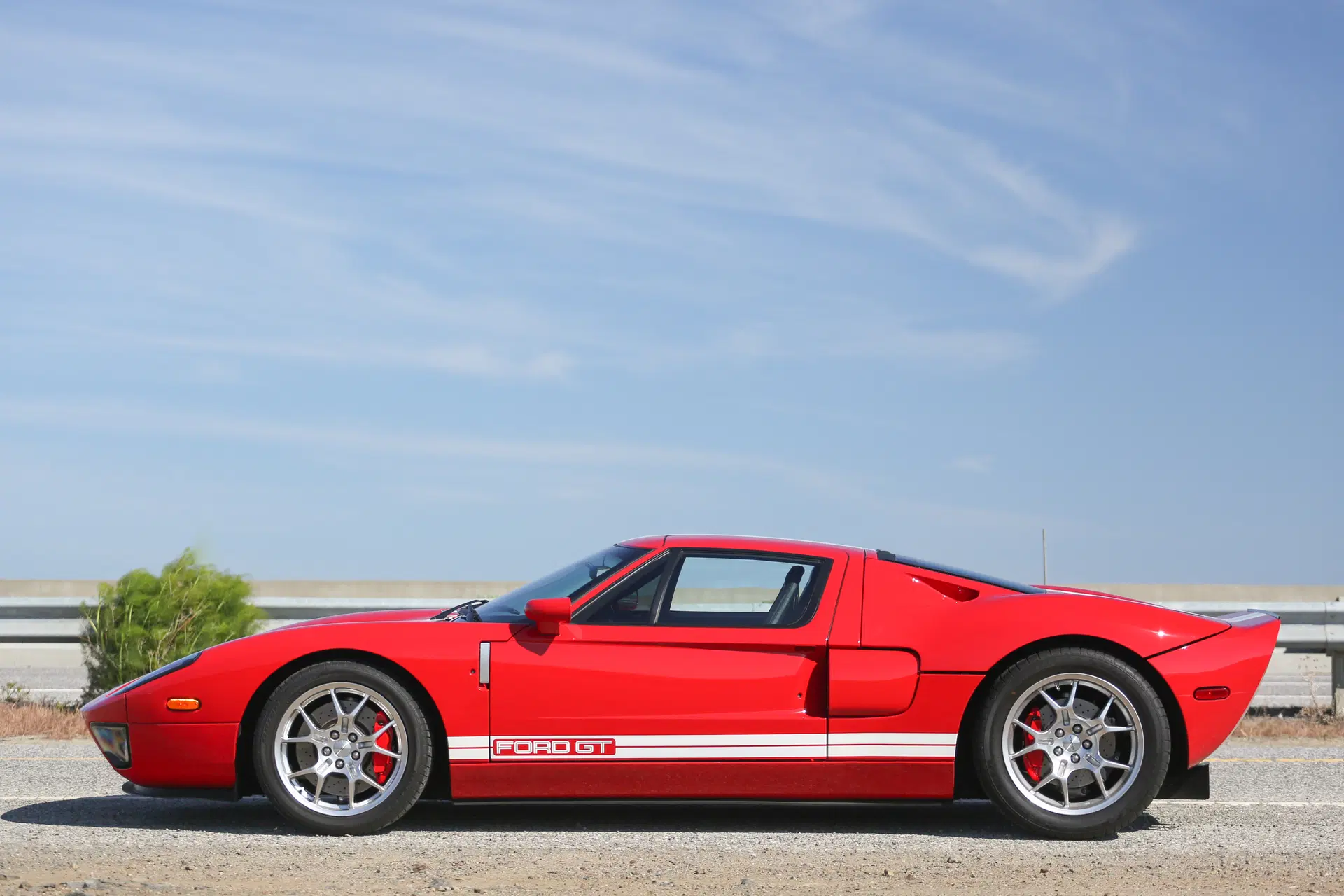
The GT maintained the 1966 GT40’s iconic silhouette while interpreting every dimension for modern proportion. Gullwing doors opened upward and forward, creating theatrical entry expected from a supercar. Pop-up headlights kept the front clean, while the aggressive lower fascia incorporated racing-inspired ground effects ducting for brake and engine cooling.
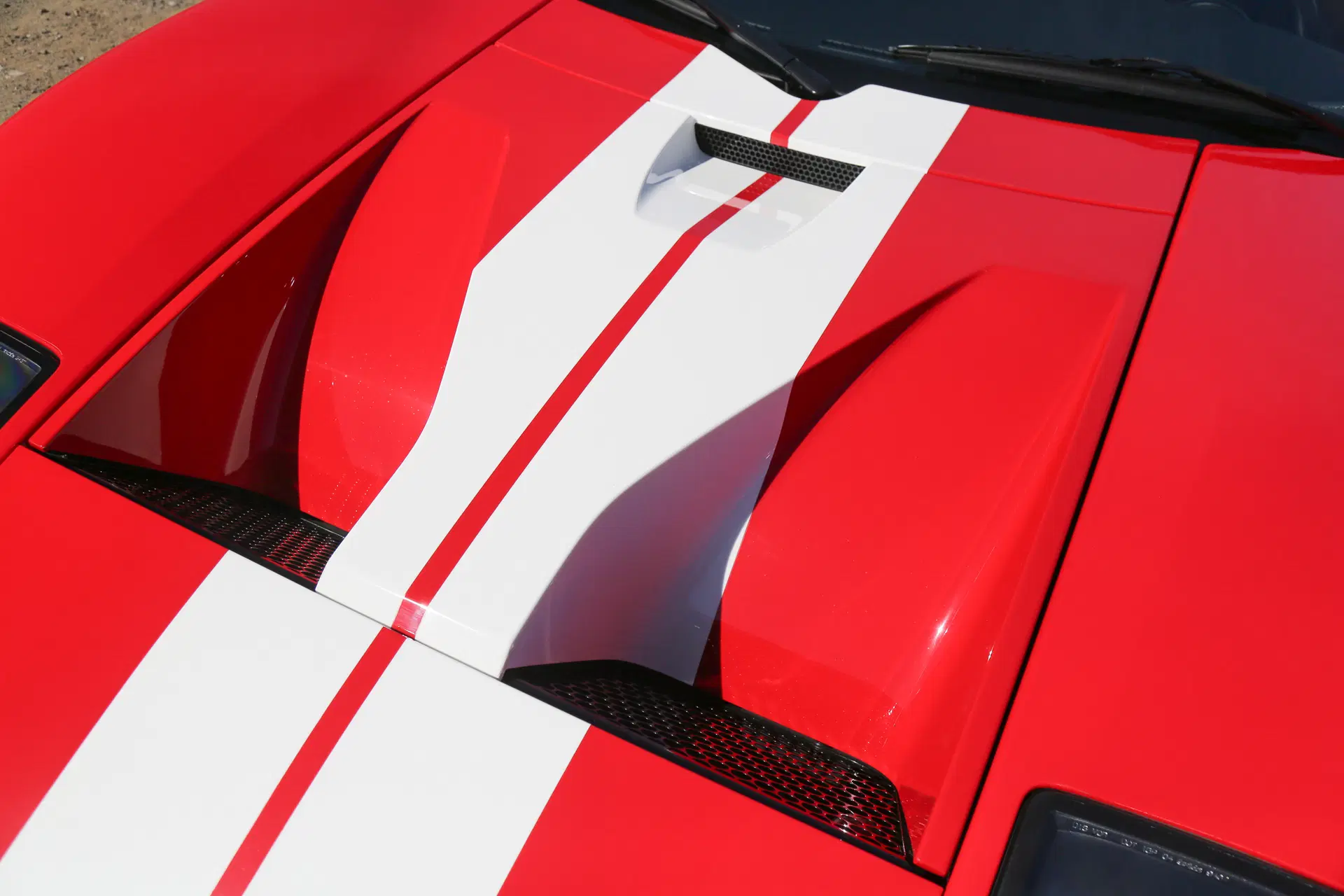
The long hood featured functional cooling ducts feeding air to the engine bay. Large side intakes provided additional cooling while contributing to the muscular appearance. A fixed rear wing provided downforce without excessive drag. The overall stance was purposeful yet restrained, reflecting Ford design philosophy rather than Italian flamboyance.
Standard wheels were eighteen-inch fronts and nineteen-inch rears wearing Goodyear Eagle F1 Supercar tires. Most early examples wore Mark IV Red with optional white racing stripes (Heritage Edition), though various colors were available.
Interior
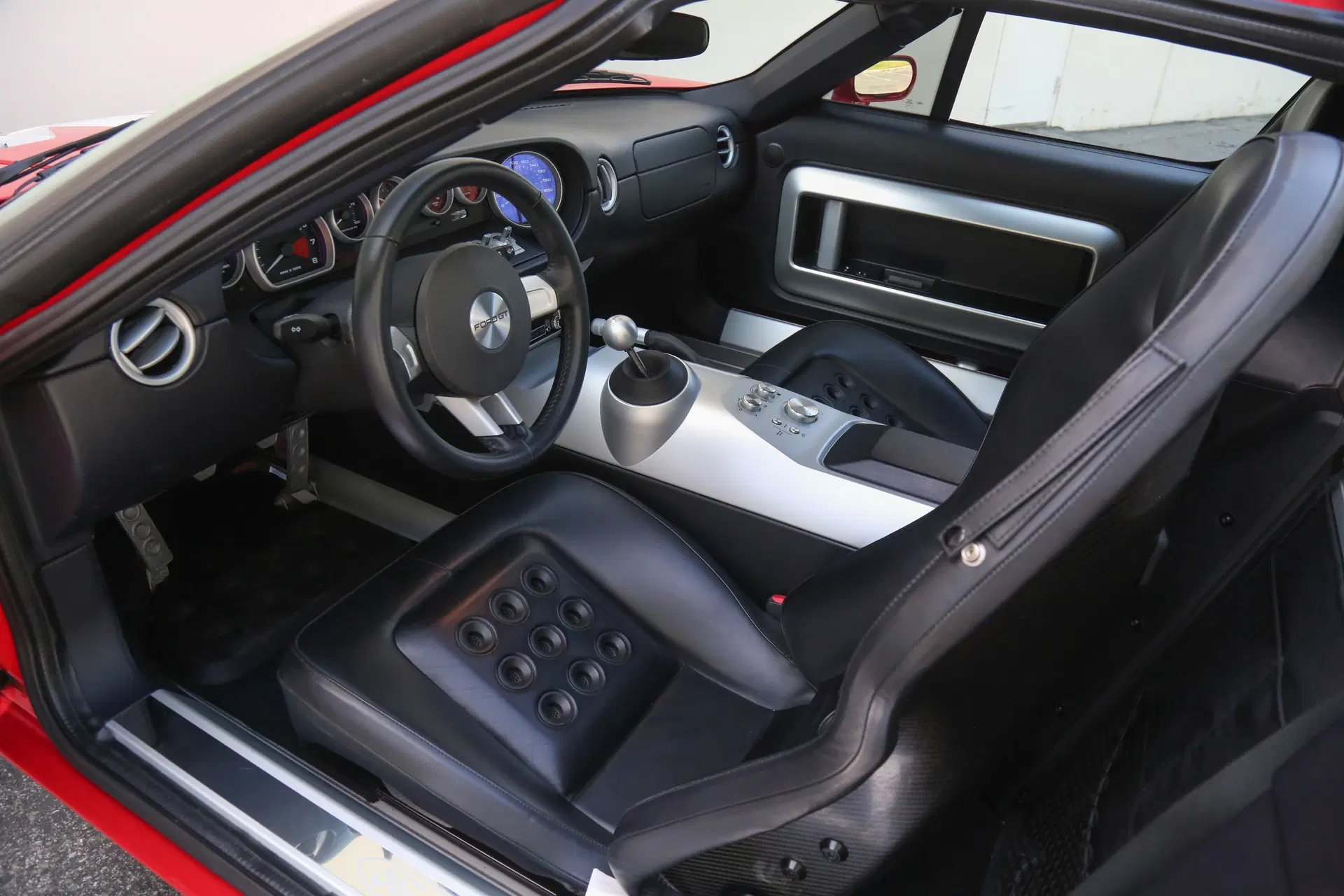
The cabin featured leather trimming with aggressive bucket seats providing excellent lateral support during spirited driving. The driving position was low and forward with excellent visibility. The dashboard was straightforward and functional with comprehensive gauges including a tachometer redlined at 7,000 rpm.
Standard equipment included air conditioning and McIntosh premium audio. The overall atmosphere balanced sporting intent with functional luxury appropriate for extended high-speed driving.
Specifications
- Engine: Modular supercharged V8, 5,409cc, SOHC per bank, two valves per cylinder, Eaton supercharger
- Power: 550 bhp at 6,000 rpm
- Torque: 550 lb-ft at 3,750 rpm
- Transmission: Six-speed manual, 3.55:1 limited-slip differential
- Chassis: Aluminum space frame, 2,710mm wheelbase
- Suspension: Double wishbones (front and rear), coil springs
- Brakes: Brembo four-piston calipers, ventilated discs 370mm (front and rear)
- Wheels: 18-inch front/19-inch rear alloy, Goodyear Eagle F1 Supercar tires
- Weight: 1,580 kg
- Performance: 205 mph top speed, 0-60 mph in 3.4 seconds
Racing History
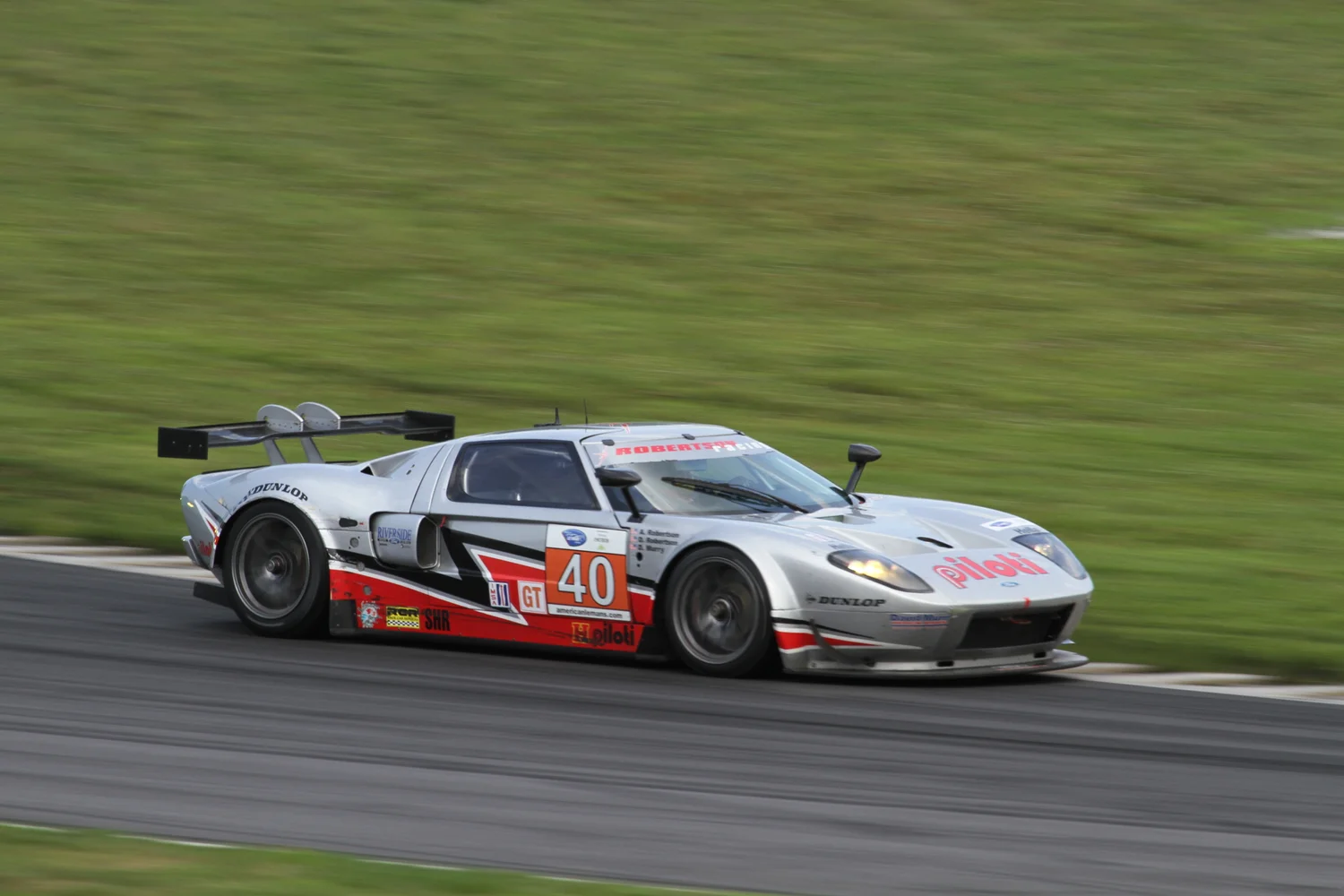
The Ford GT immediately attracted racing interest, with factory-backed competition programs utilizing the production platform. The GT competed in the American Le Mans Series and other prestigious competitions, including entries at the legendary 24 Hours of Le Mans. Privateer entries campaigned GTs in IMSA and Grand-Am racing with considerable success, demonstrating the platform’s inherent capability and competitiveness against purpose-built racing machinery.
Production and Legacy
Ford built 4,038 GT examples between 2004 and 2006, with each car hand-assembled by Saleen Special Vehicles. Limited production reflected the GT’s exclusive nature. Initial demand vastly exceeded supply, with dealer markups exceeding $100,000 over the $139,995 base price common during the first year.
The Ford GT proved that American companies could build world-class supercars. The GT remains one of Ford’s greatest achievements, a supercar celebrating past glory while proving Detroit could compete globally.