
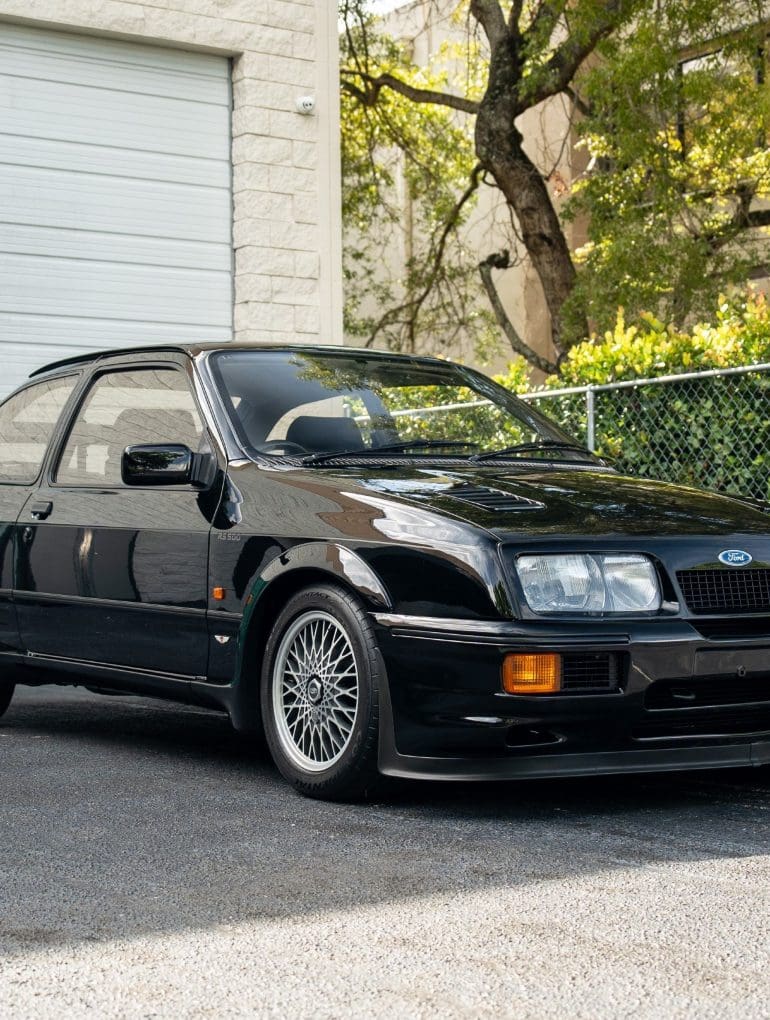

Frankfurt, September 1985. Ford unveiled the Sierra RS Cosworth, a high-performance variant designed to dominate touring car racing. The three-door hatchback featured a turbocharged 2.0-liter inline four producing 204 horsepower, rear-wheel drive, and an enormous rear wing nicknamed “the whale tail.” Developed by Ford’s Special Vehicle Engineering division at Boreham, the RS Cosworth combined the humble Sierra platform with motorsport-derived engineering. The Cosworth YBB engine featured a Garrett T3 turbocharger, intercooler, and sophisticated engine management delivering devastating performance. Ford needed 5,000 examples for Group A homologation. They built 5,545 between 1986 and 1987, creating one of the most successful touring car homologation specials ever produced.
Background and Origins
Ford dominated touring car racing in the 1960s and early 1970s with the Escort Twin Cam and RS models, but by the early 1980s, the company lacked a competitive platform. BMW’s turbocharged inline six models dominated Group A touring car championships worldwide, and Ford needed a response.
Development began in 1983 under Stuart Turner at Ford Motorsport. The brief was straightforward: create a rear-wheel drive turbocharged saloon capable of winning Group A touring car championships while satisfying FIA homologation requirements of 5,000 production units. The Sierra three-door hatchback provided the platform, offering rear-wheel drive and sufficient interior space for motorsport modifications.
Cosworth Engineering developed the engine, a turbocharged evolution of their successful naturally aspirated designs. The result was the YBB inline four, displacing 1,993cc and featuring a cast-iron block, aluminum head, and sophisticated forced induction system. Ford’s Special Vehicle Engineering division at Boreham handled final assembly.
The prototype debuted at Frankfurt in September 1985, with production beginning in July 1986. Initial demand exceeded Ford’s 5,000-unit requirement, prompting continued production until July 1987.
Design and Engineering
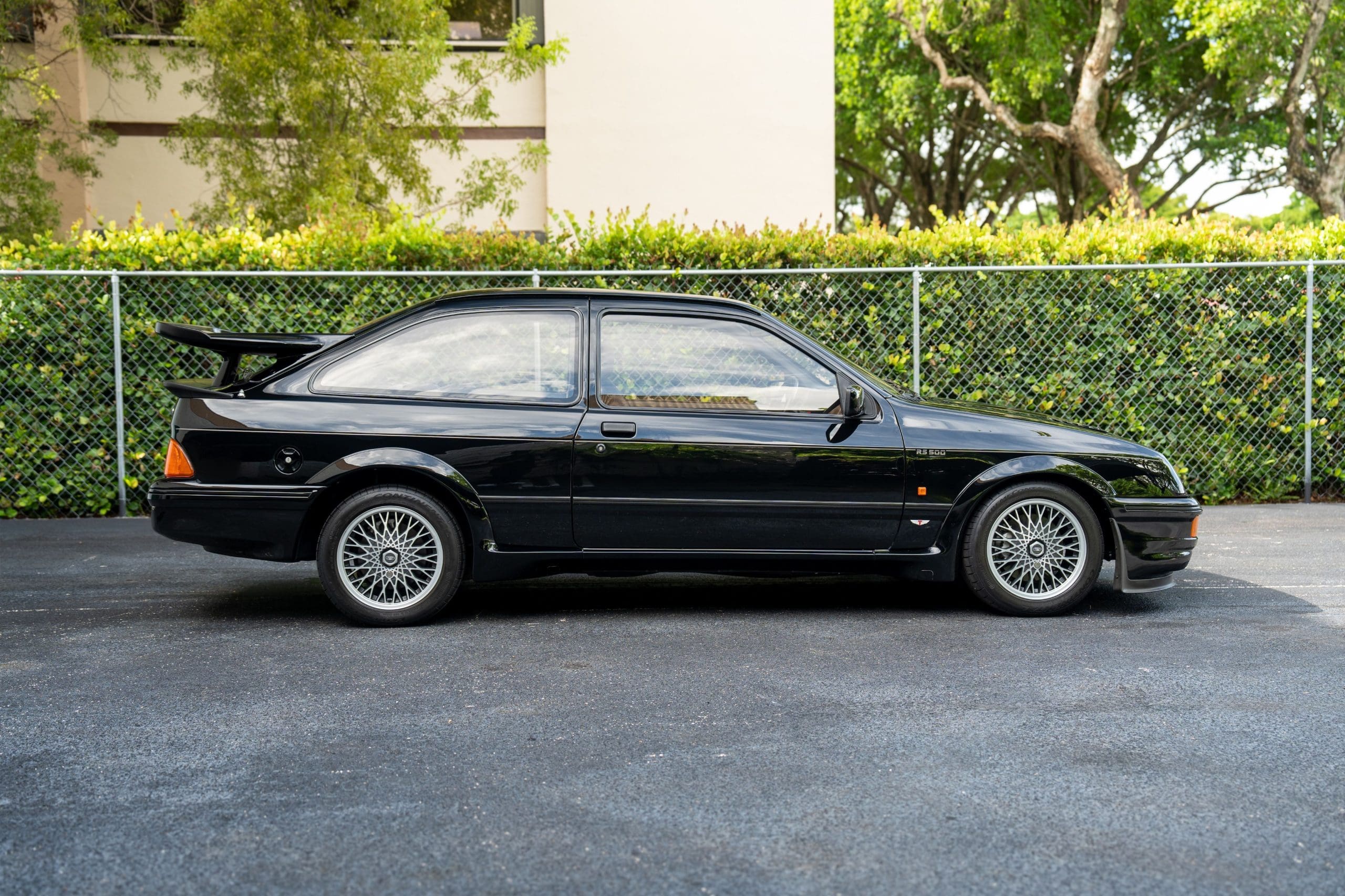
The RS Cosworth was based on the standard Sierra three-door hatchback’s unibody structure with a 2,608mm wheelbase. Ford reinforced the rear suspension mounting points and modified the floor pan to accommodate the rear differential and upgraded driveshaft. The front-wheel drive architecture was converted to rear-wheel drive using components from the Granada and XR4x4.
Front suspension used MacPherson struts with lower A-arms, revised with stiffer springs and uprated dampers. The rear employed a semi-trailing arm arrangement with coil springs, dampers, and anti-roll bar. Ride height dropped 15mm compared to standard Sierras.
Braking was by ventilated discs measuring 278mm front and 269mm rear with ATE four-piston calipers up front. The steering was power-assisted rack-and-pinion with a quick 2.9-turn lock-to-lock ratio.
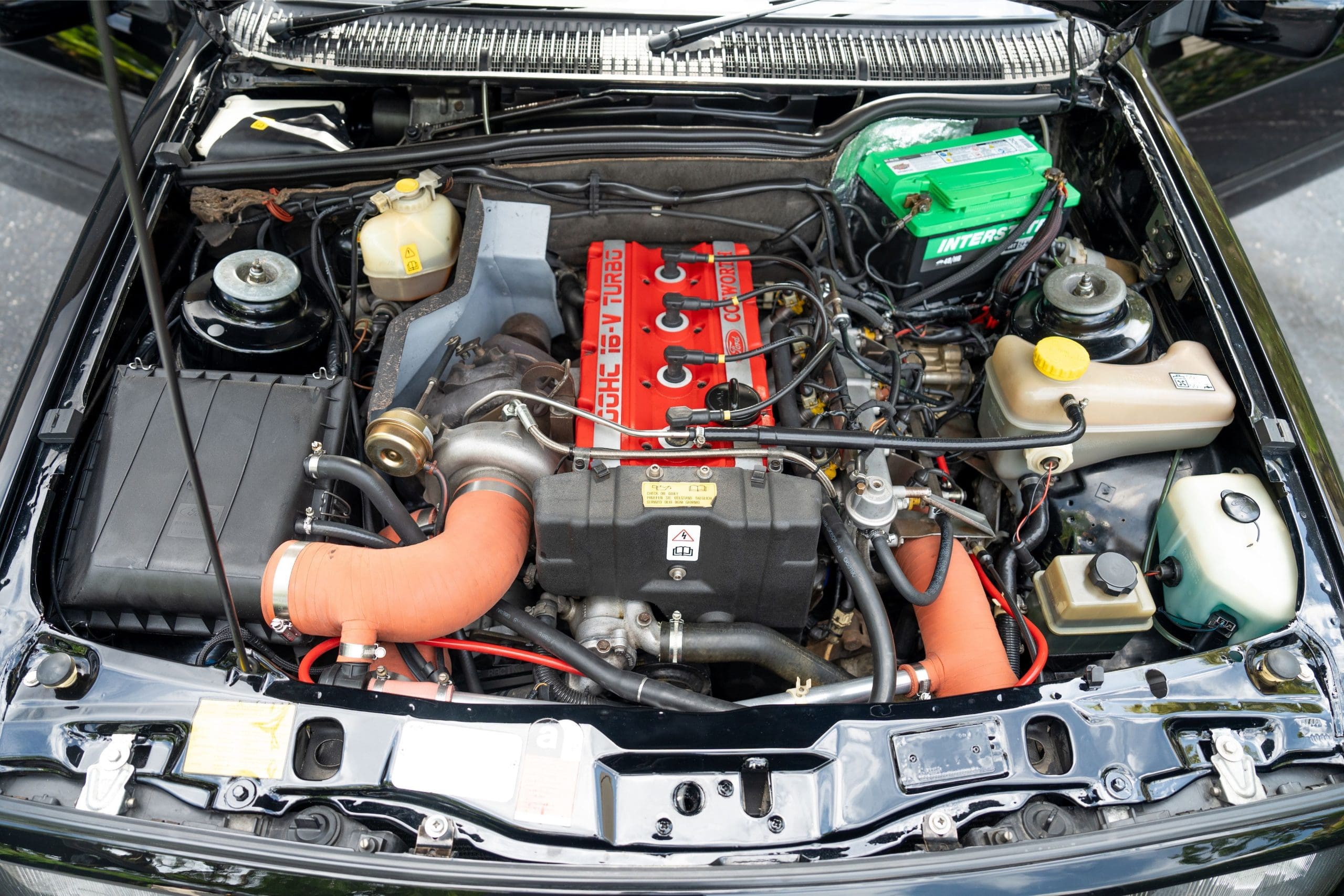
The engine was Cosworth’s YBB turbocharged inline four. Displacing 1,993cc with a 90.8mm bore and 77mm stroke, it featured a cast-iron block for strength and an aluminum DOHC head with four valves per cylinder. A Garrett T3 turbocharger provided forced induction, with compressed air cooled by an air-to-air intercooler mounted in the front bumper.
Weber-Marelli engine management controlled fuel injection and ignition timing. With an 8.0:1 compression ratio, output was 204 horsepower at 6,000 rpm and 205 lb-ft at 4,500 rpm. The broad torque curve delivered strong acceleration from 3,000 rpm onward. Competition versions produced over 500 horsepower with relatively straightforward modifications.
Transmission was a Borg-Warner T5 five-speed manual with close ratios and a 3.62:1 limited-slip differential.
Styling
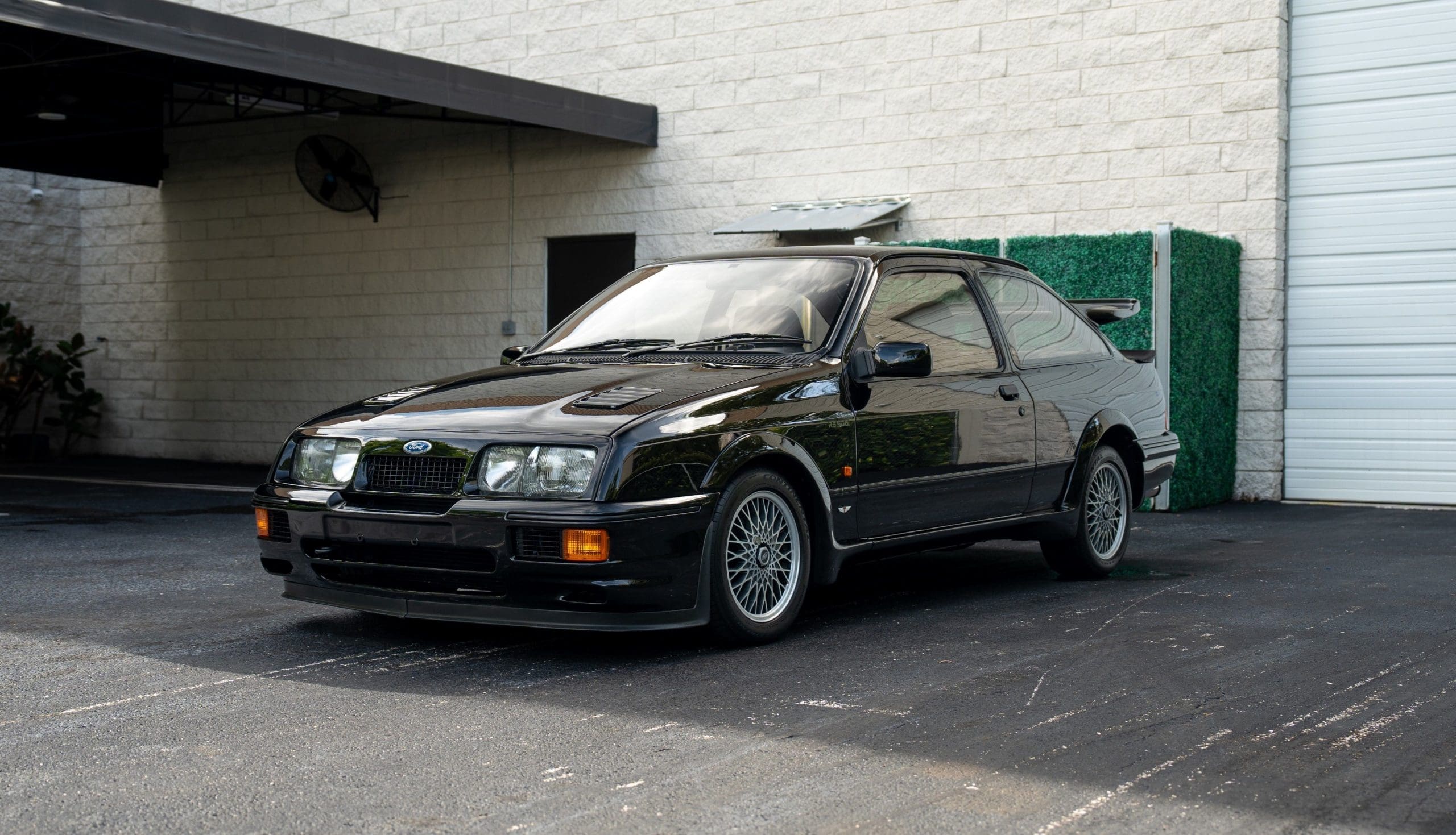
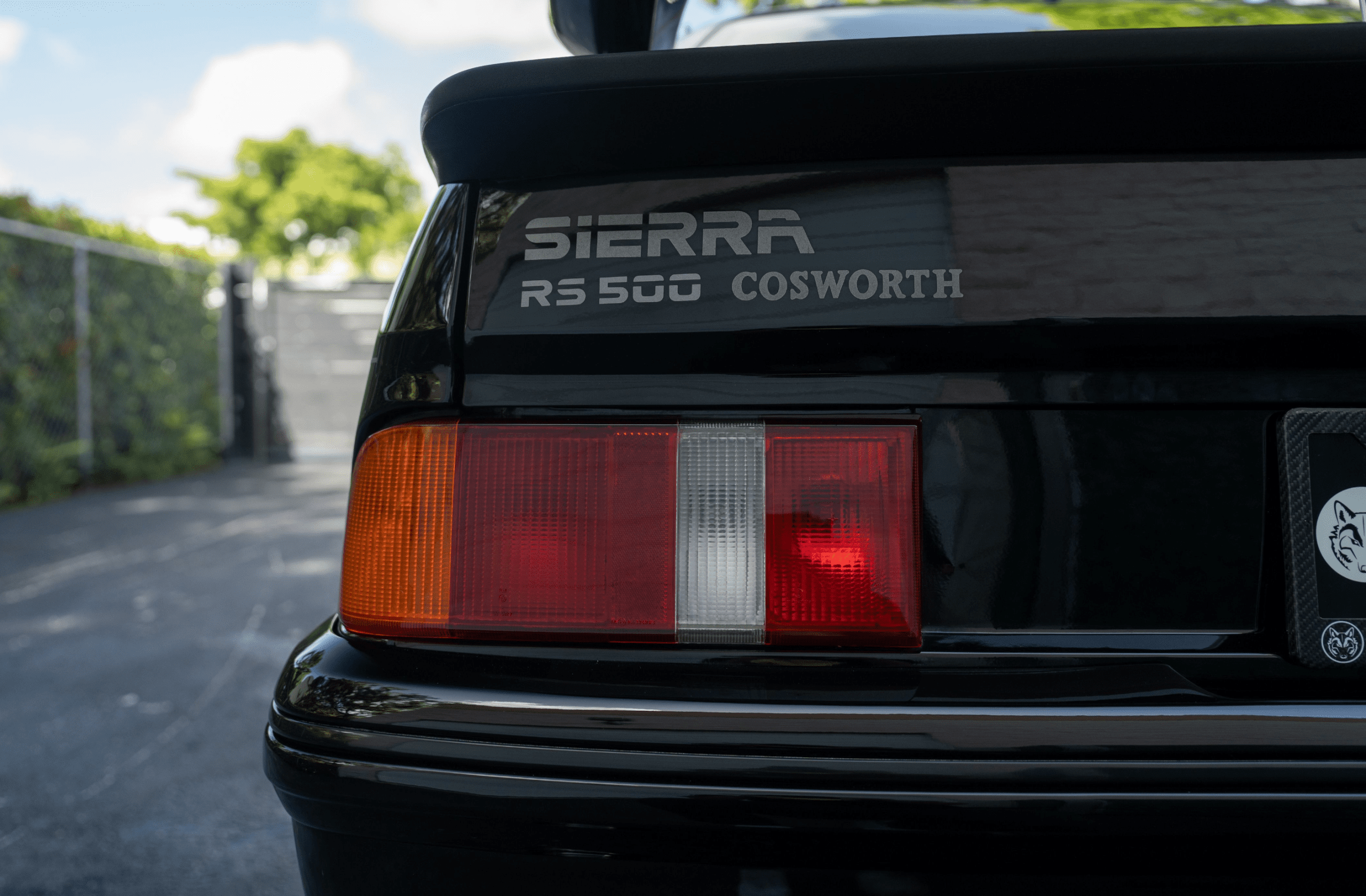
The RS Cosworth’s appearance was dominated by that enormous rear wing. The “whale tail” spoiler sat high above the rear hatch on substantial supports, providing genuine downforce while creating the car’s most distinctive visual element. The wing became synonymous with the RS Cosworth.
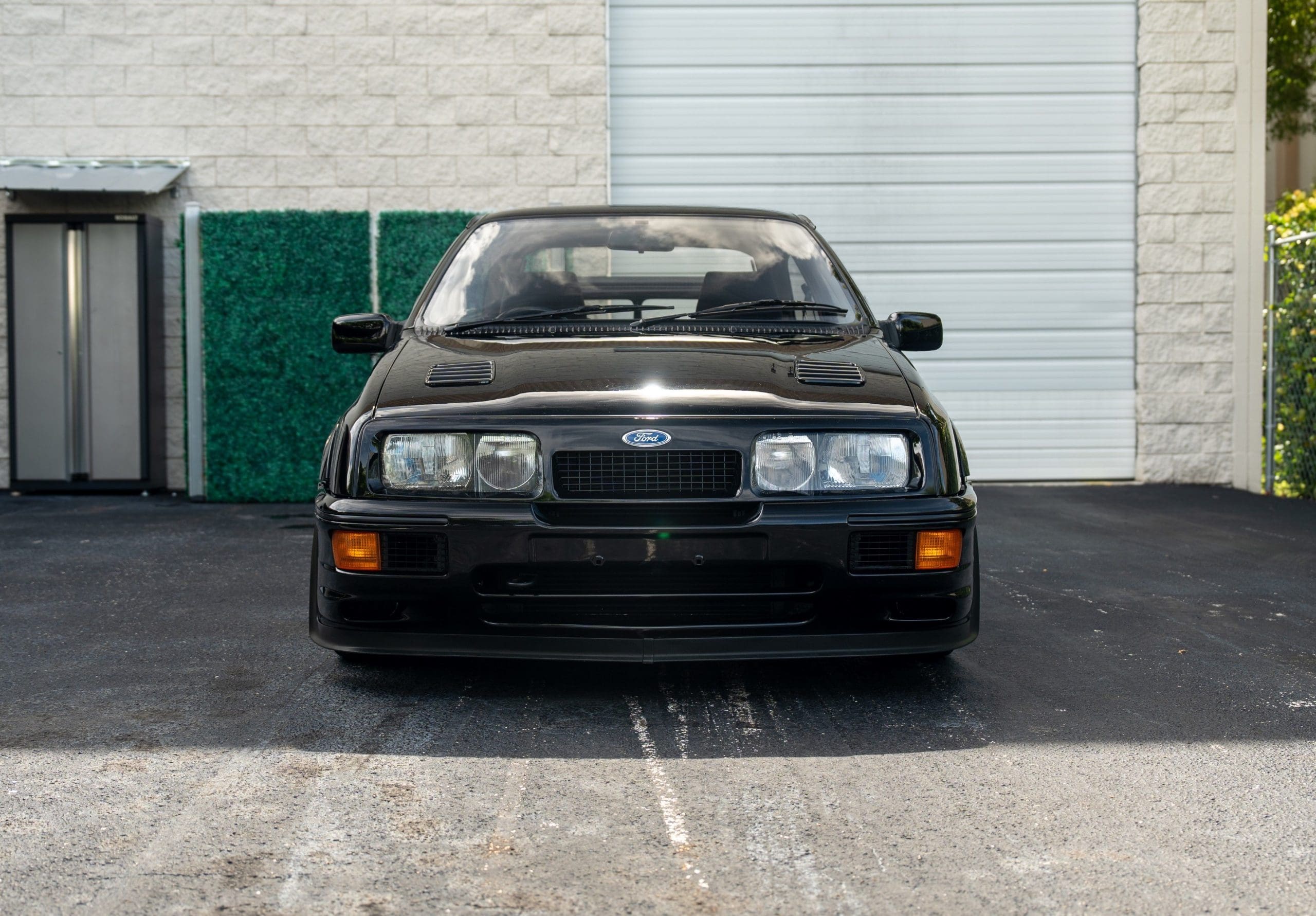
The front bumper featured a deep chin spoiler with a large central air intake feeding the intercooler. The bonnet featured a functional scoop feeding cool air to the engine bay. At the rear, a deep rear valance incorporated a diffuser and centrally mounted dual exhaust outlet.
Body-colored bumpers replaced the standard Sierra’s black plastic units. Flared wheel arches covered slightly wider tracks. RS Cosworth badges appeared on the front grille and rear panel, while Cosworth turbo graphics ran down the side skirts on many examples.
Standard wheels were 15-inch RS three-spoke alloy units measuring 7 inches wide, wearing 205/50 VR15 Goodyear Eagle NCT tires. Most cars were finished in Moonstone Blue, though white, black, and various other colors were available.
Interior
The cabin featured Recaro sport seats trimmed in grey cloth with prominent bolstering. The seats provided excellent support, though rear seat space was limited by the intrusive rear differential. An RS Cosworth plaque appeared on the center console.
The dashboard retained the standard Sierra’s layout but featured unique RS instrumentation. A boost gauge sat prominently in the center stack. The standard gauges included a tachometer redlined at 6,500 rpm, speedometer, and auxiliary dials for oil pressure, water temperature, and fuel.
A leather-wrapped steering wheel faced the driver. The gear lever was short-throw with a weighted knob. Standard equipment included power windows, central locking, and a cassette stereo.
Specifications
- Engine: Cosworth YBB turbocharged inline four, 1,993cc (90.8mm x 77mm), DOHC, four valves per cylinder, Garrett T3 turbocharger
- Power: 204 bhp at 6,000 rpm
- Torque: 205 lb-ft at 4,500 rpm
- Transmission: Borg-Warner T5 five-speed manual, 3.62:1 limited-slip differential
- Chassis: Steel unibody, 2,608mm wheelbase
- Suspension: MacPherson struts (front), semi-trailing arms (rear)
- Brakes: Vented discs 278mm (front), vented discs 269mm (rear)
- Wheels: 7×15 RS three-spoke alloy, Goodyear Eagle NCT 205/50 VR15
- Weight: 1,180 kg
- Performance: 143 mph top speed, 0-60 mph in 6.2 seconds
Competition History
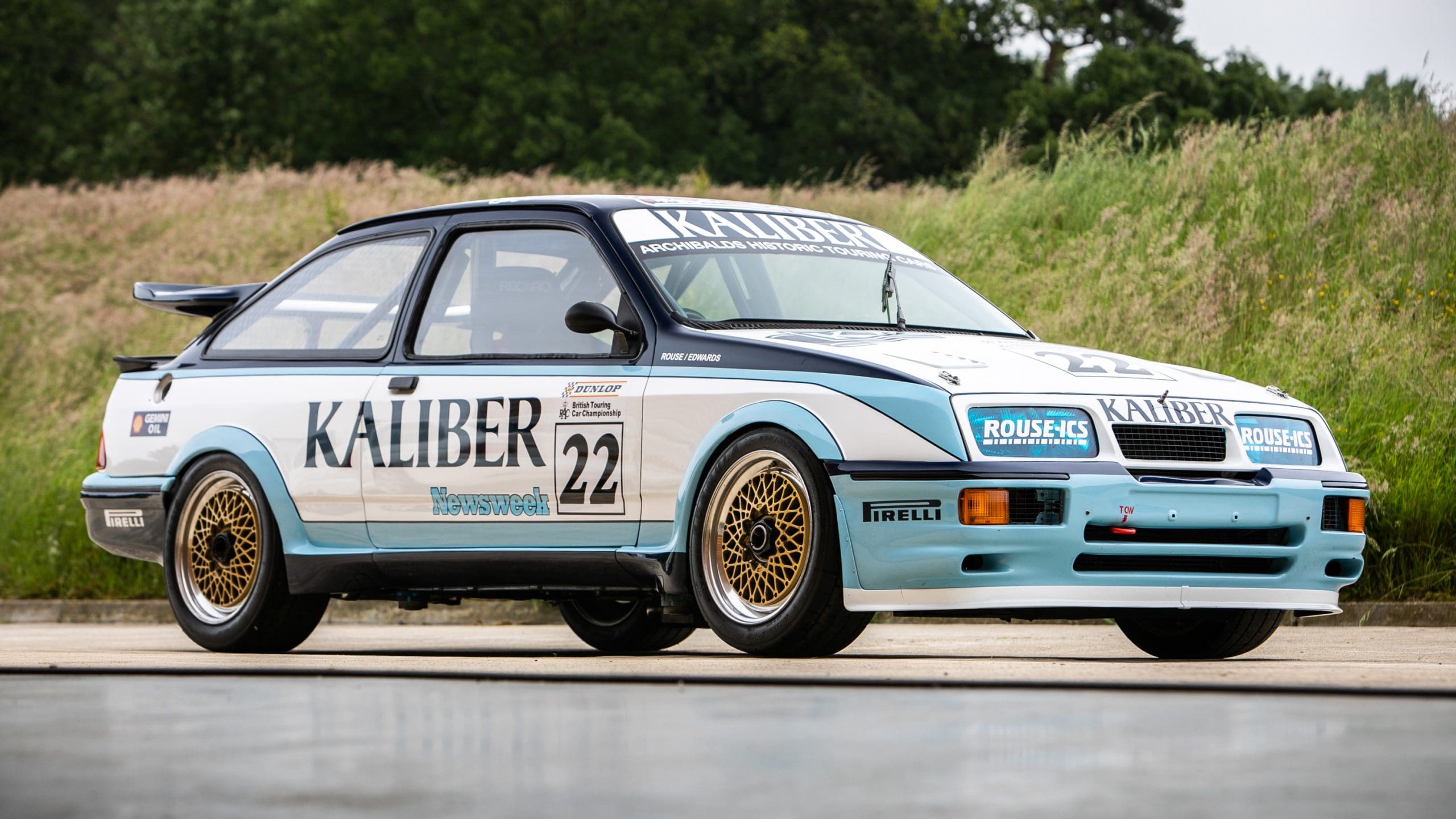
The Sierra RS Cosworth was built specifically for Group A touring car racing and achieved exactly what Ford intended. Andy Rouse drove one to the 1986 British Touring Car Championship title immediately after homologation. The RS Cosworth dominated European touring car championships throughout the late 1980s.
Klaus Ludwig and Steve Soper piloted works RS Cosworths to numerous victories in the German Touring Car Championship, while Robb Gravett achieved success in British events. The combination of turbocharged power, rear-wheel drive, and relatively light weight made the RS Cosworth devastatingly effective.
Beyond official factory efforts, numerous privateer entries campaigned RS Cosworths in national touring car series worldwide. The car’s tunability and robust mechanicals made it popular among amateur racers.
Production and Legacy
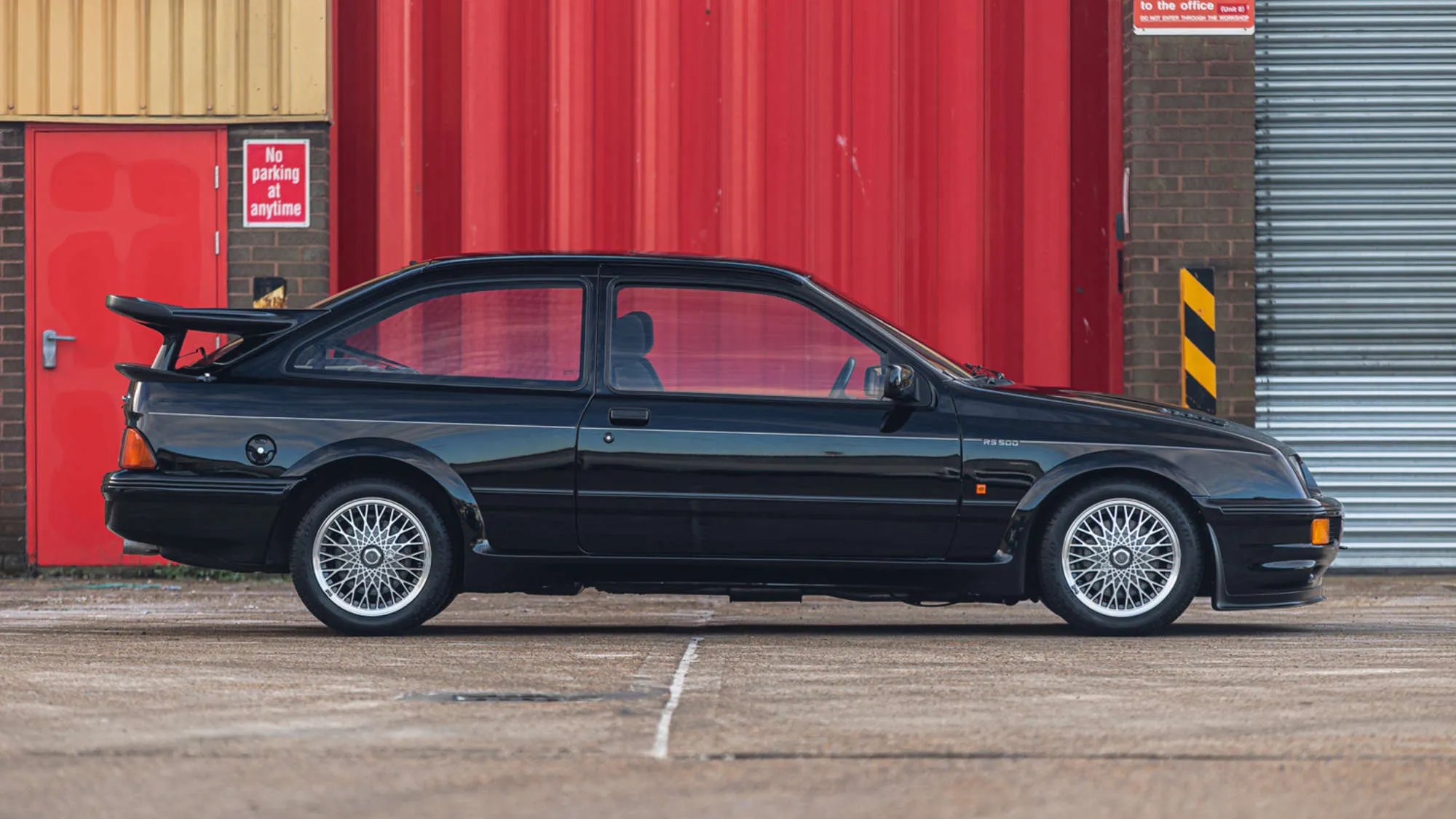
Ford built 5,545 Sierra RS Cosworths between July 1986 and July 1987 at the Genk plant in Belgium, with final assembly at Boreham. Bodies arrived from the main production line, with Boreham installing the Cosworth engine, upgraded running gear, bodywork modifications, and interior components.
The RS Cosworth succeeded commercially and in motorsport. It proved that turbocharged four-cylinder engines could deliver genuine performance, that homologation specials could be practical daily drivers, and that Ford could compete against BMW’s dominance in touring car racing.
The success spawned an entire family of Cosworth-powered Fords. The Sierra RS500 followed in 1987 with further modifications. The Sapphire RS Cosworth arrived in 1988 as a four-door variant, while the four-wheel drive Sapphire Cosworth 4×4 debuted in 1990. The Escort RS Cosworth concluded the lineage in 1992.
Today, clean Sierra RS Cosworths are increasingly collectible as enthusiasts recognize them as the car that established Ford’s modern performance credentials. The combination of motorsport success, distinctive styling, and turbocharged performance has created strong demand. Values have climbed significantly, with pristine examples commanding prices reflecting their status as icons of 1980s performance.
The Sierra RS Cosworth represented Ford’s return to touring car dominance after years in the wilderness. It proved that the company could still build focused, uncompromising performance cars when motivated by racing success. The massive rear wing, turbocharged four-cylinder engine, and rear-wheel drive layout created an icon that defined an era. It remains one of the greatest Fords ever built, a homologation special that succeeded both on track and in the showroom.