

Background and Origins
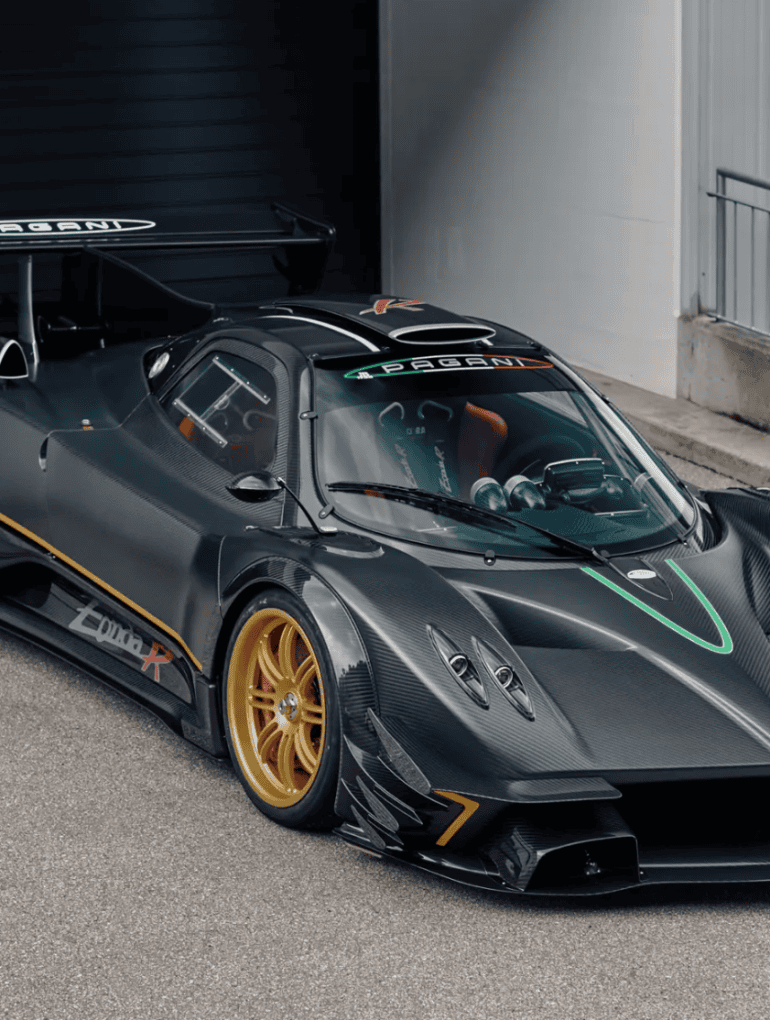
Development of the Zonda R began when a passionate Italian client approached Horacio Pagani, requesting a track-only derivative of the road-going Zonda that could push mechanical performance to its absolute limit. Rather than adapting an existing road chassis with off-the-shelf upgrades, Pagani engineering conceived a virtually clean-sheet vehicle. Although sharing a visual family resemblance to the standard Zonda, the Zonda R shared only about 10% of its components with the Zonda F, featuring a lengthened wheelbase and completely redesigned chassis architecture.
The vehicle served as the primary development platform for composite manufacturing techniques and mechanical systems destined for Pagani’s next flagship supercar, the Huayra. To handle the extreme forces, Pagani introduced a revolutionary Carbon-Titanium (Carbo-Titanium) central monocoque—weaving titanium thread into the carbon fiber weave to dramatically increase torsional rigidity and structural integrity while minimizing weight.
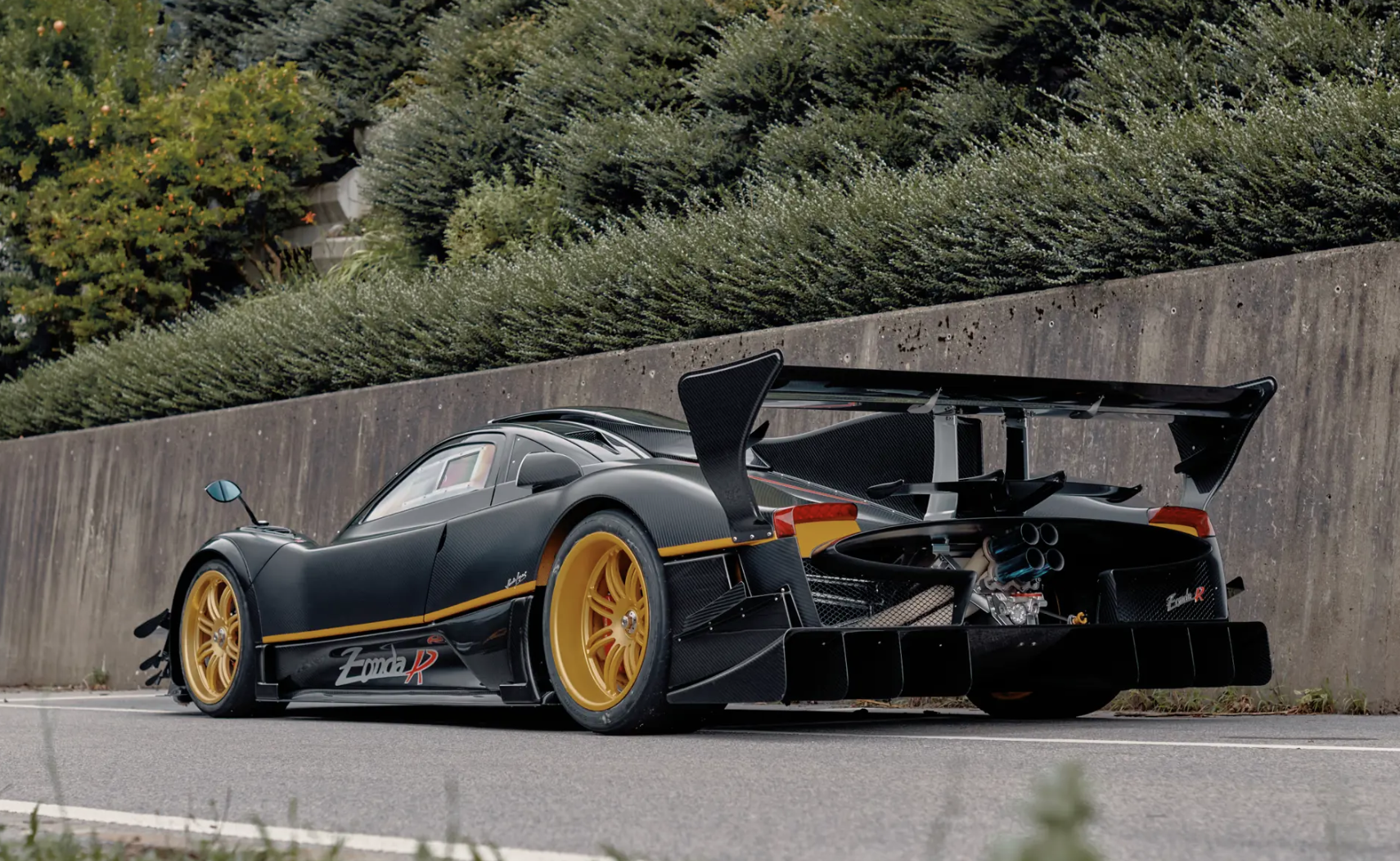
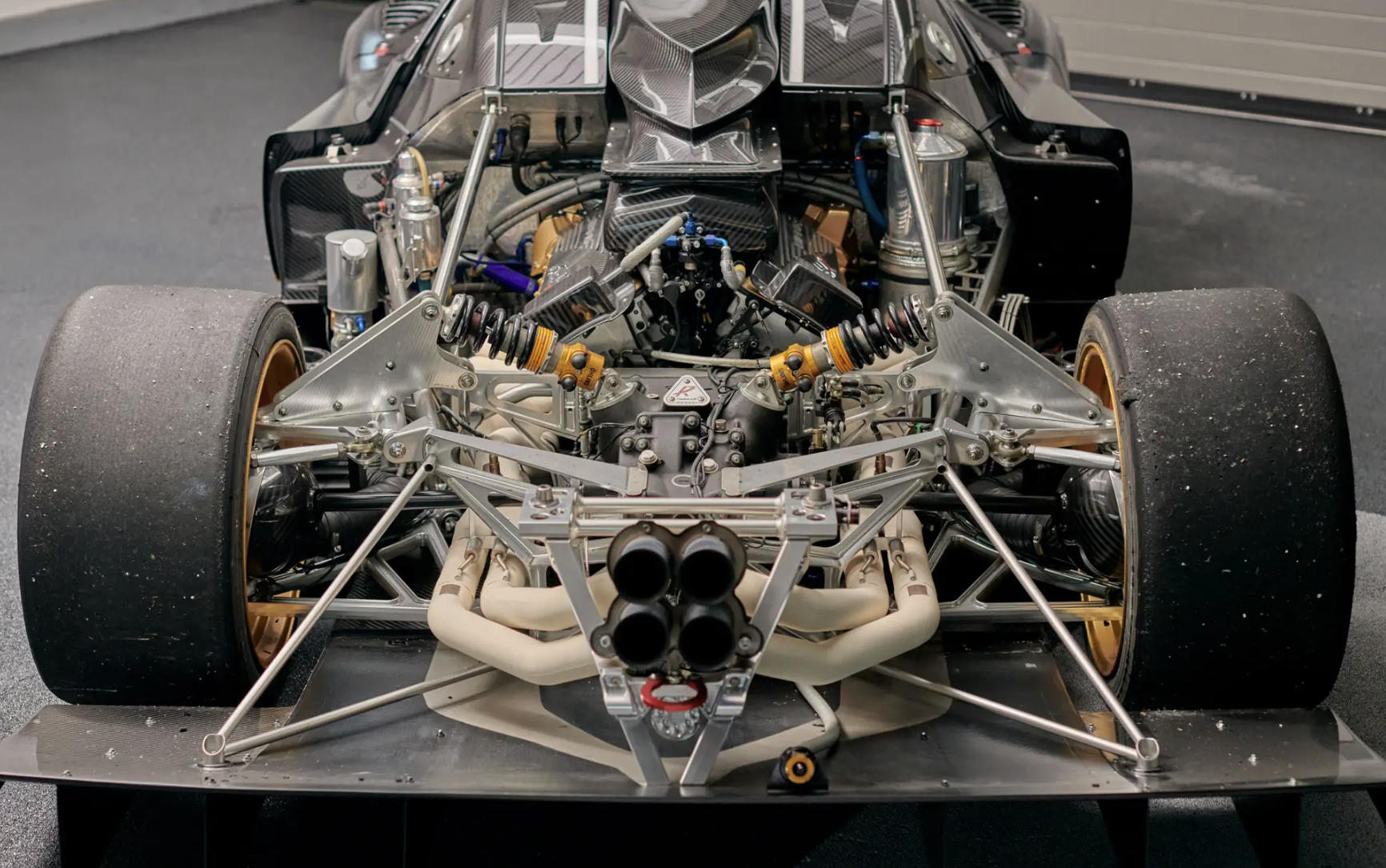
The heart of the Zonda R was a high-revving, race-bred 6.0-liter dry-sump V12 engine sourced directly from Mercedes-Benz AMG (the M120 engine variant developed for the Mercedes CLK GTR race car). Free from noise emission standards, Pagani fitted a bespoke Inconel 625 hydroformed exhaust system coated in ceramic, resulting in an unforgettable, high-pitched Formula 1-style exhaust note.
Design and Engineering
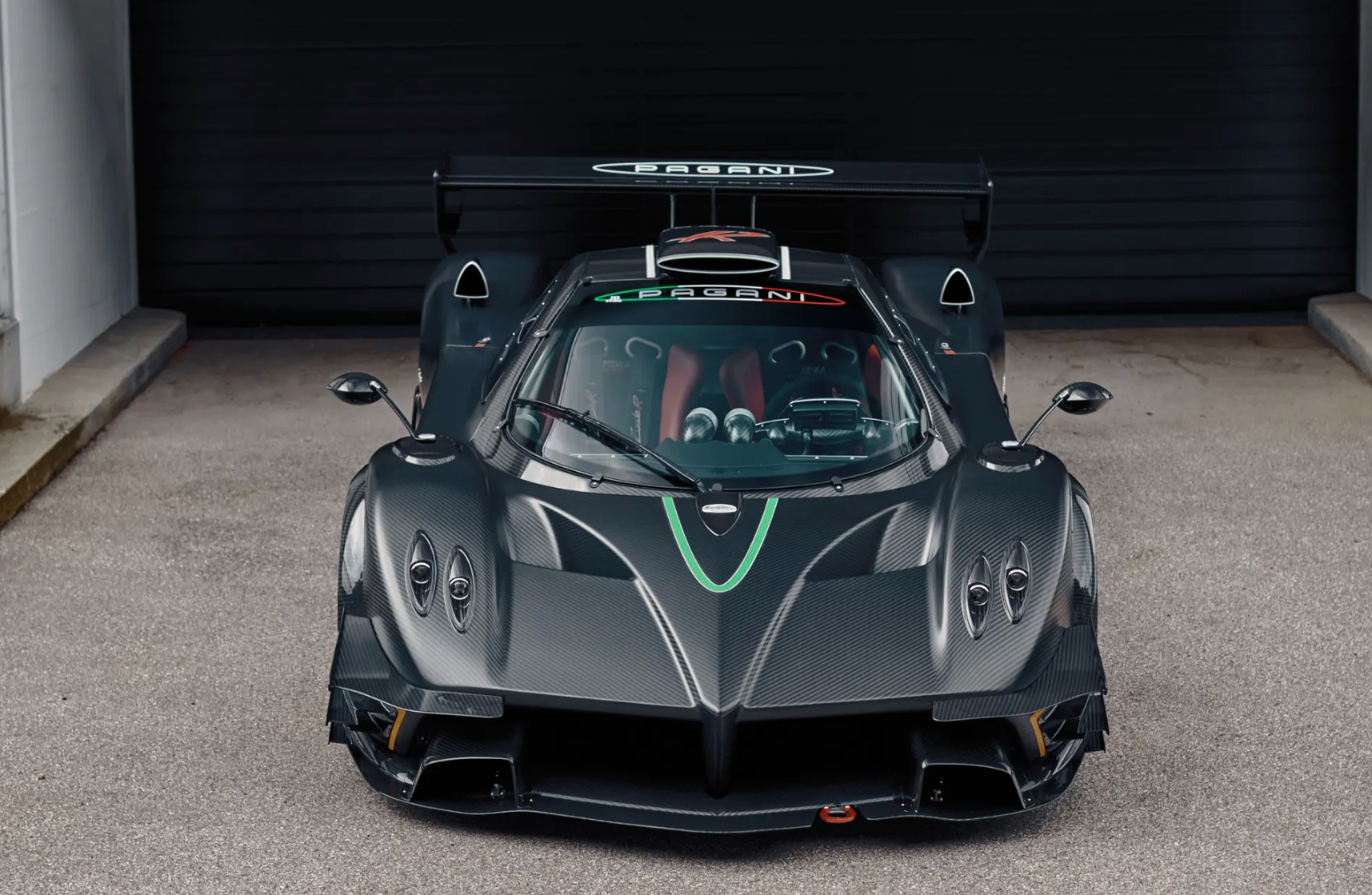
While retaining Horacio Pagani’s signature wedge profile and quad-exhaust layout, the Zonda R received radical aerodynamic refinement designed strictly for high-speed downforce and mechanical grip. The body extended longer and wider than standard Zonda models, incorporating an enlarged front splitter with double dive planes, a long rear overhang anchored by a massive adjustable rear wing, and a giant rear diffuser with a fully flat underbody.
The chassis received extensive structural and geometrical updates. The front and rear subframes were fabricated from high-strength Avional (aluminum alloy) attached to the rigid Carbon-Titanium tub. The suspension utilized double wishbones forged from Avional, featuring pushrod-actuated Öhlins adjustable shock absorbers at all four corners, allowing precision track tuning for varying circuit demands.
Brakes were Brembo carbon-ceramic (CCMR) discs squeezed by six-piston calipers up front and four-piston calipers at the rear. The braking system provided fade-free stopping power capable of shedding extreme speeds effortlessly, balanced by a multi-stage race-tuned traction control system developed by Bosch.
The 6.0-liter naturally aspirated V12 (M120 variant) displaced 5,987cc with a 89.0mm bore and 80.2mm stroke. The engine incorporated a lightweight dry-sump oiling system to allow the massive V12 to sit lower in the chassis, dramatically lowering the center of gravity. Paired with a longitudinal Xtrac 672 six-speed sequential transaxle with a magnesium casing, gear shifts were executed in a lightning-fast 20 milliseconds.
Styling
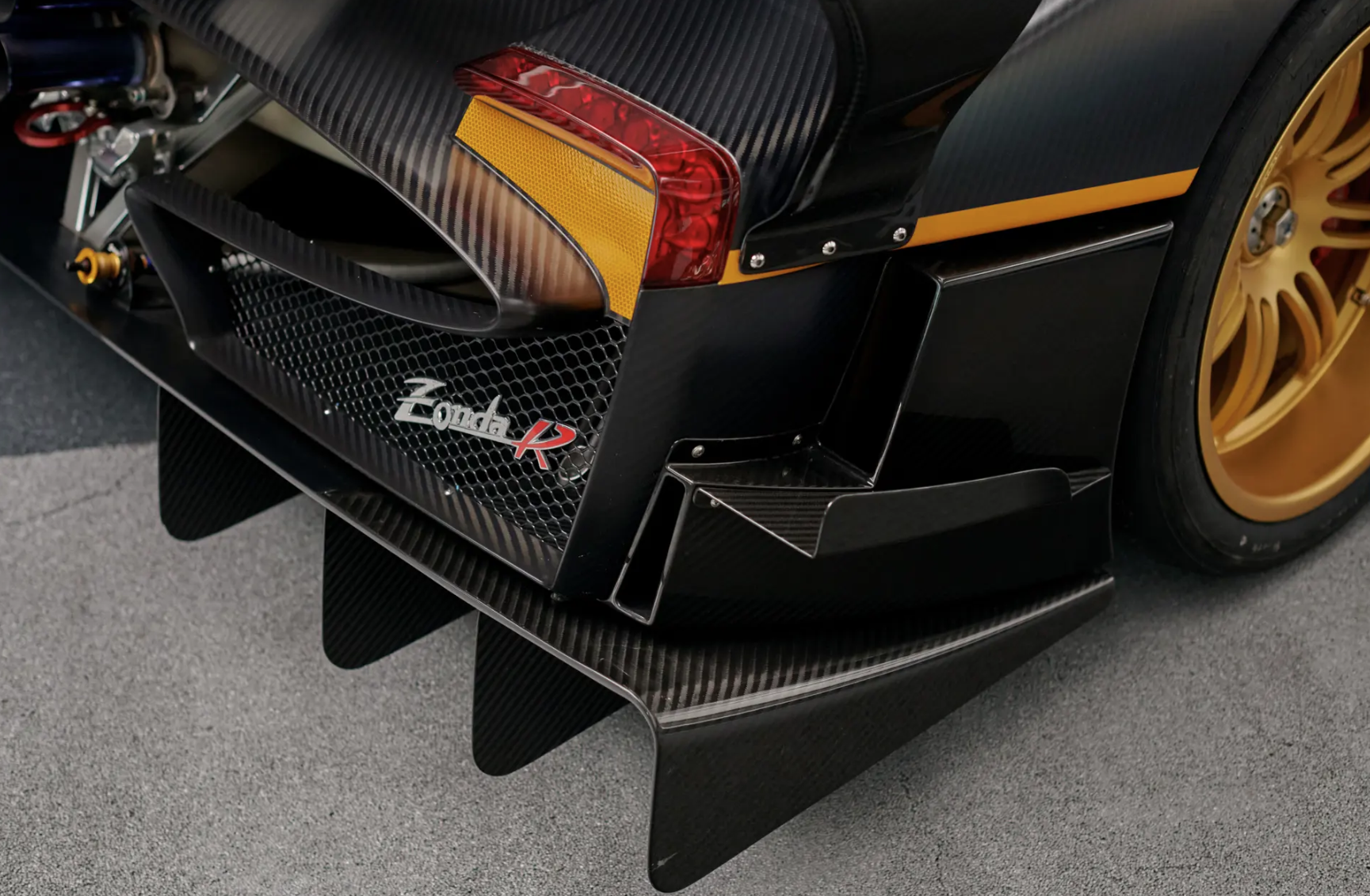
The Zonda R’s exterior styling is defined by exposed, high-gloss carbon fiber weave, often accented by subtle gold and Italian tricolor striping. The central quad-exhaust arrangement was enclosed within a carbon shield, suspended above the massive rear diffuser tunnels.
Functional aerodynamic appendages dominated the silhouette: a prominent roof scoop fed cold air directly into the AMG V12 plenum, while large side air intakes cooled the engine radiators and rear brakes. Mounted on lightweight forged aluminum APP central-locking wheels with gold finish, the stance was aggressively low, sitting mere millimeters above track asphalt.
Interior
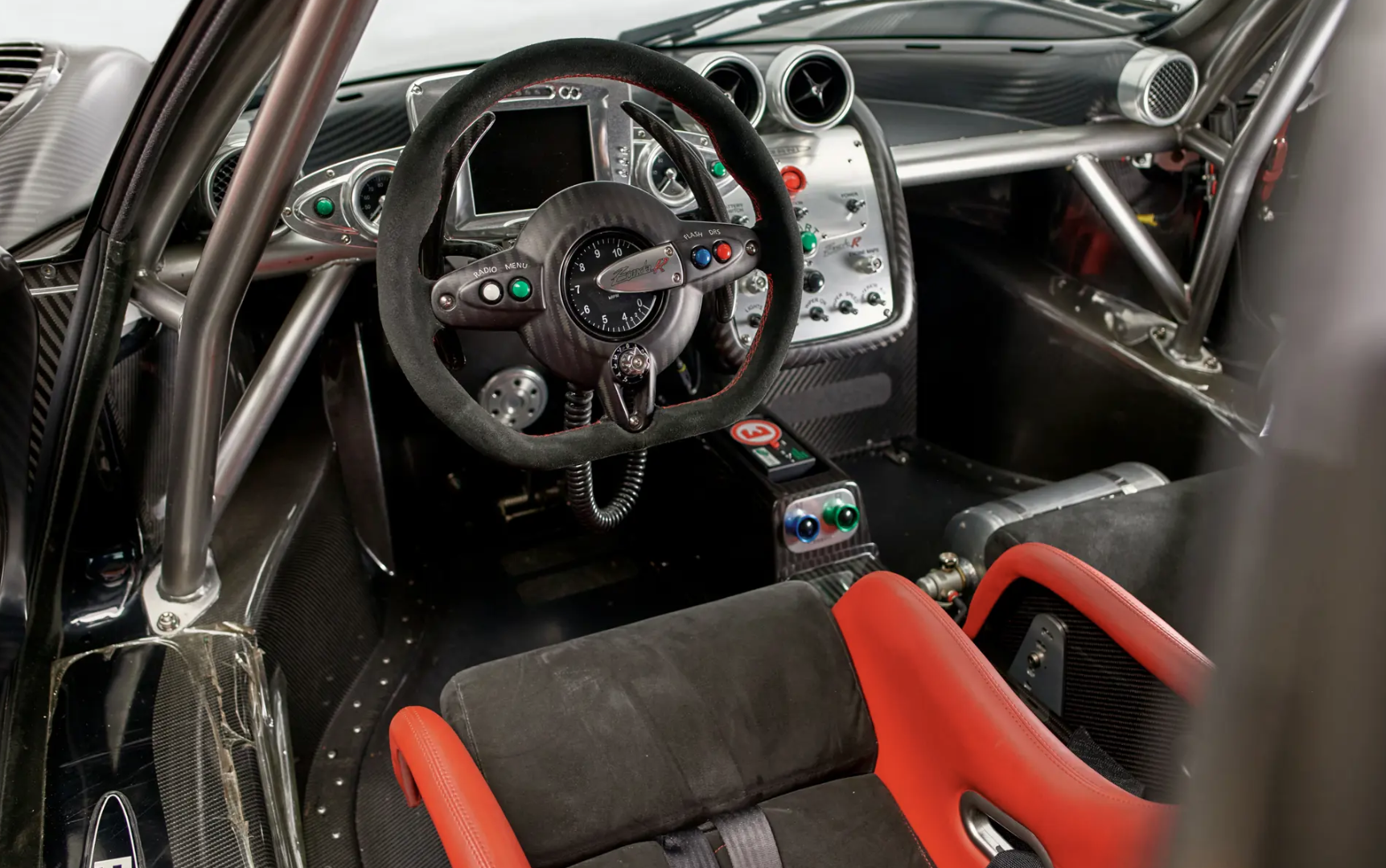
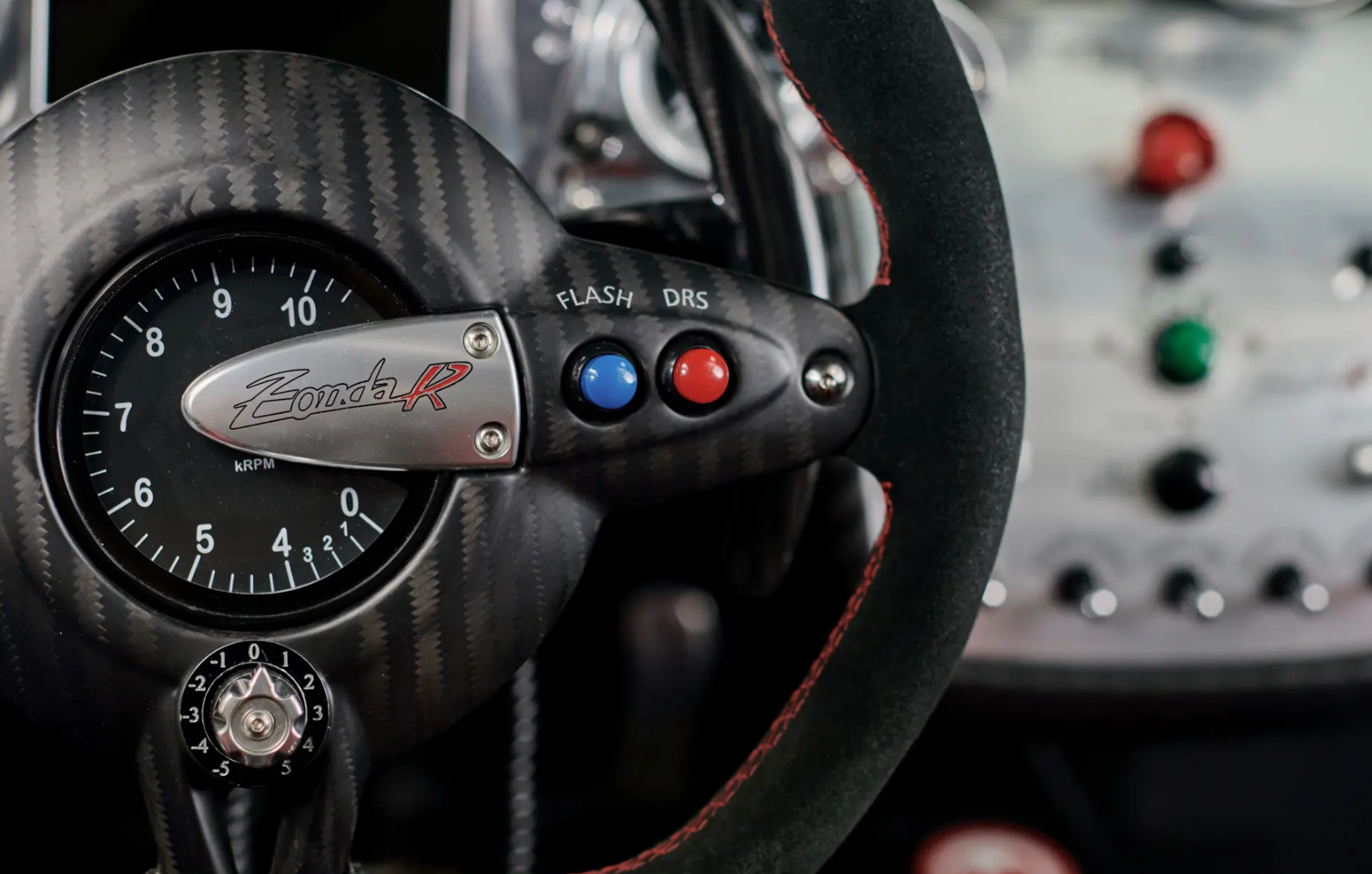
The cockpit of the Zonda R was stripped of all road-going luxuries to prioritize safety, weight savings, and telemetry. FIA-conforming carbon fiber bucket seats upholstered in minimalist suede trim held the driver securely in place with six-point racing harnesses.
The driver operated a customized racing steering wheel housing integrated LED shift lights and dynamic vehicle switches, positioned directly in front of a digital race display unit (AIM telemetry) that provided real-time data on lap times, oil temperatures, and tire pressures. There were no carpets, sound deadening, or air conditioning systems—the cabin environment was raw, loud, and uncompromised.
Specifications
- Engine: Mercedes-Benz AMG M120 6.0-liter naturally aspirated V12, 5,987cc, DOHC, 48 valves, dry-sump lubrication
- Power: 750 PS / 740 hp at 7,500 rpm
- Torque: 524 lb-ft / 710 N·m at 5,700 rpm
- Transmission: Xtrac 6-speed longitudinal sequential manual transaxle, rear-wheel drive
- Chassis: Carbon-Titanium monocoque, Avional front/rear subframes, exposed carbon fiber body panels
- Suspension: Independent double wishbones (front and rear), pushrod-actuated Öhlins coil springs
- Brakes: Brembo Carbon-Ceramic (CCMR) discs, 6-piston calipers (front), 4-piston calipers (rear)
- Wheels: Forged alloy APP central-locking wheels (19-inch front, 20-inch rear)
- Weight: 1,070 kg / 2,359 lbs (dry weight)
- Performance: 233 mph / 375 km/h top speed, 0-60 mph in 2.7 seconds
Production and Legacy
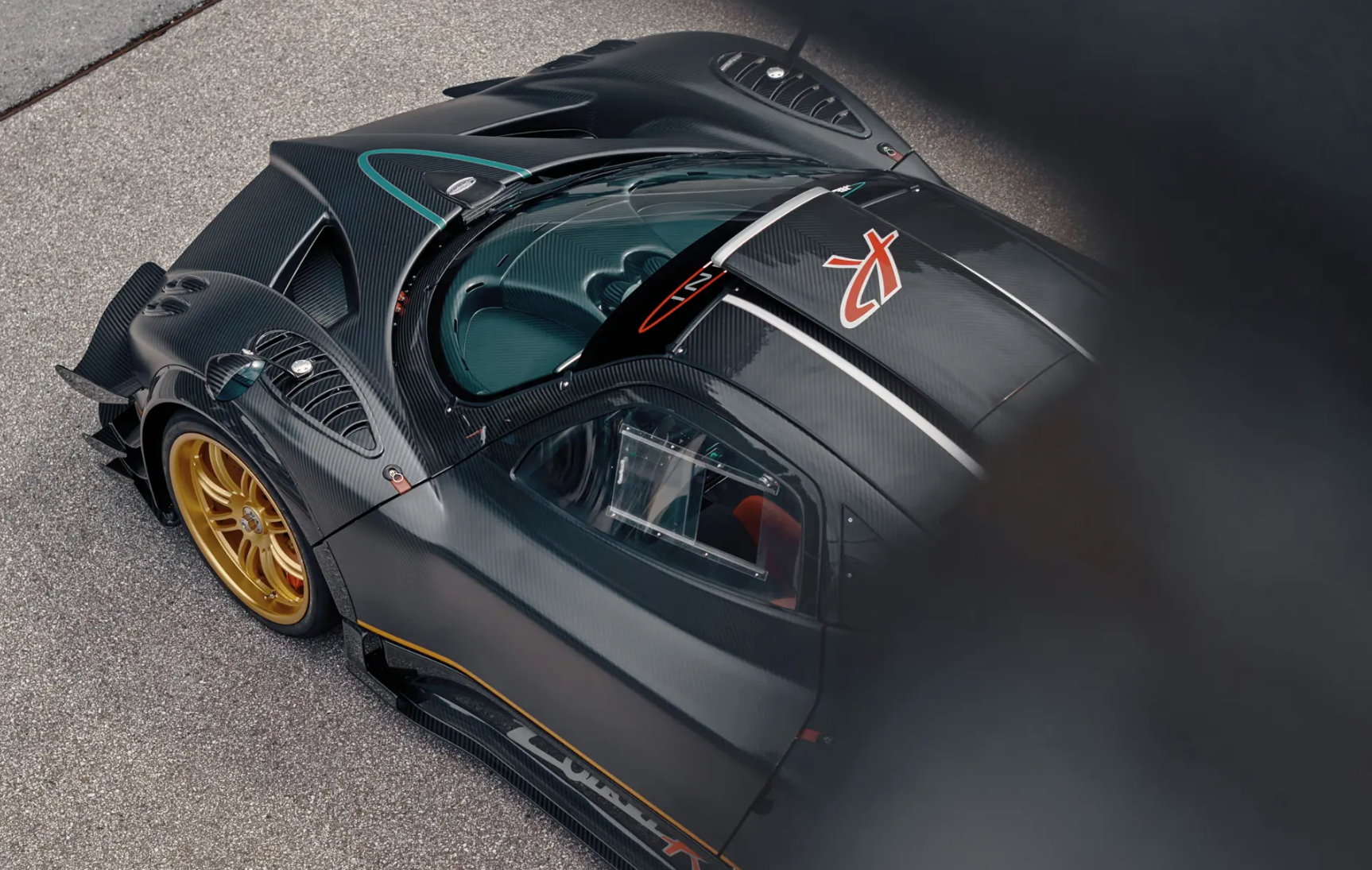
Pagani hand-assembled just 15 production examples of the Zonda R at San Cesario sul Panaro between 2009 and 2011 (followed later by a small number of ultra-exclusive “Evolution” upgrade packages). Priced at approximately €1.4 million plus taxes when new, the track-only model catered to an elite tier of collectors and track-day enthusiasts.
The Zonda R cemented its place in motorsport lore in June 2010 when driver Marc Basseng set a staggering lap time of 6 minutes and 47.50 seconds at the Nürburgring Nordschleife, breaking the lap record for non-road-legal sports cars and proving the immense performance of Pagani’s engineering.
Today, the 2010 Zonda R remains a holy grail collectible—a masterpiece of raw mechanical symphony, carbon-titanium composite technology, and uninhibited aerodynamic design that established Pagani as a master of ultra-exclusive track machinery.