

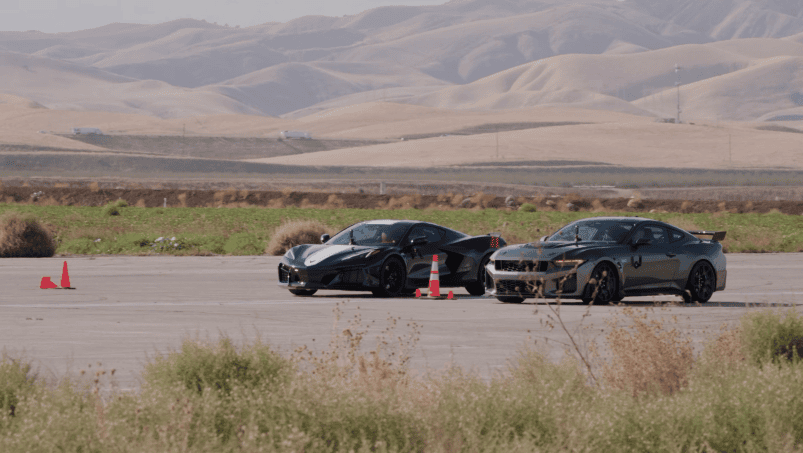
Edmunds kicks off a new season of its U-Drags competition with an intriguing American performance showdown, pitting the supercharged 2026 Ford Mustang Dark Horse SC against the naturally aspirated 2027 Chevrolet Corvette Grand Sport. Hosts Alastair Weaver and Jonathan Elfalan take the wheel for a demanding test that combines straight-line acceleration, heavy braking, cornering, and another sprint to the finish.
Unlike a conventional drag race, the Edmunds U-Drags format requires competitors to complete a quarter-mile sprint before braking hard, executing a 180-degree turn, and accelerating back toward the starting line. The unconventional layout places considerable emphasis on more than horsepower, testing each vehicle’s ability to deploy power, maintain traction, shed speed, and regain momentum through a demanding transition.
Supercharged Mustang vs. Naturally Aspirated Corvette
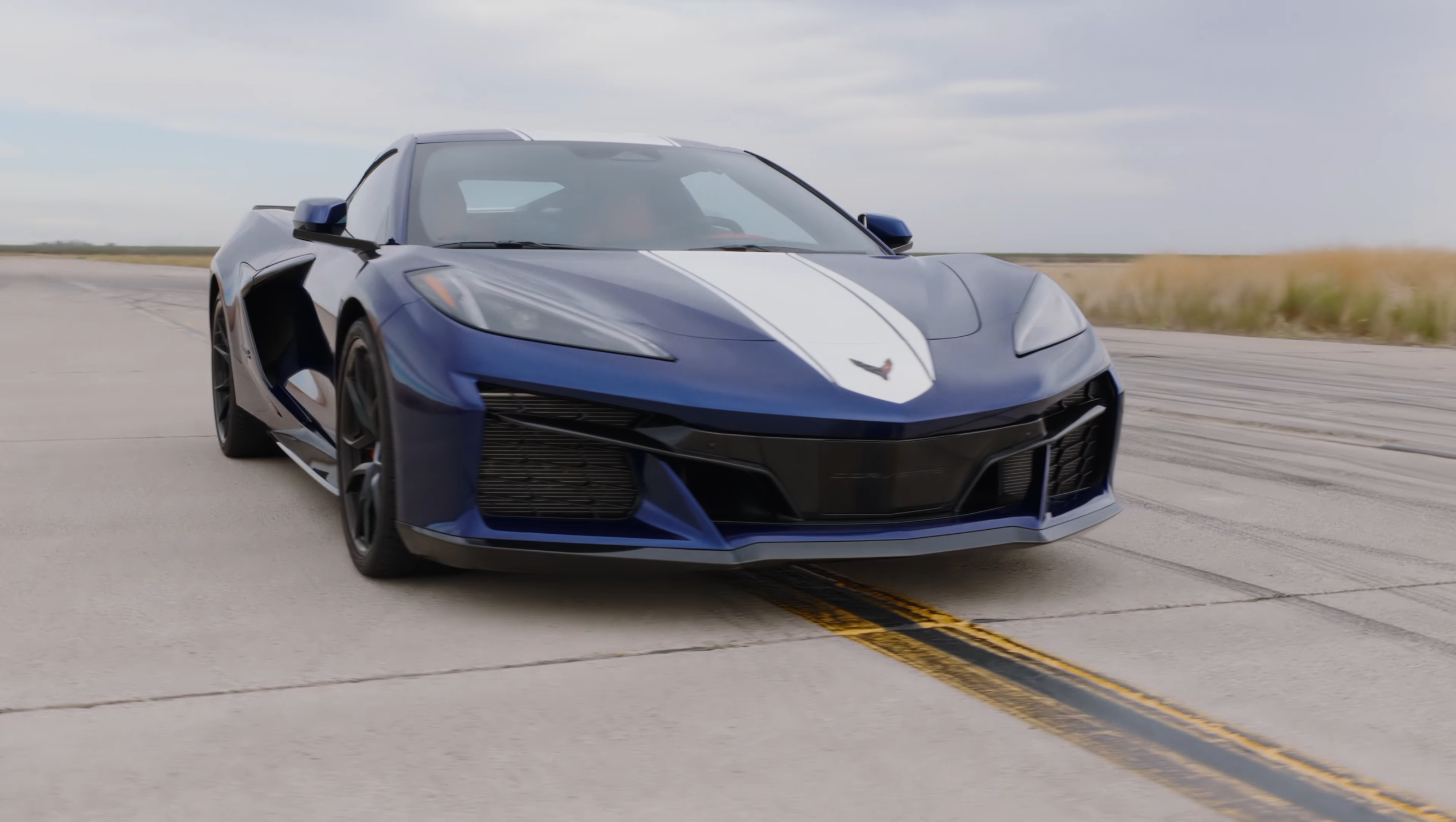
The Corvette Grand Sport brings a naturally aspirated 6.7-liter V8 producing 535 horsepower and 520 lb-ft of torque, with power delivered through Michelin Pilot Sport 4S tires. Its mid-engine configuration provides a fundamental handling advantage, while its chassis and performance traction management system are designed to deliver predictable cornering behavior and strong traction on corner exits.
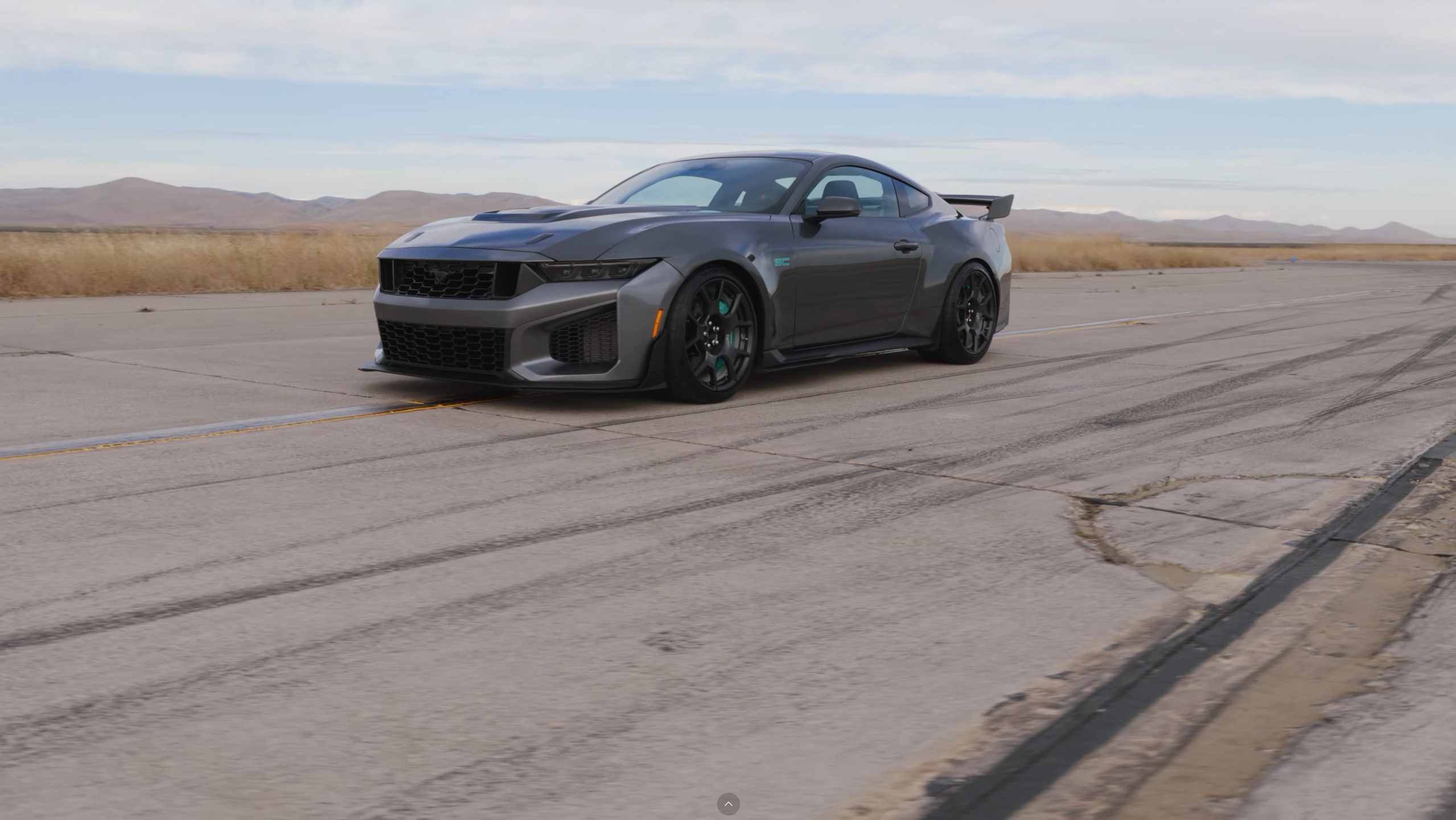
Facing it is the substantially more powerful Mustang Dark Horse SC, equipped with a supercharged V8 generating 795 horsepower and 660 lb-ft of torque. The test car features the optional Track Pack, which adds upgraded suspension components, carbon-ceramic brakes, carbon-fiber wheels, and Michelin Pilot Sport Cup 2 R tires. With these enhancements, its price climbs to approximately $150,000.
Launch Control, Braking and Cornering Under Pressure
The Mustang’s launch control and line-lock functions help prepare its tires for the initial acceleration phase, while the Corvette relies on its launch control and Performance Traction Management system to maximize grip.
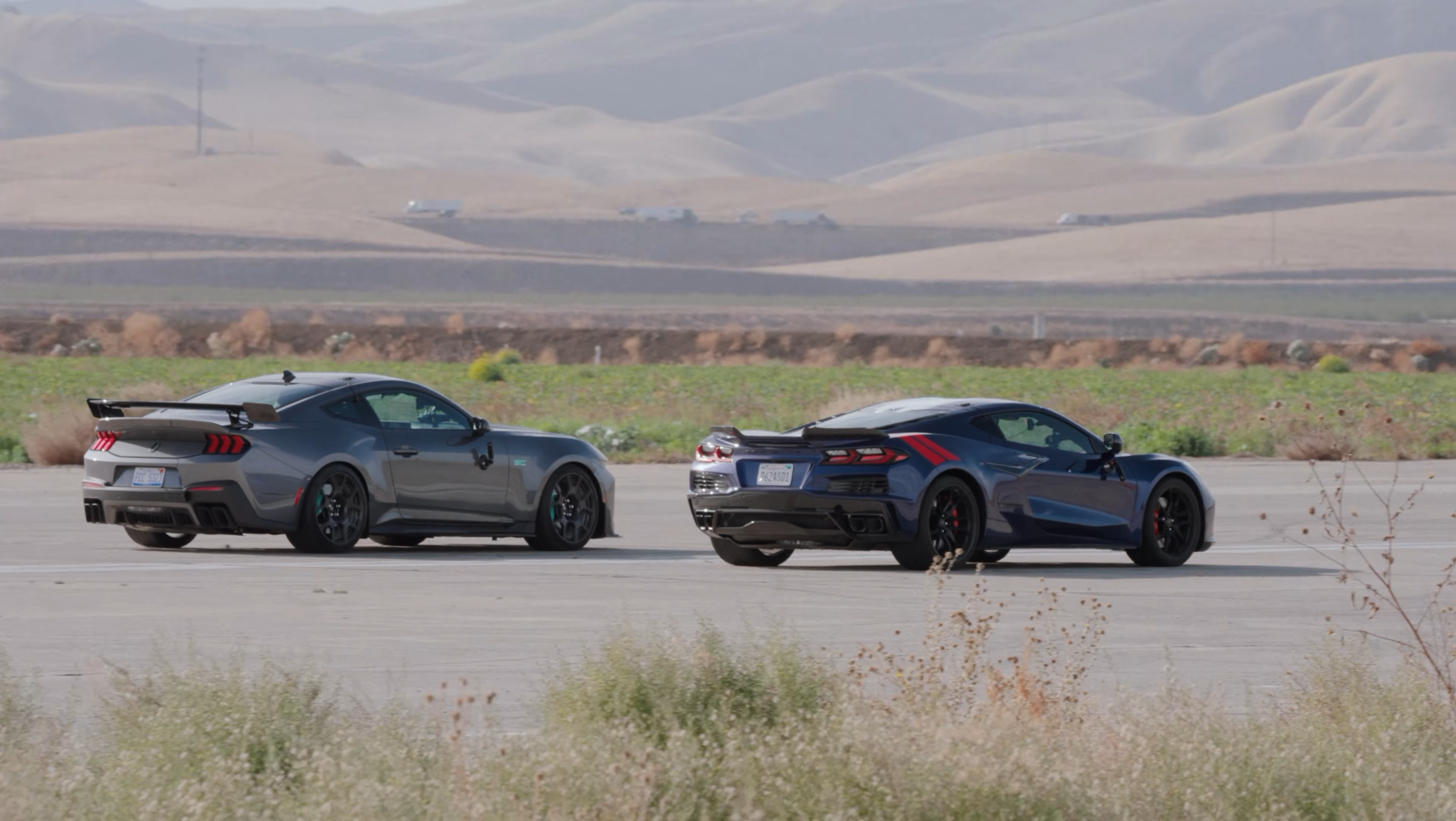
During the first run, the Mustang establishes a significant advantage through its immense power delivery, while its braking package demonstrates impressive stopping capability. The Corvette remains competitive through the technical sections but struggles to match the Ford’s acceleration. The Mustang’s carbon-ceramic braking system and exceptionally sticky tires also allow it to attack the braking zone with considerable confidence.
After switching cars and lanes, Weaver and Elfalan repeat the challenge. Although the Corvette initially gets away cleanly, the Mustang’s superior power quickly becomes apparent, allowing it to recover and establish another commanding advantage.
U-Drags Performance Results
The final numbers confirm the Mustang’s dominance. It records a 3.4-second 0–60 mph time and completes the quarter-mile in 11.2 seconds at 132.1 mph. The Corvette, meanwhile, takes the maximum-cornering honors with 1.23 g, highlighting its chassis capabilities.
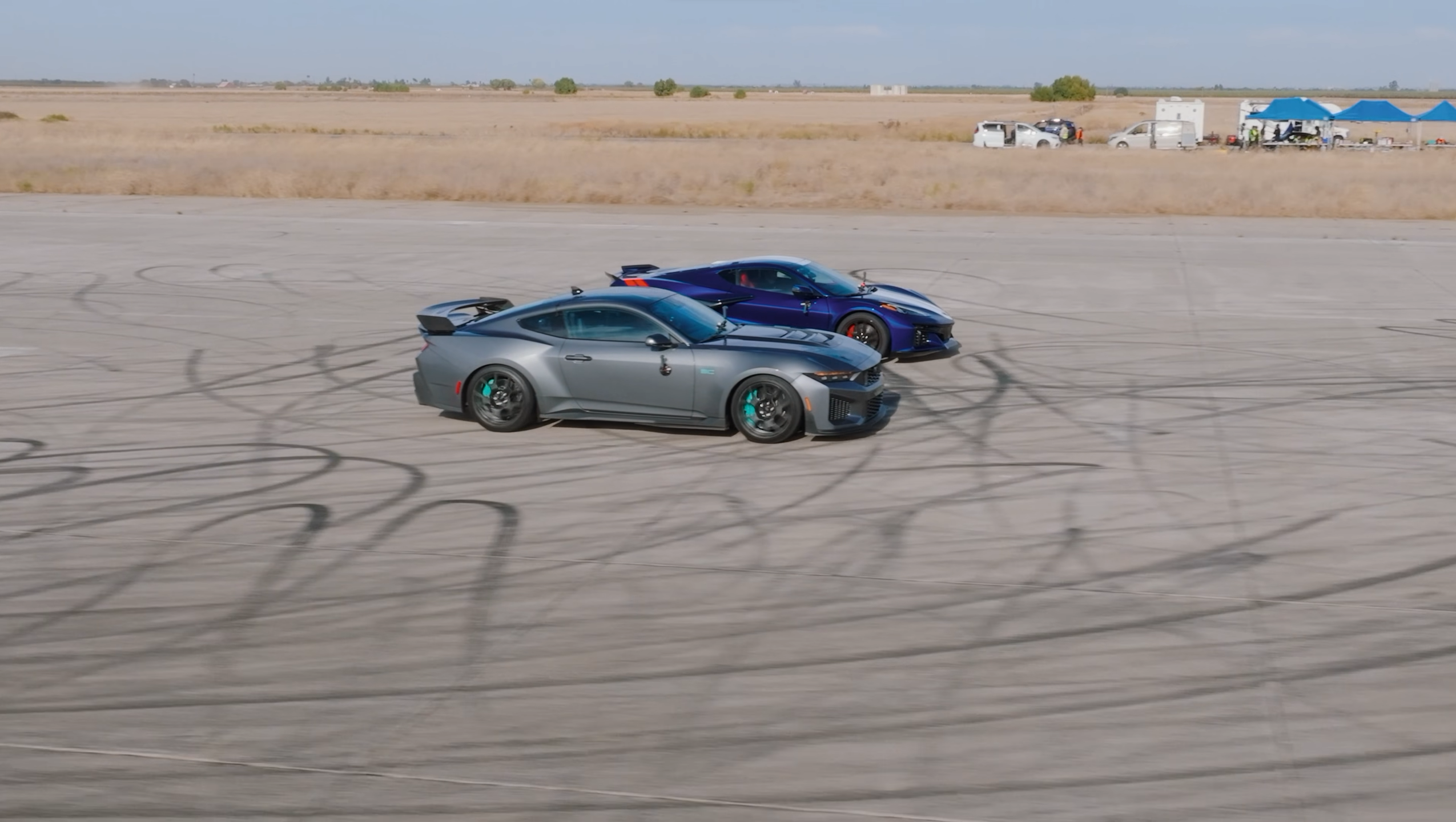
The overall U-Drags victory goes to the Mustang Dark Horse SC, which completes the course in 32.5 seconds at 141.8 mph. The Corvette finishes in 33.8 seconds at 129.5 mph.
| Performance Metric | Mustang Dark Horse SC | Corvette Grand Sport |
|---|---|---|
| Horsepower | 795 hp | 535 hp |
| Torque | 660 lb-ft | 520 lb-ft |
| 0–60 mph | 3.4 seconds | — |
| Quarter-mile | 11.2 seconds | — |
| Quarter-mile trap speed | 132.1 mph | — |
| Maximum cornering | — | 1.23 g |
| U-Drags time | 32.5 seconds | 33.8 seconds |
| Finish-line speed | 141.8 mph | 129.5 mph |
The Price of Performance
However, the comparison raises an important question about value. The Mustang’s Track Pack equipment contributes substantially to its performance but also pushes its price to approximately $150,000, roughly $50,000 above the Corvette’s. While the Ford proves exceptionally capable, the Grand Sport retains an advantage as a more naturally balanced sports car and potentially more approachable everyday performance machine.
The test also highlights the influence of environmental conditions. Edmunds notes that warmer 72-degree conditions affected the performance of both competitors compared with earlier tests conducted in cooler 40-degree weather. The Mustang nevertheless demonstrated stronger cornering speed than the older GT500, helped by its Michelin Pilot Sport Cup 2 R tires.
Source: Edmunds Cars