
For more than half a century, two simple letters have represented the most extreme interpretation of Lamborghini’s legendary V12 supercars: SV.

Nowadays, short for Super Veloce, or “Super Fast,” the designation has been reserved for some of the most focused, lightweight and uncompromising machines ever to leave Sant’Agata Bolognese. From the Miura SV of 1971 to the newly unveiled Revuelto SV, the formula has remained remarkably consistent: more power, less weight, sharper dynamics and a driving experience pushed closer to the limit.
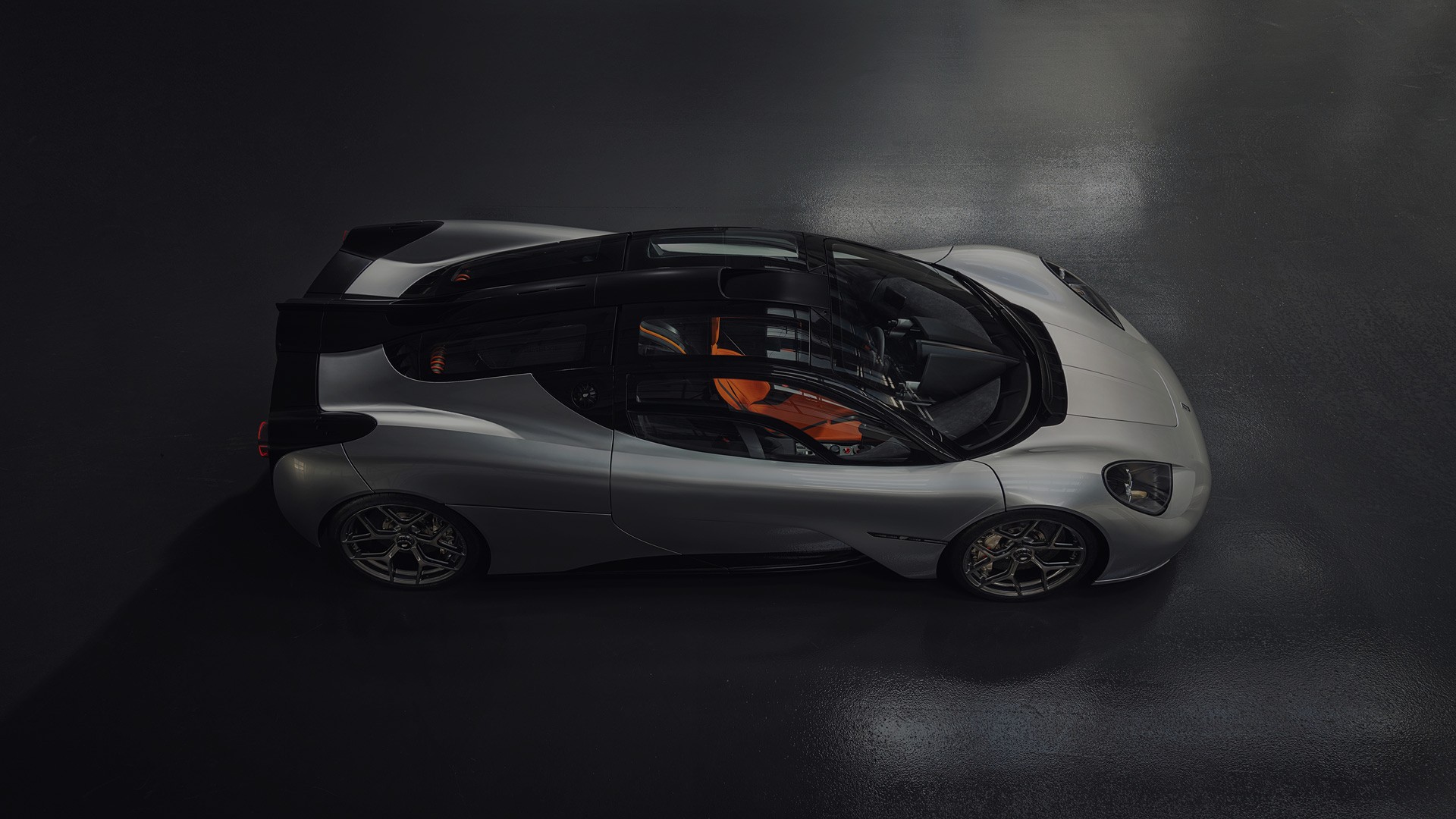
55 years after the first Miura SV established the formula, Lamborghini is celebrating the history of one of its most iconic badges with the introduction of the latest chapter in the story, the Revuelto SV.

The Super Veloce name has appeared on only a handful of Lamborghini’s flagship V12 models. The Miura SV was followed decades later by the Diablo SV, before the badge returned on the Murciélago LP 670-4 SV and the Aventador SV. In August 2026, during Monterey Car Week in California, Lamborghini introduced the Revuelto SV, bringing the famous designation into the electrified era for the very first time.
“For 55 years, the letters SV have represented an important expression of Lamborghini’s V12 philosophy,” said Stephan Winkelmann, Chairman and CEO of Automobili Lamborghini. “Every Super Veloce has redefined the limits of performance in its own era while remaining true to the values that have always distinguished Lamborghini: innovation, lightweight engineering, exclusivity and pure driving emotion.”

Winkelmann has personally introduced three generations of the modern Super Veloce: the Murciélago LP 670-4 SV, the Aventador SV and now the Revuelto SV. Each represented the ultimate expression of Lamborghini performance in its respective era.
Lamborghini Revuelto SV: Super Veloce Enters the Hybrid Era
The new Revuelto SV represents a significant moment in Lamborghini history. For the first time, a Super Veloce model uses a hybrid powertrain. Rather than abandoning the naturally aspirated V12 formula, Lamborghini has combined it with hybrid technology to create the most powerful production car the company has ever built.
The Revuelto SV produces a combined 1,065 CV and 1,425 Nm of torque, while also delivering the highest performance figures ever recorded by a production Lamborghini. Production will be limited to 1,963 units, ensuring that the latest Super Veloce remains as exclusive as its predecessors.

The SV treatment goes far beyond additional power. Lamborghini has developed enhanced aerodynamics, lightweight components, a newly developed suspension system, next-generation braking technology and a dedicated Pilota driving mode designed to make the Revuelto even more focused and engaging.
According to Federico Foschini, Lamborghini’s Chief Marketing and Sales Officer, the Super Veloce badge has always represented something beyond simply being the fastest version of a Lamborghini.
“For our customers, an SV has always been much more than a high-performance variant,” Foschini said. “It embodies a unique combination of exclusivity, driving emotion and technological excellence.”
With the Revuelto SV, that philosophy enters a new era—combining the unmistakable character of Lamborghini’s naturally aspirated V12 with electrification and increasingly sophisticated vehicle dynamics.
Lamborghini Miura SV (1971)
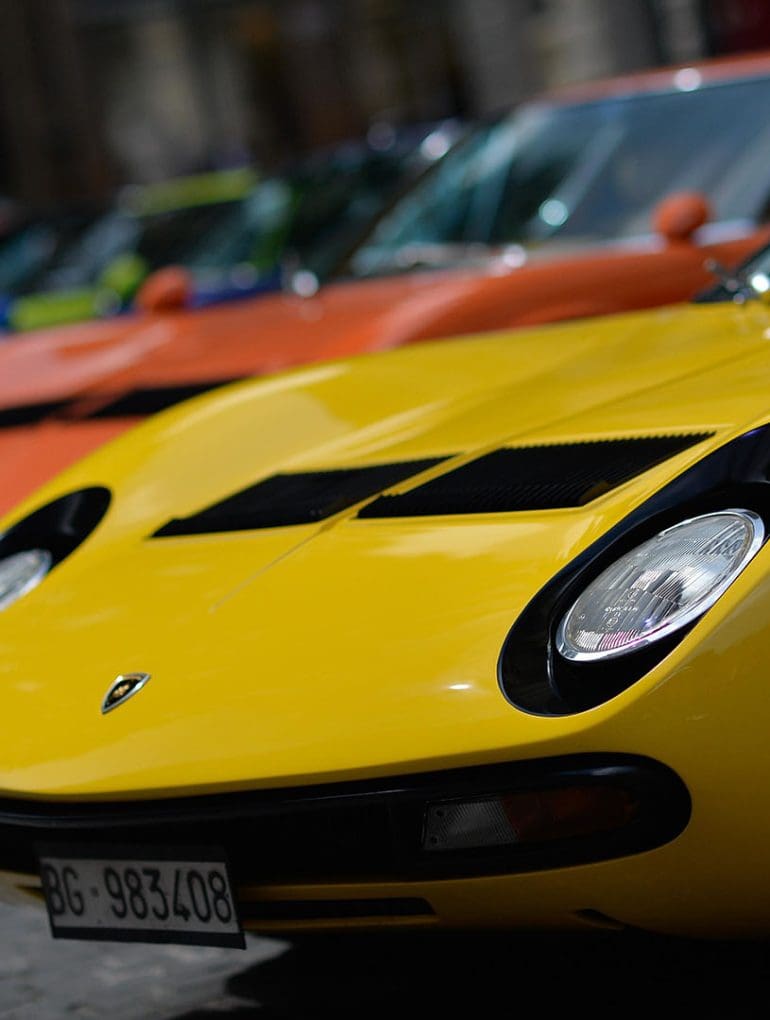
The story began with the Miura SV, from what I’ve been told, the SV stood for Spinto Veloce in the Seventies, unveiled in 1971, the final and most advanced evolution of Lamborghini’s groundbreaking Miura became the first car to wear the Super Veloce designation.

Its 4.0-liter mid-mounted V12 produced 385 hp, allowing the Miura SV to reach 62 mph in approximately 5.5 seconds and continue to a top speed of more than 174 mph. The SV featured a reinforced body, improved cooling, increased power and a number of refinements designed to improve both performance and usability.

Only 150 examples were delivered to customers, but its importance extends far beyond production numbers. The Miura SV established the formula that would define every Super Veloce to follow. It wasn’t simply a faster Miura. It was a more focused Miura.
Lamborghini Diablo SV (1995)
More than two decades later, the Super Veloce badge returned with the Diablo SV, but rumor has it it wasn’t a Super Veloce, but a Sport Veloce in the Nineties.

Introduced in 1995, the Diablo SV represented a considerably more aggressive interpretation of Lamborghini’s flagship supercar. It was approximately 40 kg lighter than the standard Diablo and featured revised aerodynamics, larger air intakes, upgraded suspension and braking systems, and rear-wheel drive.

Its 5.7-liter V12 produced 510 hp, allowing the Diablo SV to reach 62 mph in around 4.5 seconds. With its dramatic graphics, large rear wing and unmistakably aggressive character, the Diablo SV helped reintroduce the Super Veloce philosophy to a new generation of Lamborghini enthusiasts.
Lamborghini Murciélago LP 670-4 SV (2009)
By 2009, Lamborghini was ready to take the formula to another level. The Murciélago LP 670-4 SV combined a naturally aspirated 6.5-liter V12 producing 670 hp with approximately 100 kg of weight savings compared with the standard car.

Performance was staggering for the time, with 0-62 mph arriving in approximately 3.2 seconds. But the LP 670-4 SV was about more than straight-line acceleration. Revised aerodynamics included a new front splitter and rear spoiler, while the chassis and all-wheel-drive system were developed with serious track performance in mind.

Production was limited to 350 coupes and 50 roadsters, making it one of the rarest and most desirable modern Lamborghini flagships. For many enthusiasts, the Murciélago LP 670-4 SV represents the ultimate evolution of Lamborghini’s classic V12 era.
Lamborghini Aventador SV (2015)
The Aventador SV arrived in 2015 and brought the Super Veloce formula firmly into the modern age. Its 6.5-liter naturally aspirated V12 produced 750 hp, launching the Aventador SV from 0 to 62 mph in just 2.8 seconds.

Lamborghini focused heavily on reducing weight and improving aerodynamic efficiency, with extensive use of carbon fiber and a more aggressive aerodynamic package helping transform the Aventador into a significantly more focused machine.

Production was limited to 600 units, ensuring that exclusivity remained an essential part of the Super Veloce experience. Like every SV before it, the Aventador SV wasn’t designed to appeal to everyone. It was designed for those who wanted the most intense version of the Lamborghini experience.
Lamborghini Revuelto SV (2026)
That brings us to the Revuelto SV. The latest Super Veloce takes everything Lamborghini has learned over the past 55 years and applies it to an entirely new technological era.
More aerodynamic. Lighter. More powerful. More capable on track. But perhaps more importantly, Lamborghini says the Revuelto SV remains focused on the same fundamental principle that defined the Miura SV more than five decades ago: creating a stronger connection between the driver and the machine.

The technology may have changed dramatically since 1971. Naturally aspirated V12 engines are now joined by electric motors, advanced control systems and sophisticated hybrid powertrains.
The philosophy, however, remains familiar. The Super Veloce badge is still reserved for Lamborghini’s most uncompromising V12 machines. And 55 years after the first Miura SV, the latest chapter proves that the letters SV still mean exactly what they always have: Lamborghini at its most extreme.