

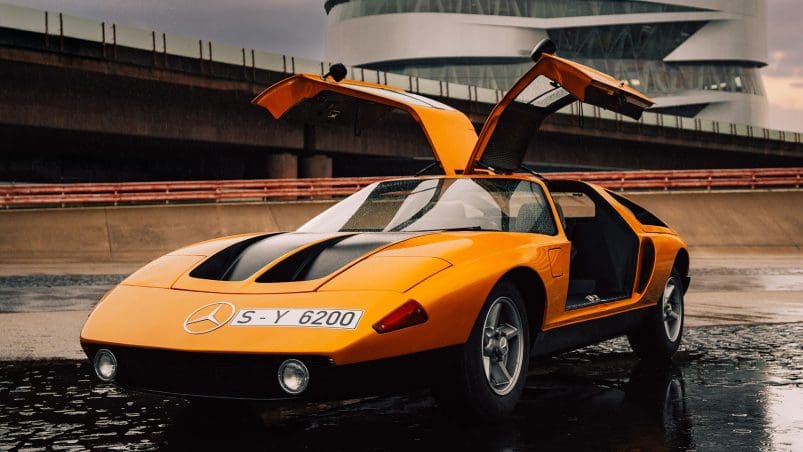
One of Mercedes-Benz’s most extraordinary experimental supercars is finally going up for sale. On February 3, 2027, a rare C 111-II powered by its original 2.4-liter four-rotor Wankel engine will cross the auction block at the Palais du Louvre in Paris, with RM Sotheby’s handling the historic sale.

For the first time ever, Mercedes-Benz is offering a C 111 for public sale. Even more remarkably, this will be a one-time opportunity. The automaker has contractually committed not to sell another C 111 for at least 25 years, making this a potentially once-in-a-generation chance to own one of the most fascinating prototypes in automotive history.
The proceeds will support the Mercedes-Benz Museum 2.0 project, an ambitious initiative designed to bring the brand’s heritage to new audiences through expanded exhibitions and digital experiences.
A Mercedes-Benz icon finally finds a new home
First unveiled at the 1969 Frankfurt International Motor Show (IAA), the C 111 represented Mercedes-Benz’s vision for a new generation of high-performance sports cars. Its futuristic styling, dramatic gullwing doors, mid-engine layout and experimental Wankel powertrain made it one of the most talked-about automotive concepts of its era.

Despite enormous public interest, the C 111 never entered production. Mercedes-Benz built just 17 examples across the various development stages, and the company famously resisted repeated attempts from wealthy enthusiasts to purchase one. Some prospective buyers reportedly even sent blank checks to Stuttgart, but none were successful.
“To this day, the fascination of the C 111 remains undiminished and it continues to inspire us, as the Vision One-Eleven demonstrates,” explains Marcus Breitschwerdt, CEO of Mercedes-Benz Heritage GmbH. “We are now turning a new page and, for the first time, passing one of these vehicles from our collection into new hands.”
Supporting the future of the Mercedes-Benz Museum
The auction proceeds will contribute to Mercedes-Benz Museum 2.0, a project focused on preserving and presenting the company’s history for future generations.

Alongside the ongoing development of the physical museum in Stuttgart, a major part of the initiative involves creating a digital twin of the facility. Developed in collaboration with The Classic Car Trust (TCCT) and its Roarington digital platform, the project will allow visitors worldwide to explore the museum virtually and interact with its exhibits regardless of their location.
The first results are expected to become visible in 2027.
Car 33: An exceptionally important C 111-II
The car heading to auction is the third C 111-II ever produced, internally identified within the Mercedes-Benz Collection as Car 33.
Built from March 1970, it originally featured a distinctive Weißherbst exterior finish, complemented by sports seats upholstered in a gray-and-white houndstooth pattern. Other original details include a four-spoke safety steering wheel and a vertically mounted Becker Europa radio.

The car initially served as a development vehicle before receiving its most significant upgrade in August 1970: the installation of a 2.4-liter four-rotor Wankel engine, designated M 950 W 48.
Producing 345 hp (257 kW), the rotary engine sits behind the passenger compartment and sends the lightweight 2,734-pound (1,240-kg) supercar to a claimed top speed of 186 mph (300 km/h).
During its time in the Mercedes-Benz test fleet, registered as S-Y 6200, Car 33 was involved in several important development programs. Engineers used it to investigate fuel distribution between its two side-mounted tanks, which together hold 30.6 gallons (116 liters), and to conduct temperature measurements in the rear luggage compartment. It also underwent testing at the Hockenheimring, including early work involving anti-lock braking technology. The ABS system is no longer operational today.

The car was also fitted with different wheel configurations throughout its development. Contemporary 8×15-inch alloy wheels are included, along with wider 10×15-inch and 13×15-inch magnesium wheels originally used for racetrack testing. Due to their age and condition, the magnesium wheels are now intended for display rather than road use.
A car with an interesting history
Car 33 quickly became one of the most recognizable examples of the C 111 program. In 1971, renowned conductor Herbert von Karajan was introduced to the project using this very car during a visit to the Mercedes-Benz test track in Stuttgart.

A year later, it appeared prominently in the first German edition of Playboy magazine, further cementing its status as one of the most desirable experimental cars of the period.
In 1975, the vehicle joined the company’s official collection, where it remained for decades. Since the Mercedes-Benz Museum opened in 2006, Car 33 has been displayed in its Fascination Design exhibition.
In 2024, Mercedes-Benz Classic Center in Fellbach carefully restored the car to running condition. The restoration deliberately preserved the original patina of the exterior and interior, while the powertrain received a comprehensive overhaul. A fire-extinguishing system was also installed in the engine compartment.

Later that year, Car 33 made an appearance at the prestigious Pebble Beach Concours d’Elegance in California, where it featured in the special exhibition dedicated to wedge-shaped concept cars and prototypes.
When photographed in October 2026, the odometer showed just 24,766 kilometers.
The C 111: A supercar that was never meant to be ordinary
The original C 111 made its debut in September 1969, combining an advanced mid-engine layout with a lightweight fiberglass-reinforced plastic body and an experimental rotary engine.
Its gullwing doors paid tribute to the legendary Mercedes-Benz 300 SL (W 198), while its futuristic wedge-shaped bodywork looked more like something from the future than a car approaching production.
The Wankel engine was one of the project’s most intriguing features. Compared with conventional piston engines, rotary technology promised impressive power output from a compact, lightweight package, along with exceptionally smooth operation.
At the 1970 Geneva Motor Show, Mercedes-Benz introduced the significantly revised C 111-II. Its four-rotor 2.4-liter engine produced 345 hp (257 kW), delivering performance figures that were extraordinary for the time. The car could accelerate from 0 to 62 mph in just 4.8 seconds and reach a maximum speed of 186 mph.

However, despite considerable public enthusiasm, the C 111 never became a production model. Rising development and manufacturing costs, increasingly strict emissions regulations and the 1973 oil crisis ultimately prevented the project from progressing beyond the experimental stage.
Mercedes-Benz nevertheless continued using the C 111 platform to explore the limits of automotive engineering.
In 1976, the C 111-II D, equipped with a five-cylinder OM 617 A turbodiesel engine, established an impressive 16 records, including three world records. Over a distance of 10,000 miles, it achieved an average speed of 156.46 mph (251.798 km/h).
The development continued with the C 111-III in 1978, also powered by a turbodiesel engine.

Then came the C 111-IV in 1979. Featuring a 494-hp (368-kW) twin-turbocharged V8, this final evolution took things even further. At the high-speed test circuit in Nardò, Italy, it recorded a remarkable 251.02 mph (403.978 km/h), establishing another circuit world record.
Of the 17 C 111 vehicles originally built, one was used for crash testing and three others were dismantled during the 1970s. Mercedes-Benz retains 13 examples in its collection.

Until now, not a single C 111 had ever left the company’s ownership.
RM Sotheby’s to handle the historic auction in Paris
Mercedes-Benz has selected RM Sotheby’s to manage the sale, continuing a relationship that has already produced some of the most significant automotive auctions in history.
In 2022, the auction house sold the legendary Mercedes-Benz 300 SLR Uhlenhaut Coupé for a record-breaking €135 million. In 2025, the W 196 R Streamliner from the Indianapolis Motor Speedway Museum collection achieved €51,155,000. Both sales took place at the Mercedes-Benz Museum in Stuttgart.

Rob Myers, Chairman and CEO of RM Sotheby’s, describes the C 111 as a milestone in automotive history and one of the most innovative creations ever produced by Mercedes-Benz.
The auction will take place on February 3, 2027, at the Salles du Carrousel within the Palais du Louvre in Paris, coinciding with the prestigious Retromobile international classic car show.
Interested collectors will be able to participate in person or bid by telephone, subject to advance registration. Details regarding the auction conditions, bidder registration and opportunities to inspect the vehicle are available through the Mercedes-Benz Classic Center website.
For collectors of significant automotive history, this is an extraordinary opportunity. After more than five decades behind the walls of Mercedes-Benz, one of the most recognizable experimental supercars ever built is finally becoming available to private ownership.