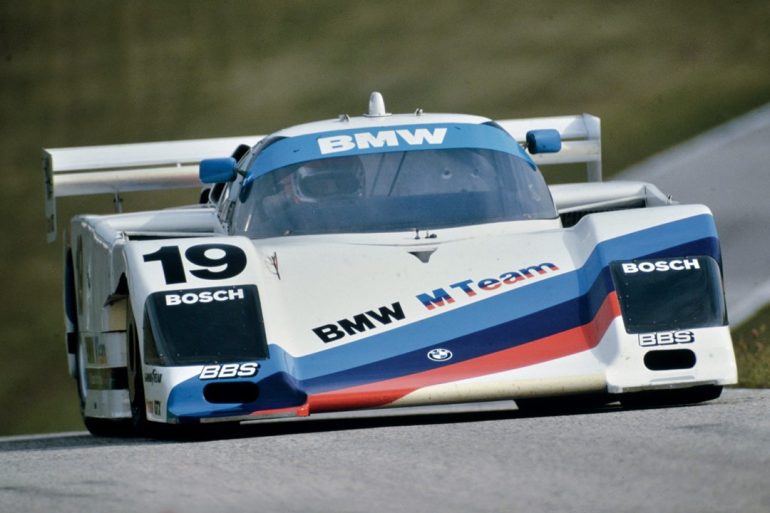
Primarily, my racing with BMW was through Teddy Mayer and McLaren, as BMW and McLaren had been partners in a previous racing program when David Hobbs drove for them. The BMW GTP project relied on input from McLaren North America, as it wasn’t something BMW’s headquarters in Munich got too involved with. Indeed, McLaren North America was separate from the UK McLaren Company based in Woking, or wherever they were based at that time. McLaren North America worked out of Detroit and was mainly involved in engines and other bits and pieces for other manufacturers. I’m not sure how, but somehow this BMW IMSA program came to fruition. The first I was aware was in the middle to end of 1985, I was asked to go out and basically drive the test car or “mule,” prior to the development of the 1986 car, which wasn’t available until very late in 1985 or early 1986. So, from there I agreed to a deal with McLaren to be one of their four drivers, the others being David Hobbs, who sold BMWs in the U.S., and the two youngsters John Andretti and Davy Jones.
John Watson
I enjoyed racing in North America. Unlike many of the European circuits of today they haven’t been messed about with and retain most of the original charm and characteristics they had 40, 50 or 60 years ago. I think the first tests were carried out at Sears Point Raceway, which is now known as Sonoma, in California. The car was powered by, what was in effect a two-liter version of the 1500-cc turbo F1 engine that Piquet used to win his World Championship. I’m not too sure what the deal was. Clearly, the car was painted in BMW colors, but it was McLaren who seemed to have a major input into the project. The beauty of the engine was it was quite small and compact compared to the Porsche or Chevrolet, but yet very powerful given the small displacement and high-pressure turbocharger. Part of the brief was for March to produce the chassis, but the body shape was based on a theme BMW had prepared bearing on what a BMW should look like. It wasn’t the prettiest, or the most eye-catching, or appealing racecar ever to grace the track. If you think of the BMW M1s that BMW used in the Pro-Am series, they were great looking and exactly what a BMW should look like, this certainly wasn’t in that vein. It was in effect a quite “draggy” and high-ish downforce bodied car—that was what was needed and that’s what they got. Who was responsible for the external surfaces? I’m not really sure, but even the March that it was based on wasn’t a good-looking car either. It was simply a car designed for a purpose.
The latest supercar news, rumors, reviews and more delivered to you each week. Cool supercar stuff only. No crap, we promise.
Members only$29 / year
Keep going. This is where it gets good.
Supercars.net Membership is for people who'd rather know the spec sheet by heart than skim ten headlines. The rest of this story — and every other one like it — is a few seconds away.
Thousands of members-only stories
Deep dives, driven reviews and the full archive back to 2005.
No ads. None.
The whole site reads like a magazine, on every device.
Every car, every spec
Twenty years of models, numbers and history in one place.
30% off the shop
Every Supercars.net shirt and piece of merch, all year.
$29 a year. Cancel anytime, no hoops. Already a member? Sign in
BY CAR PEOPLE, NOT A NAMELESS MEDIA COMPANY. Your membership keeps a small independent team that celebrates the brands and cars that defined this industry doing this.