
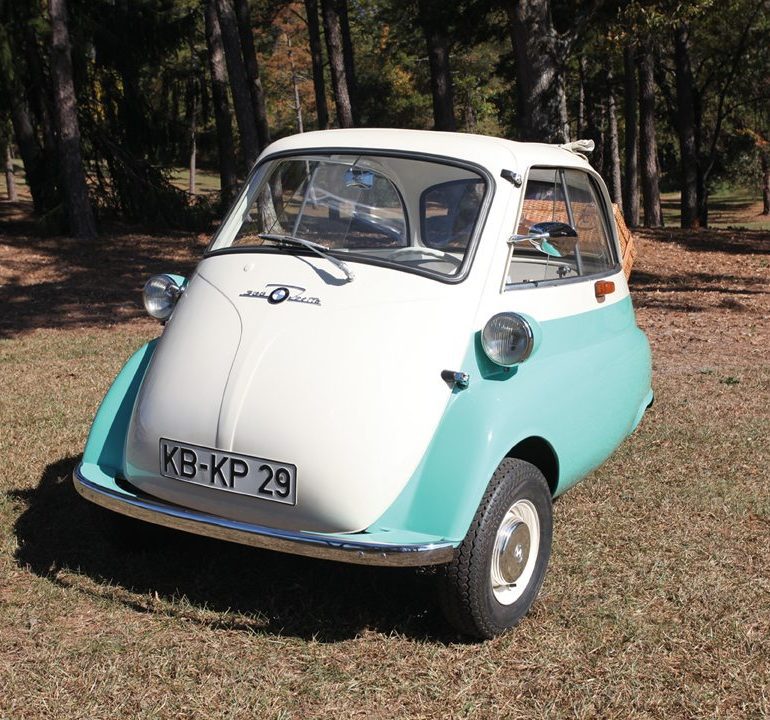

The first thought after looking around the garage has to be “why would a woman with four Ferraris have an Isetta?” In the profile of her 512 BBi (Vintage Roadcar, January 2017), Julie Ibrahim gave the answer to that question, “I was always a car girl.” And that she is. In addition to the Ferraris and the Isetta, there is an Alfa Romeo GTV and a recently added Lotus Elise.
Ibrahim became interested in micro cars when she saw the marketing information RM distributed about their auction of the entire collection of the Bruce Weiner Microcar Museum. She was interested in 10 or 12 of the cars being offered, so she and her fiancé got in her plane and flew down to Madison, Georgia, a week early to visit the museum before it closed. “I had looked over almost all the cars that I wanted, even crawling under them and looking at the engine, but each time one would come up, it went for more than I was willing to pay. Toward the end of the auction, I strayed away from David (Scott, her fiancé) and started to get a little panicky that I would walk away without anything—every auctioneer’s dream.” Then the Isetta moved across the stage. She loved the color, and “it had me at the picnic basket.”
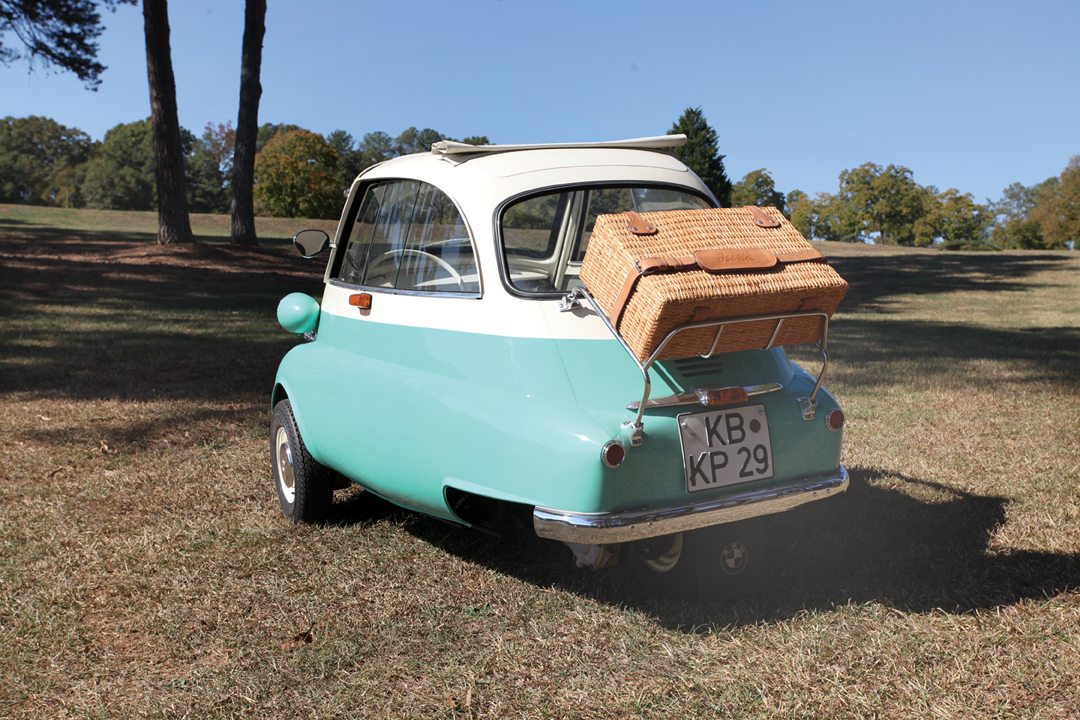 Turns out that it was one car that she had not inspected underneath. It needed quite a bit of work. Her fiancé did a lot of research on the car, and a friend, Eric Barnhill, and Isetta’s R US in Atlanta did the necessary repairs. The car is now a fun ride on small, local roads.
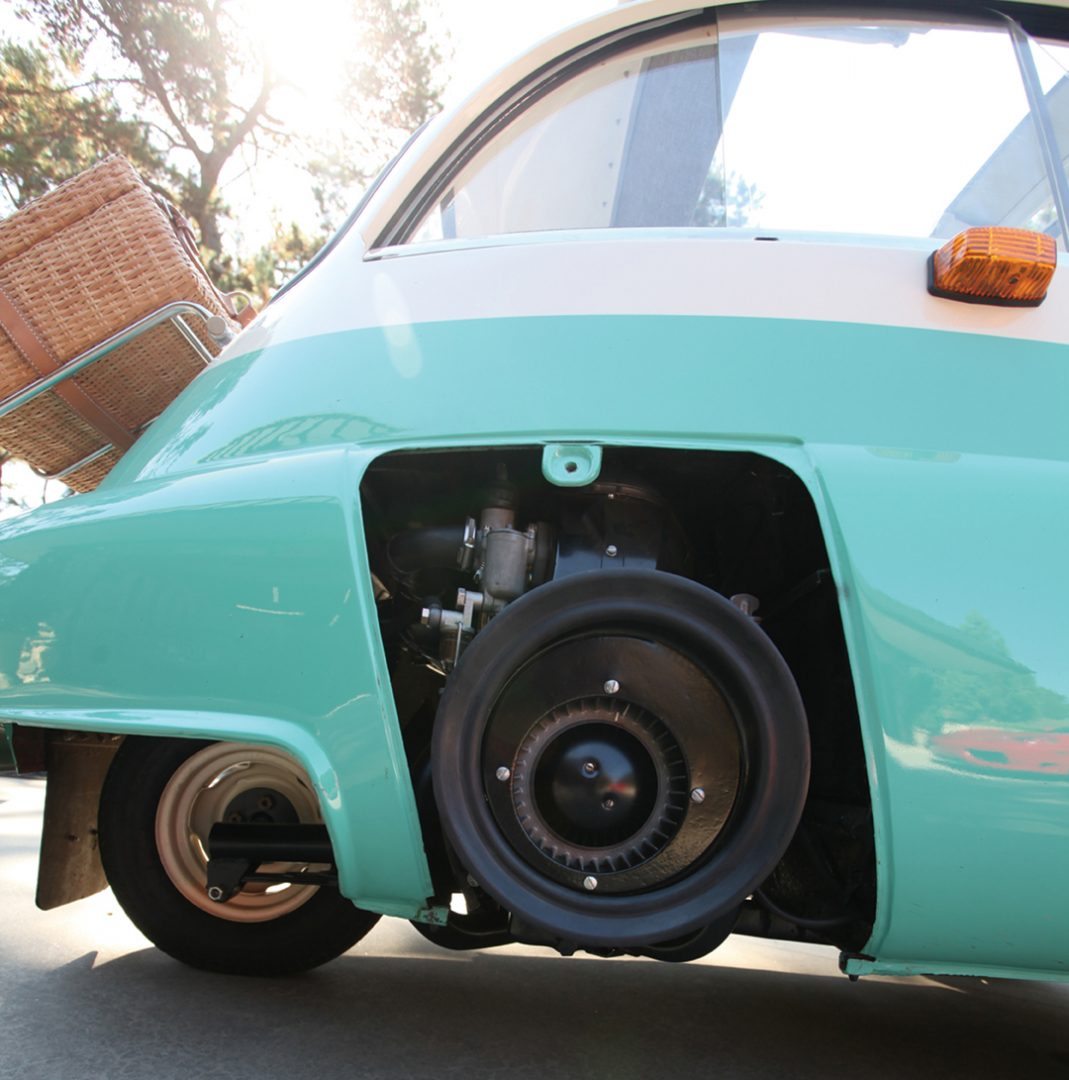
The Isetta is an odd little car, with its three wheels, one-cylinder engine, and a single door that opens out of the front of the car, swinging the steering wheel out of the way with it. With 13 hp and 14-lb-ft of torque, it’s not much on speed and, with three wheels, also not much on handling. So, how does a car like this come about?
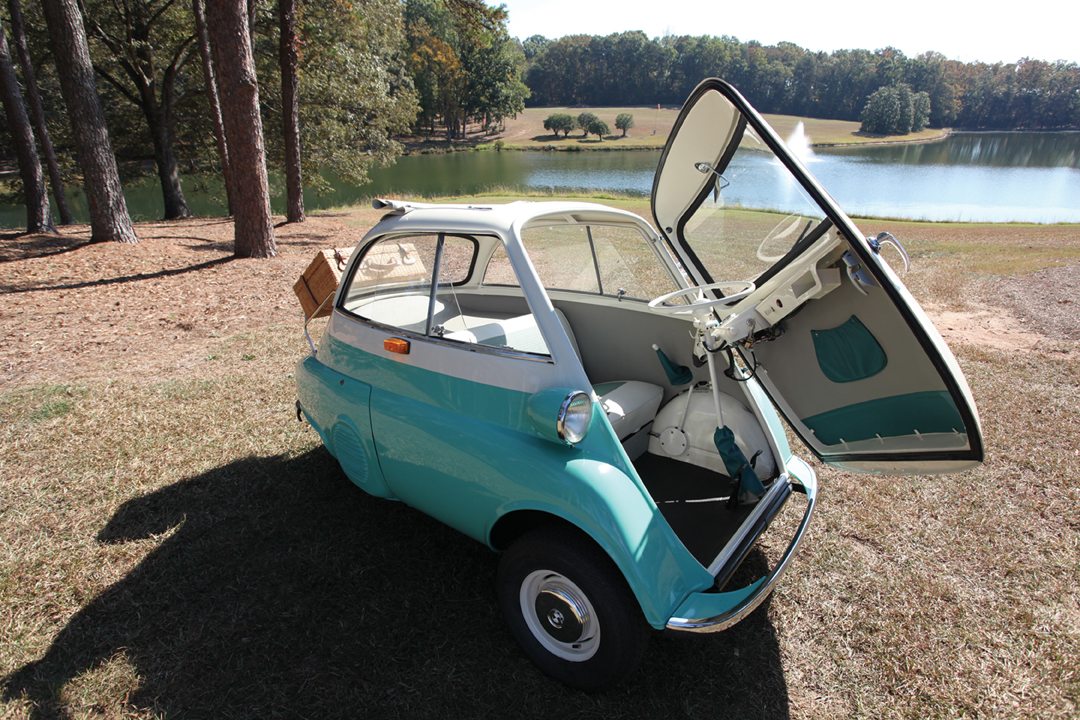 After World War II, the economies of all the European countries that had participated in the war were hurting. Infrastructure and manufacturing were being rebuilt, but the people needed more than jobs, they needed transportation. In the early 1950s, Renzo Rivolta, the owner of Iso SpA saw an opportunity to expand from building scooters and small three-wheeled trucks to producing automobiles for the expanding market. In 1953, he introduced the Isetta (little Iso). It was the first “bubble car,” and it soon became very popular. Popular enough that Rivolta was able to license it in several other countries. The firm that made best use of the Isetta was BMW. In 1954, BMW bought the body tooling from ISO and began making changes to the car, especially adapting their 250-cc, single-cylinder motorcycle engines to the Isetta. Initially, German tax regulations required that the engine be under 250-cc to qualify as a motorcycle, but in 1956, that was raised to 300-cc and BMW responded, producing the car that Ibrahim purchased. The cars were classed as motorcycles in Germany, but that was not the case in other countries. In response, BMW produced this “Special Export Model” with three wheels, allowing it to qualify as a motorcycle in the UK and other countries and providing a significant savings in taxes.
Driving Impressions
There were only a few things to learn about driving the Isetta. Most obvious was the shift pattern, which was backward and upside down, i.e. fourth, up and to the left, while first was back and to the right. Choke and heater controls are on the side wall of the cabin in front of the shifter. Heizung is the heater, and the choke is just above it—back to start and forward to run. The only advice was to keep it in first when heading up the hill away from the garage and not shift into second until coming back down.
Getting inside takes a little thought before attempting it, since you have to step in and turn around. It’s fairly comfortable for a hard bench seat, except that the steering wheel is right against your stomach—well, mine at least. To make it go, you pump the gas, pull the choke back to Starten, and turn the key. The engine starts immediately, but it’s best to keep the revs up so as not to stall once you move the choke to Fahren. It is a hard shift into first, but the clutch is smooth, so it moves away nicely. Ibrahim has a long, curved driveway. I turn right out of the garage area and head up the hill in first. Topping the hill, I shift into second to head down the other side of the driveway. It’s a sloppy shift, but it takes little effort. That’s when the ride gets to be fun. As the car picks up speed because of its lightness and gravity, I just had to smile. That turned into a laugh out loud on the second lap and continued for a half a dozen or more circuits. Once speed is up, the car seems peppy, but it’s also noisy and bouncy. But it is FUN! I can’t imagine taking this car out in traffic, and certainly not on a highway, but on a road where traffic is light, it’s a blast!
 I think I know why Ibrahim bought this car. It is cute, it has a great picnic basket, it makes you smile to look at it, and it is just fun to drive. Thank you Julie Ibrahim for allowing me to enjoy your car.
Specifications
Production: 1959-1962 Body: Steel Chassis: Steel tube Engine: BMW 300 cc single Displacement: 295 cc Bore: 72.0 millimeters/2.835 inches Stroke: 73.0 millimeters/2.874 inches Power: 13 hp @ 5200 rpm Torque: 14 ft-lbs @ 4200 rpm Transmission: 4-speed manual with reverse Length: 90 inches Width: 54.5 inches Weight: 709 lbs/775.189 kg Front Suspension: Swing arm Rear Suspension: Leaf springs Brakes: Hydraulic Wheels (3): 4.80×10 inches
Performance
Top Speed: 85 kph/53 mph 0-60 mph: 27.7 sec 0-100 mph: Dream on! Avg. Fuel Consumption: 63 mpg
Valuation
Price at Launch: $ 1,050 Concours: $62,400 Excellent: $44,500 Good: $25,700 Fair: $18,900