
Fifty years after its debut at the 1976 Geneva Motor Show, the Lamborghini Silhouette remains a landmark in the brand’s history. Designed by Bertone and developed from the Urraco, it became Lamborghini’s first series-production open-top model, pairing a mid-mounted V8 with a removable targa roof and a more focused, two-seat layout.

Produced in just over 50 examples between 1976 and 1979, the Silhouette was an exclusive take on Lamborghini’s sporting formula and laid the groundwork for future open-top models, including the Jalpa, Gallardo Spyder and Huracán Spyder.
From the Urraco to the Silhouette
Developed under the internal designation Tipo 118, the Silhouette initially carried the name Urraco Silhouette. Its final name referenced Group 5 racing, where heavily modified competition cars retained the recognizable silhouettes of their production counterparts.

The new model was based on the Urraco P300, retaining its transverse, mid-mounted V8 architecture while introducing a more aggressive design and a distinctly different driving experience. The transition from four seats to two, combined with a removable hardtop, gave the Silhouette a more purposeful character.

“The Silhouette represents an important moment in Lamborghini’s history, as it is the first series-production model from our company to offer a new open-top driving experience,” says Stephan Winkelmann, Chairman and CEO of Automobili Lamborghini.
That philosophy remains relevant today, with Lamborghini continuing to combine high performance with the emotional appeal of open-air driving.
Bertone design with a purpose
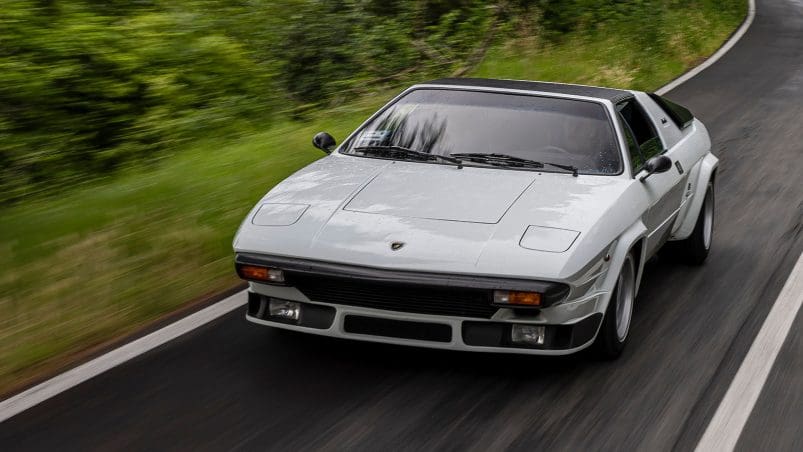
The Silhouette was far more than a Urraco with its roof removed. Bertone reworked the car’s proportions, adding wider wheel arches to accommodate larger tires, a prominent front spoiler and a redesigned rear section.

One of its most distinctive features was the vertical rear window, framed by angled pillars that replaced the Urraco’s signature engine-cover slats. The result gave the Silhouette a unique profile, whether its roof was fitted or removed.
The targa roof itself was made from rigid synthetic material and could be detached from the windshield frame and rear roll bar. When not in use, it could be stored in a dedicated compartment behind the seats, allowing owners to enjoy open-air driving without leaving the roof behind.

The configuration also reflected the project’s focus on the North American market, where safety requirements influenced the choice of a targa design.
Inside, the two-seat cabin received a redesigned dashboard, revised instrument layout and new seats and upholstery. Lamborghini also paid attention to airflow, helping reduce turbulence when driving with the roof removed.
Mid-mounted V8 power and sharper handling
Under the rear section sits a 3.0-liter V8 derived from the Urraco P300. Featuring twin overhead camshafts per cylinder bank and four twin-choke Weber carburetors, the engine retained the transverse mid-engine layout, five-speed manual transmission and rear-wheel-drive configuration of its predecessor.

Lamborghini also revised the chassis to suit the new body style. Structural reinforcements compensated for the absence of a fixed roof, while revised suspension tuning, stiffer springs and dampers, and anti-roll bars helped sharpen the car’s handling.
The Silhouette also introduced low-profile Pirelli P7 tires, measuring 195/50 VR 15 at the front and 285/40 VR 15 at the rear. These were mounted on 15-inch Campagnolo magnesium-alloy wheels featuring a distinctive telephone-dial design derived from the 1974 Lamborghini Bravo concept.

With a claimed top speed of 260 km/h (161 mph), the Silhouette delivered serious performance for its era, adding the freedom of open-top motoring to Lamborghini’s mid-engine sports-car formula.
The beginning of a Lamborghini Spyder legacy
The Silhouette’s production run ended in 1979, but its concept lived on in the Lamborghini Jalpa. Introduced in 1981, the Jalpa further developed the compact, mid-engined V8 formula before production concluded in 1988.

After the Jalpa, Lamborghini’s open-top offerings followed a different path, with larger V12-powered models such as the Diablo Roadster and Murciélago Roadster bringing open-air driving to the brand’s flagship supercars.
The compact open-top concept eventually returned with the Gallardo Spyder and later the Huracán Spyder, bringing a new generation of drivers into the experience first established by the Silhouette.

Today, the Silhouette remains one of Lamborghini’s rarest production models. More importantly, it represents an early expression of an idea that continues to define the brand: combining unmistakable supercar performance with the added excitement of driving without a roof.