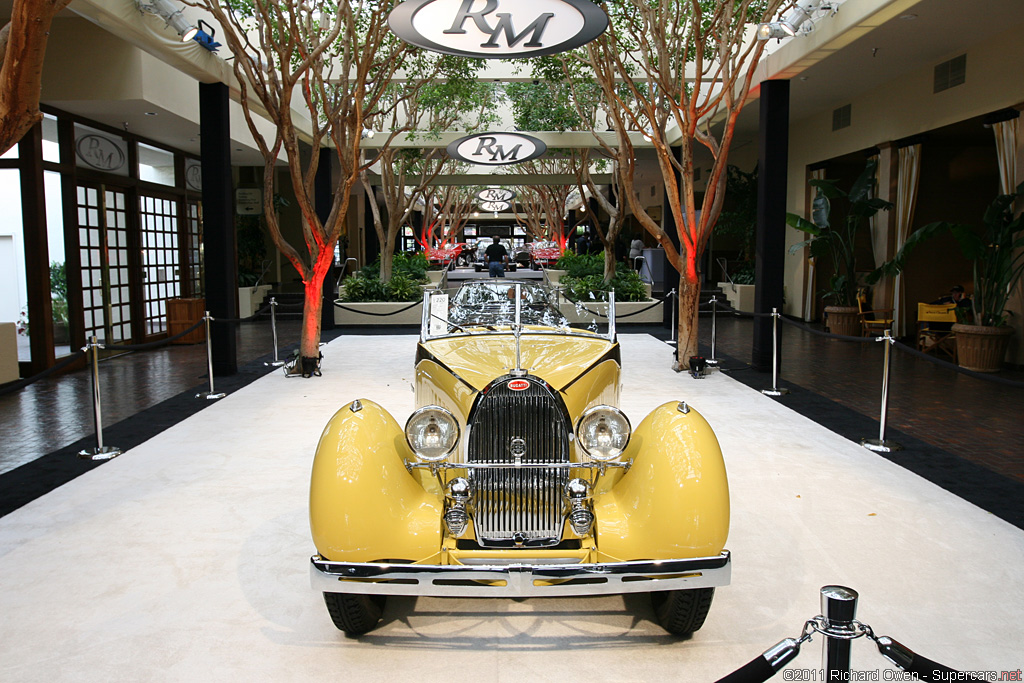

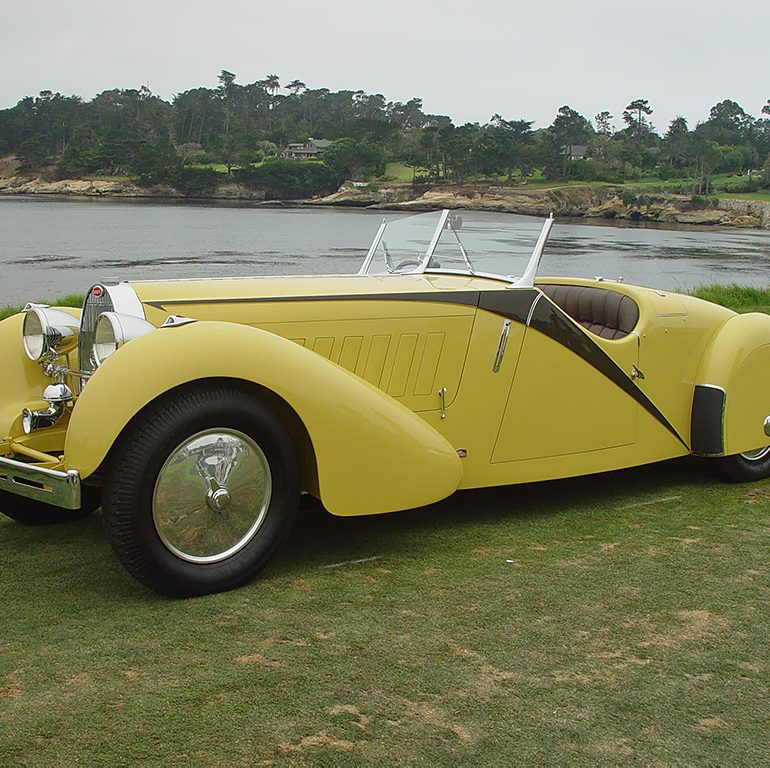
1935 Bugatti Type 57C


Above Images ©IMAGE CREDITS - Supercars.net @ 2003 Pebble Beach Concours, Anthony Hazelaar, Wouter Melissen

After decades of building separate various models for sport and luxury Bugatti decided to consolidate their range for in what would be the final wave for the company. The Type 57 was first and foremost a passenger car that kept the excitement of Bugatti's race cars but maintained everyday practicality. By 1936 these were fitted with an optional roots-type supercharger that increased power to nearly 220hp.

Largely influenced by Ettoire's son, Jean Bugatti, the Type 57 was a high performance chassis built in large quantities that could still capture the exclusive market which was once occupied by the Type 41 Royale and Type 46/50 range. He also wanted to focus on a passenger car which would compete with the 1930s custom coachwork Delahayes and Delages, going so far as to design some bodies himself!

As far as engineering was concerned, the Type 57 was entirely new with the closest model being the Type 49 single-cam car. The engine, displacing 3.3 liters, featured twin overhead camshafts, 90 degree inclined valves and central spark plugs which offered 35 more horsepower than the preceding model. Chassis arrangements included Rudge Witworth wire wheels, fifteen inch drum brakes and an uncluttered chassis having good strength. As with most Bugatti designs the Type 57 was relatively simple in design, but the result of complicated craftsmanship.

Also complementing the Type 57 was a entirely new transmission. It was integrally linked to the engine by means of a bell housing, unlike previous models that cast the engine and transmission as separate units.

Throughout production, the Type 57 was constantly upgraded mostly in the areas of braking and suspension. After around 230 cars had been completed, several changes were made to the from late 1936 onwards. These Series II cars changed the engine mounting from solid to rubber. Since the front of the chassis relied on the engine for rigidity, the rubber mounted cars needed extra reinforcements which made them heavier than the solid mounted cars. Subtle changes to the camshafts and engine timing were also made.

Nearing the end of 1938, all type 57s were built to Series III specification. The most important change was the inclusion of Lockheed design hydraulic brakes with twin master cylinders. Also aiding in the comfort of the car were Alliquant shock absorbers that replaced the de Rams 57S units or Hardford Friction Dampers.

Road Going Chassis Variats

Type 57S: First introduced in 1935, the 57S was a more sporting version of the car first released in 1934. The chassis was both shorter and more low-slung with the rear axle actually running through the frame. Changes to the engine included dry sump lubrication, slight tuning with a higher compression and a dash mounted Scintilla Vertex Magneto. The front and rear axles also received de Ram shock absorbers instead of the Hartford Friction Dampers. Only 41 Type 57S chassis were built including SC cars.

Type 57C: A Roots type supercharger was introduced with the Type 57C. It was a relatively silent running unit that provided three to four pounds of boost pressure. This forced induction helped the engine reach 175-220 horsepower. Both the engine and chassis characteristics remained identical to that of the standard model.

Type 57SC: These cars combined the elements of the 57C and 57S to produce the most exclusive Type 57. With this setup, the engine offered 200 to 220 horsepower with a rev limit of 5500 rpm. Almost all of these cars featured striking coachwork unique to this type.

Body Styles

As the Type 57 was a larger chassis compared to earlier models of similar engine size, there was a lot of flexibility to accommodate custom coachwork. Both third party and in house coachwork varied from two to four seat designs.

One aspect which really defined the Type 57 design language was the four different body designs available in house. Jean Bugatti and his team were largely responsible for creating four distinct bodies which would clothe the majority of the type 57s. Named after peaks in the Alps, the Ventoux and Galibier bodes were similar except the ladder was a four door model. Reserved specifically for two seats, the Atalante coupe featured kidney-shaped side widows and a split rear window. Almost all Atalantes were built on the SC chassis and cost twice as much as any other design.

The forth body which was designed by the factory was a two seater Stelvio cabriolet. This was the only Jean Bugatti design which was not constructed in house and instead was entrusted to Gangloff. With the Stelvio, Gangloff became the most popular third party coachbuilder for the Type 57 and added their own touches to each individual car.

Other coachbuilders outside of Molsheim which graced the Type 57 chassis include: Graber, Van Vooren, Labourdette, Guilloret and Warblaufen.

The most exclusive body fitted to the Type 57 was the Atlantic which was penned by Jean Bugatti on the Type 57SC chassis. Only four original cars were made with this body which had unique riveted panels. Classic car aficionados consider the Atlantic one of the very first supercars


Chassis & Sales

1939 Bugatti Type 57C Atalante Coupe 57624 - sold for $880,000 This 1939 Bugatti Type 57C Atalante Coupe was delivered in naturally aspirated form on April 4th of 1938 to one of Bugatti's Sechaud agents in Geneva, Switzerland. The first owner is unknown; the second owner was the renowned collector Monsieur Charles Renaud of Neuchatel. By this point in history (around the early 1950s), it had been upgraded to C specifications by the factory in Molsheim. In the early 1960s, it was in the United States, o... more
Gallery: 2008 Monterey Preview


1939 Bugatti Type 57C Faux Cabriolet 468 - did not sell for $375,000 This lovely car remains in exceptional condition, with its original chassis plate and all of its original components, including the supercharger, intact. Its odometer reads just 55,000 miles, and the one-off James Young Faux Cabriolet coachwork exhibits fabulous patina throughout, especially with respect to its completely original interior where the tan leather remains soft and remarkably supple. In the course of this car’s long known history,... more
Gallery: 2008 Monterey Preview


1938 Bugatti Type 57C Atalante 57766 - sold for €848,100 There is a great deal of patina present throughout. Yet, despite the passage of time, much of the Atalante’s rich black paint retains a deep lustre; the worn leather has surprising suppleness, and the twin-cam engine’s polished aluminium still gleams faintly. It is a true time warp example. Moreover, this Bugatti’s supercharged straight eight is still a surprisingly powerful engine. The long shift lever has remarkably short travel. Throttle r... more
Gallery: 2008 RM Automobiles of London


1939 Bugatti Type 57C Faux Cabriolet Charmaine - did not sell for $380,000 Extensively-documented in the Bugatti Trust Archives, featured in countless Bugatti books, including 57: The Last French Bugatti by Barrie Price, and written about in the Bugatti Owners’ Club publication, Bugantics, “Charmaine” has always been properly maintained, preserved and stored by a series of distinguished collectors. This lovely car remains in exceptional condition, with its original chassis plate and all of its original components,... more
Gallery: 2009 Automobiles of Amelia Island RM Auction


1939 Bugatti Type 57C Faux Cabriolet - sold for €346,500 This Type 57C, chassis no. 57787, was ordered by William P. Harges, a wealthy American living in England. A supercharged model, it was fitted with an elegant, one-of-a-kind custom body, by British coachbuilders James Young of Bromley, that was crafted to Rolls-Royce standards. It was delivered to Mr. Harges in March 1939 by the London Bugatti agent, Jack Barclay Ltd. This car was one of the last Bugattis to leave France before the Germans ente... more
Gallery: 2009 RM Auctions' Automobiles of London


1939 Bugatti Type 57C Three-Position Letourneur & Marchand Drophead Coupe 57809 - sold for $913,000 Intriguing World War II provenance. Meticulous restoration. Multiple concours award-winner and proven rally participant. One of only 96 Type 57Cs built. As researched by French Bugatti historian Pierre-Yves Laugier, chassis 57809 was ordered on December 22, 1938 by M. Gerand Ankerman from Paris. The chassis was dispatched to Letourneur & Marchand in February 1939. It had been registered in Paris before being sent to the coachbuilder. The co... more
Gallery: 2011 Automobiles of Arizona by RM Auctions


1937 Bugatti Type 57C Atalante 57756 - sold for €579,966 When chassis 57 C No. 57756 was delivered, Roger Teillac removed the Atalante body from chassis 57554 in order to reassemble it on Medrano's new chassis with hydraulic brakes. The transfer of the bodywork must have been carried out in the autumn of 1938. It is possible that a Cotal gearbox may have been installed at that point, as Jérome Medrano confirmed that he had seen the car used with this type of transmission, which could be adapted to t... more
Gallery: 2011 Salon Rétromobile Aucion by Artcurial


1937 Bugatti Type 57C Ventoux 57664 - sold for $797,500 The example we are pleased to offer here, chassis number 57664, is a remarkable automobile. It was treated to a no-expense-spared, full body-off, concours-quality restoration in the mid-1990s, performed by Bugatti specialists Ivan Dutton Ltd. of Aylesbury, Buckinghamshire, England. Approximately $450,000 was spent on the restoration to ensure that this Type 57C Ventoux would become the very finest Bugatti in world.
Gallery: 2011 Monterey Auction by RM


Videos